

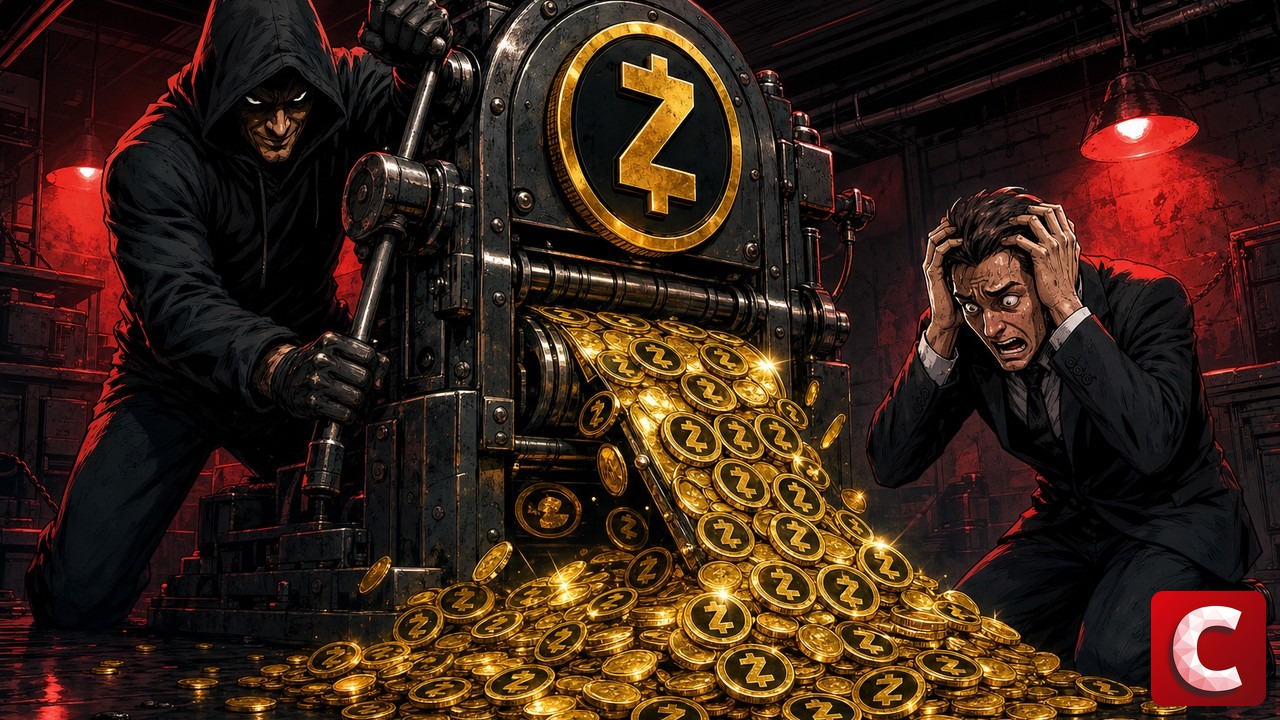
The Orchard pool of Zcash lived with a critical flaw for nearly four years. Disclosed on May 29, 2026 and patched on June 2, the vulnerability allowed anyone to mint counterfeit ZEC in an undetectable way. Markets reacted instantly, with ZEC collapsing roughly 40% in 24 hours and Arthur Hayes liquidating his entire position.
Key Takeaways
- A critical flaw in Zcash’s Orchard pool went undetected from May 2022 until late May 2026
- ZEC plunges about 40% in 24 hours after the public disclosure of the bug
- Arthur Hayes dumps his full stack and argues supply integrity can no longer be proven
Get an AI Summary of This Article
ChatGPTA Silent Bug That Sat for Four Years Inside the Orchard Pool
The vulnerability was discovered on May 29, 2026 by Taylor Hornby, an engineer at Shielded Labs, with assistance from Anthropic’s Claude Opus 4.8. The flaw had been sitting inside the Orchard pool code since May 2022, almost four full years of silent exposure.
The Orchard pool is the most advanced privacy zone of the Zcash protocol. It is where shielded transactions are processed and where the privacy first narrative of the chain actually lives. A bug at this exact layer hits the structural core of the system, not some peripheral component.
According to Shielded Labs, the defect could have been exploited to create an unlimited amount of counterfeit ZEC in an undetectable manner. No on-chain trail, no signal, no alert. An attacker could have inflated ZEC supply without anyone noticing, neither nodes, nor developers, nor holders.
The patch was deployed on June 2, 2026, four days after the discovery. Shielded Labs reports no sign of active exploitation and says it is not too worried despite the scale of the security gap. The stance is unusual. A bug capable of minting ZEC at will, surviving multiple audit cycles, and going unnoticed for four years raises hard questions about how rigorously the protocol has been reviewed.

Markets Snap and Arthur Hayes Walks Out
Before the disclosure, ZEC was running through an exceptional sequence. The token had climbed over 1,000% since October, lifted by renewed institutional appetite for privacy assets. The price stood at $315.78 when the bug was revealed, after a rally that had made it one of the strongest altcoins of recent months.
The drop took only hours. ZEC lost around 40% of its value within a 24 hour window, erasing a meaningful share of the rally accumulated since the previous autumn. The market did not wait for deep technical analysis. The mere existence of doubt was enough to trigger the unwind.
Arthur Hayes, BitMEX cofounder, sold his full position. His reasoning is sharp. According to his own words, it is impossible to formally prove that no fraudulent token creation occurred, and the privacy narrative demands perfection rather than mere improbability. For context, see our earlier piece on Cryptonomic: Worldcoin: Arthur Hayes Dumps Position, WLD Plunges. For context, see our earlier piece on Cryptonomic: Worldcoin: Arthur Hayes Dumps Position, WLD Plunges.
Hayes leaving the trade amplified the decline mechanically. When a long standing public supporter of the project walks out in the middle of the storm, the remaining holders have very little left to lean on. Stop losses cascade, market makers follow, and ZEC keeps accelerating to the downside.
Also on Cryptonomic:
- Bitcoin Crash Below $62,000: $1.5B Wiped Out in 24 Hours
- Hyperliquid’s HYPE Token: $673M Unlock on June 6
- AMF: French Crypto Firms Have Until June 30 for MiCA License
The Privacy Thesis Hits the Wall of Unprovability
The issue stretches well beyond ZEC itself. Privacy chains rest on a simple bet: convince the user and the market that supply is rigorously controlled while keeping it invisible. If supply cannot be audited publicly, everything ultimately rests on trust in the code.
That trust has been broken. Four years of exposure to a flaw capable of minting phantom tokens with zero trace puts the very possibility of proving ZEC supply integrity in question. No retroactive audit can demonstrate with certainty that no counterfeit token was created between 2022 and 2026, which is exactly the point Hayes flagged in his statement.
The problem turns existential for other privacy protocols. Monero, privacy oriented zk-rollups and upcoming projects will now have to explain why their architecture does not suffer from the same fragility. European and US regulators, already hostile to privacy coins, gain an extra argument to tighten the pressure on this category of assets.
Shielded Labs’ public stance is also hard to digest. Announcing the discovery of the flaw while saying it is not too worried creates a clear gap between the technical severity and the institutional tone. Holders who learn about the episode today get one more reason to wonder how long it will take before a similar bug surfaces somewhere else, on another protocol, inside another shielded pool.
Follow the story on Cryptonomic.



Pingback: Zcash Jumps 16.5% and Leads the Crypto Rebound - Cryptonomic
Pingback: Bitcoin 60,000 Floor Cracks After Explosive Jobs Report - Cryptonomic
Pingback: Privacy Coin Zcash Climbs Into the Top 10 - Cryptonomic