

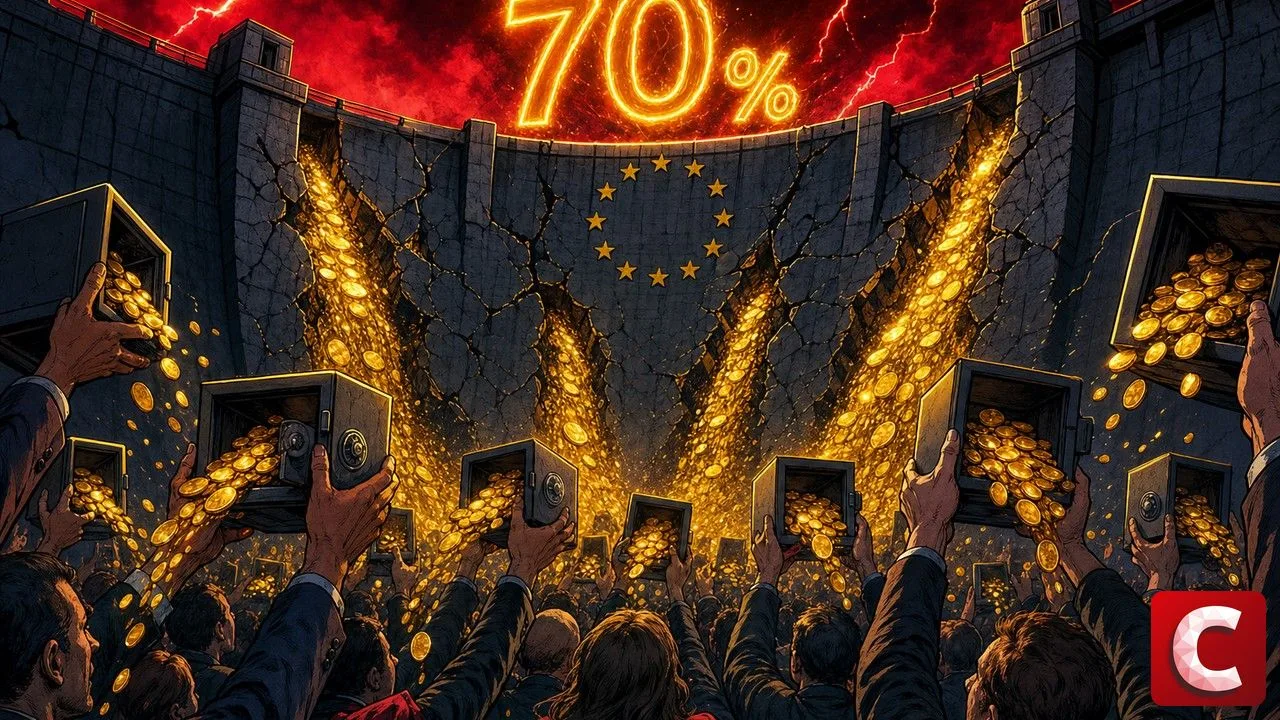
Since MiCA took full effect on July 1, crypto Europe is draining from the bottom. Of the 3,389 firms that once served European clients, only 244 secured a license. And when users pull their funds, 70% move to self-custody, into self-hosted wallets rather than a licensed platform. The regulation set out to supervise the market, and mostly pushed Europeans out of the system instead.
Key Takeaways
- Only 244 firms obtained a MiCA license out of 3,389 recorded players
- 70% of withdrawn funds go to self-custody, 30% to licensed platforms
- Binance ceased European operations, and USDT was pushed out by major exchanges
Get an AI Summary of This Article
ChatGPT3,389 Firms, 244 Licenses: Europe’s Crypto Drain
The cull was drastic. In May 2025, 3,389 crypto firms still served European clients. After the eighteen-month transition period ended, only 244 secured a MiCA license. The gap says everything about a regulatory filter of rare severity.
The move had started before the deadline. Roughly 20% of European platforms had already left the field by the end of 2025, anticipating a compliance cost they judged too heavy. July 1, 2026 only formalized an exit that was well underway.
This contraction is no surprise to Cryptonomic, which sized the impact at the switchover, when ten million EU users lost their platform. What the new data reveals is where the money goes once the platform shuts down.
The lesson is direct. A framework this tight does not keep users inside the system, it pushes them out. Where the regulator hoped for consolidation around licensed players, it sees dispersion into self-custody, beyond any supervised counter.

USDT Pushed Out as Binance Exits Europe
The tightening also played out on stablecoins. USDT was restricted or removed by Coinbase, the exchange Kraken, OKX, Bitstamp and Crypto.com for their European clients. The trigger was Tether’s refusal to comply with the requirement to hold 60% of reserves in Europe.
The departure of the largest player left a mark. Binance ceased its European operations on June 30, 2026, on the eve of the deadline. Cryptonomic tracked the final rulings on that file when Binance France missed the MiCA deadline and faced restrictions. The ECB had shaped that endgame, deciding the fate of 37 million Binance clients.
Binance co-CEO Richard Teng flagged the scale of the outflow on the user side. Those figures, relayed without independent audit, should be treated with caution, yet they line up with the trend seen elsewhere in the market. The flight effect looks real, even if its exact size is still debated.
Dropping USDT reshapes the European trader’s daily life. The market’s most liquid pair becomes harder to reach on compliant platforms, which mechanically pushes users toward licensed USDC or toward off-exchange solutions. Liquidity does not vanish, it relocates.
Also on Cryptonomic:
- Crypto App Fees Hit $5.9B as the Market Sinks 36%
- Token Unlocks: How They Move a Crypto Price
- XRP Death Cross Forms as Bitcoin Takes a Breather
Self-Custody, the Unintended Winner of MiCA
The real beneficiary was never on the agenda. Of the funds withdrawn, 70% moved to self-hosted wallets, against just 30% redirected to licensed platforms. The regulation therefore shifted asset custody to the user, not to a supervised third party.
The outcome is paradoxical against the stated goals. MiCA aimed at consumer protection and flow traceability. By pushing two-thirds of the funds into self-custody, it reduces regulators’ visibility over those holdings and transfers all the security risk onto the end user.
In the near term, the shift benefits hardware wallet makers and individual custody solutions. A European who can no longer trust their usual platform learns, often in a hurry, to manage their own keys. The self-custody market gains users it would not have converted otherwise.
Over the medium term, the question is about the coherence of the whole scheme. A single framework was meant to harmonize the European market, as our breakdown of how MiCA sets one crypto framework across Europe laid out. Whether a regulator can claim a win when most of the funds now escape its view is another matter.
The shift also hands leverage to jurisdictions outside the bloc. Users who refuse both the licensed platforms and the key-management burden simply route their activity through venues beyond European reach. Capital that leaves a supervised counter rarely comes back on the regulator’s terms.
For the investor, the signal is twofold. Compliant Europe tightens around a handful of licensed players, and self-custody becomes a baseline skill rather than a purist’s option. The regulation reshuffled the deck, just not in the direction its authors hoped for.
Follow the story on Cryptonomic.