
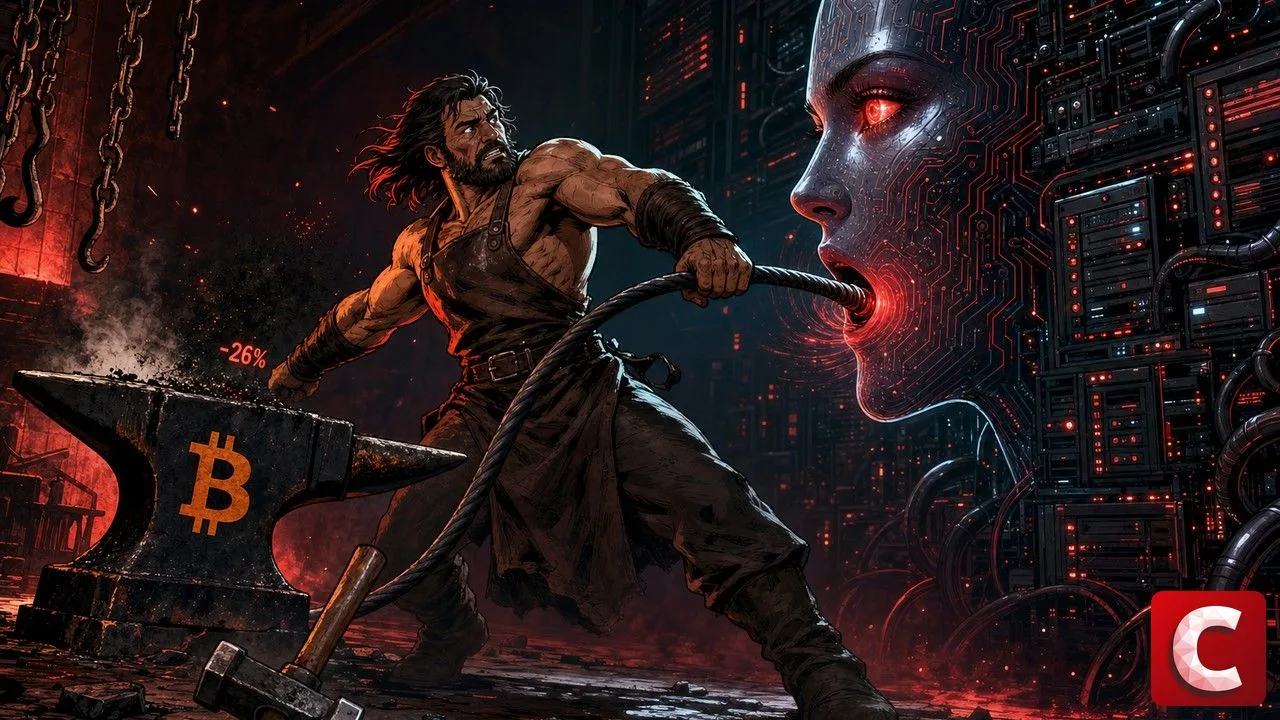
Bitcoin mining difficulty just dropped for the ninth time in 2026, a cumulative 13.82% slide over the year that reveals hashing power quietly leaving the network. Behind that number sits an equation that no longer works, with Bitcoin down 26% since January and the revenue per unit of hash shrinking fast. Many Bitcoin miners are no longer plugging their rigs back in to produce blocks, they are renting their megawatts to artificial intelligence clients instead. The network is watching a slice of its blacksmiths walk toward a more profitable market.
Key Takeaways
- Difficulty has fallen 13.82% in 2026, its ninth downward move of the year
- Hashprice slid from $37.39 to $32.21 in 206 days, gutting mining margins
- Hut 8, IREN and TeraWulf are turning mining farms into AI data centers
Get an AI Summary of This Article
ChatGPTMining Difficulty Slips for the Ninth Time in 2026
The latest adjustment stripped 0.74% from difficulty at block 959,616, pulling the metric from 146.47 trillion down to 126.23 trillion since the start of the year. Across fifteen adjustments in 2026, nine were cuts and six were increases. The balance is decisive, with a cumulative 13.82% decline that tells the story of a machine emptying out. That drain hits first the farms already stuck five months below their real production cost.
Difficulty works like a thermostat. It climbs when Bitcoin miners switch machines on, it falls when they unplug them. Increases totaled 31.04% on the year while decreases reached 43.96%, with an average gap of 6.4 points per adjustment. That swing is the sign of a fleet reorganizing rather than collapsing.
The real signal lives in revenue. Hashprice, the daily yield of a unit of power, fell from $37.39 to $32.21 over 206 days, a drop of nearly 13.8%. With Bitcoin off 26% since January, the margin has closed on the most exposed Bitcoin miners. That squeeze also shows up in a jittery market, with Bitcoin volatility back at its usual 38% floor and no quick rebound in sight.

Renting Power to AI Pays More Than Minting Blocks
The math is brutally simple. A miner holds two scarce assets, long-term electricity access and buildings built to absorb heavy energy density. Both are worth more leased to an AI lab than spent hashing SHA-256. With energy and infrastructure costs fixed, the switch to AI mechanically lifts the yield per megawatt.
TeraWulf set the template. The company signed a twenty-year lease with Anthropic for roughly 401 MW of capacity at its Hawesville campus in Kentucky, a deal set to generate close to $19B in revenue over its initial term. The specifics sit in the official statement TeraWulf published on the Anthropic lease. The first block is expected to go live in the second half of 2027.
The others are walking the same road. Hut 8 closed a $9.8B, fifteen-year lease for the second phase of its Texas campus, IREN booked $2.8B in cloud contracts and targets annualized revenue above $4B, and Core Scientific tied itself to CoreWeave to morph into a compute host. The sector is reshaping quickly, after already testing state control such as the state-mandated mining pool imposed in Oman. The geography of hashing is changing in nature.
Also on Cryptonomic:
- Satsuma Sells All 668 BTC and Delists in London
- BitMEX Shuts Down for Good After 11 Years
- Bitcoin Holds as Tech Sheds $800B on AI Fears
The Miners’ AI Turn Hits a $50B Wall
In the short term, the Bitcoin network absorbs the shock. Every departure of power lowers difficulty, which hands more breathing room to the miners still loyal to the block. Protocol security does not rest on any single operator, it rests on the price that rewards the effort. As long as Bitcoin stays under pressure, the pull to lease watts to AI will stay strong.
The turn carries a dizzying entry price. A framework published by VanEck puts the sector’s near-term funding gap at roughly $50B, and its long-term capital needs at as much as $221B, with only a quarter of already-leased capacity actually delivered. The detail lives in the valuation framework for miners as AI infrastructure laid out by VanEck. Players with a signed lease trade above ten times their energized power, those still selling a pipeline cap at two to six times.
The fault line runs between those who execute and those who promise. Marathon Digital, Riot Platforms and CleanSpark are moving on a hybrid strategy, one foot in the block, one foot in compute. Over six months, access to capital will split winners from losers. The halving already trims the block reward every cycle, AI offers an exit door, but it costs cash and demands flawless execution.
Follow the story on Cryptonomic.