

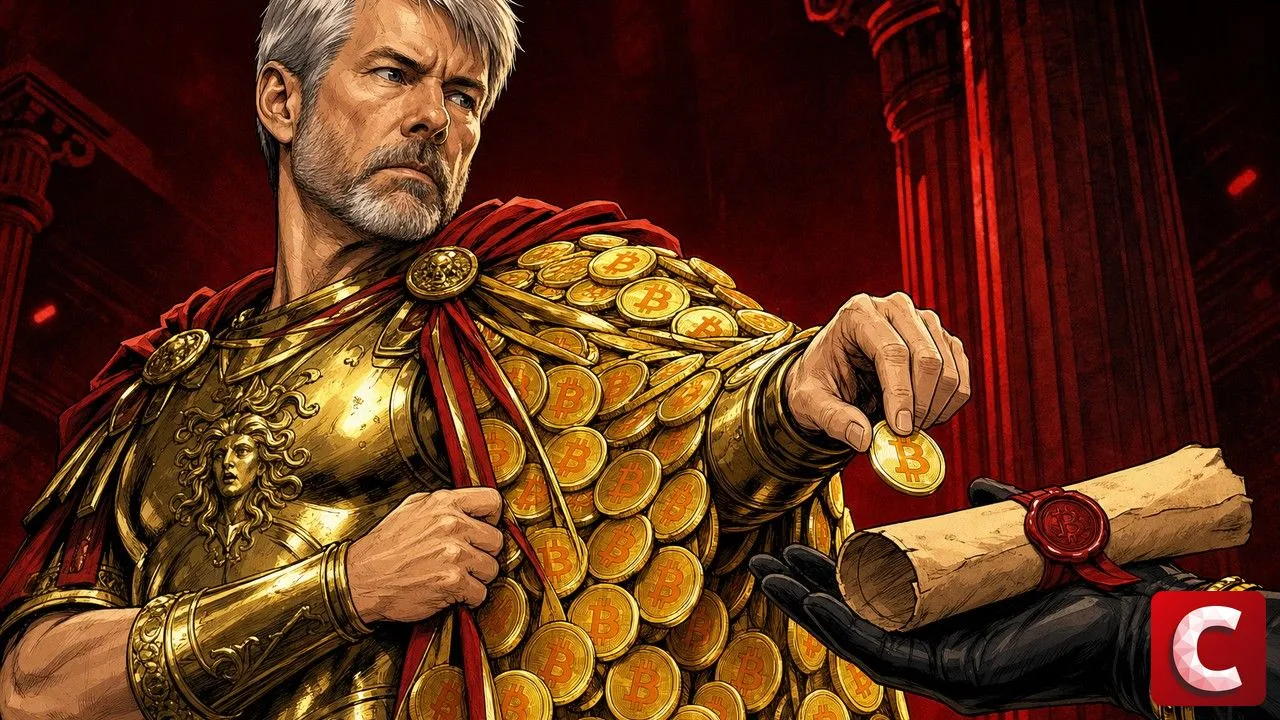
Strategy offloaded 1,638 bitcoin between July 27 and August 2 to raise $104.7M, almost entirely earmarked for its dividends and buybacks of its STRC preferred stock. Michael Saylor’s firm sold at $63,957 apiece, well below its $75,419 average acquisition cost. Its treasury slips to 842,138 BTC, yet stays by far the largest corporate hoard on the planet. The sale is a reminder that the hold-forever doctrine stops where the financial obligations begin.
Key Takeaways
- Strategy sold 1,638 BTC at $63,957 for $104.7M, under its $75,419 average cost.
- Proceeds cover $52.4M in STRC dividends and $52.3M in buybacks of the same stock.
- The treasury drops to 842,138 BTC, just over 4% of Bitcoin’s total supply.
Get an AI Summary of This Article
ChatGPTA Sale at a Loss to Service the STRC Preferred
The disposal ran across a full week, from July 27 to August 2, for a total of 1,638 bitcoin sold at an average price of $63,957. Gross proceeds landed at $104.7M, which makes it the second-largest sale of 2026 for the company.
The sting is in the price. Strategy carries its bitcoin at a $75,419 average acquisition cost. Selling at $63,957 books a loss of roughly $11,500 per coin, a trade the firm owns in the name of managing its capital stack.
This is not the first time the treasury has doubled as a cash window. The company ran the same move when MicroStrategy liquidated $216M in bitcoin to cover its dividends. The mechanic repeats, only bigger this time.
After the sale, the balance sheet holds 842,138 BTC for a cumulative $63.51B investment. Strategy stays the world’s top corporate holder, with a stash that still weighs more than 4% of the circulating supply.

The Dividend Machine That Forces Saylor’s Hand
The use of proceeds tells the whole story. Of the $104.7M raised, $52.4M went to dividend payments on the STRC preferred stock, and $52.3M funded buybacks of that same instrument on the open market.
The STRC preferred is the pressure point. It is a perpetual instrument that owes a fixed cash payout whatever bitcoin does, so the obligation lands on schedule even when the price sits below cost. That is what turns a market swing into a forced sale: the coupon is due in dollars, and the treasury is where the dollars come from.
In plain terms, the firm sells the asset it is built to accumulate in order to fund the promises it made to its securities holders. That constant back-and-forth is nothing new: Strategy stunned the market when it bought 1,550 BTC right after selling just 32 coins, proof the treasury is steered trade by trade.
Michael Saylor moved to frame the message. His “Never Sell” mantra applies to his personal holdings, not the company’s treasury operations, a distinction he already had to defend when he publicly rewrote his hold-forever doctrine. The line is convenient, but it concedes that the corporate hoard can shrink when the bill comes due.
Also on Cryptonomic:
- Crypto Capital Rotation Sends Money to AI and Real Estate
- Ethereum Whales Scoop 1.11M ETH in a Single Week
- Tether Clears $1.5B but Its Reserve Buffer Halves
What the Sale Changes for the Biggest Bitcoin Treasury
In the near term, the market did not punish the move. The stock actually climbed after the disclosure, carried by analyst targets that leave a comfortable upside. Traders read the sale as a treasury adjustment, not a capitulation signal.
The longer view is where the logic gets tested. Funding dividends by selling bitcoin below cost chips away at the reserve, and the debate over the model’s durability resurfaces at every deadline, exactly as when the market asked whether the firm was collapsing under the weight of its own bitcoin treasury.
Over the medium term, Strategy keeps a dominance no rival comes close to: 842,138 BTC is a colossal cushion that absorbs a sale this size without strain. The question is not the treasury’s survival, but its purpose.
The sale also feeds a defensive shift. Alongside servicing the preferred, Strategy has been building a multi-billion-dollar cash reserve, a buffer that sits oddly against a company whose entire identity is being fully invested in bitcoin. A war chest is ordinary prudence for most firms. For this one, it quietly concedes that the all-in thesis needs a cash cushion to survive its own obligations.
The whole tension fits in one sentence: a vehicle designed to accumulate bitcoin now sells it to pay its creditors. As long as the price sits below the $75,419 average cost, every dividend-driven sale books a loss the company accepts, and turns a long-term promise into a quarterly treasury exercise.
Follow the story on Cryptonomic.