

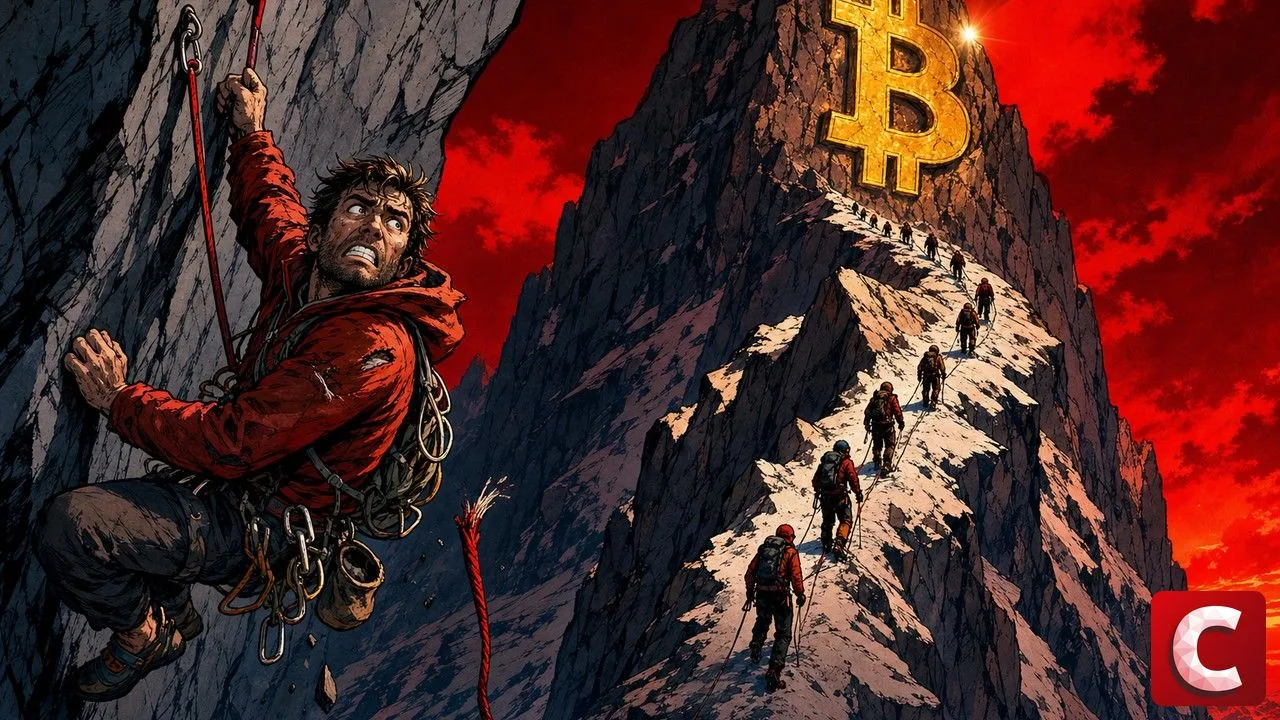
The BIP-110 soft fork attempt died within eight hours. The breakaway chain produced two blocks and then froze at block 961,633, while the main network stacked 48 over the same window. Miner signaling never climbed past 2.53%, nowhere near the 55% needed for a clean activation. Bitcoin changed hands at $65,220.98 on Monday morning, barely acknowledging any of it.
Key Takeaways
- Miner signaling topped out at 2.53%, against the 55% threshold required to activate without a split.
- The breakaway chain stopped at block 961,633 after two blocks while the main network added 48.
- Recalculating its difficulty would take roughly 350 days, against 14 days for Bitcoin.
Get an AI Summary of This Article
ChatGPTTwo Blocks in Eight Hours, Then Silence
The split happened at block 961,632. AntPool mined the first block that declined to signal the proposal, Ocean answered with an alternative that honored BIP-110, and the two histories diverged from there. Eight hours later, the dissenting branch was still sitting on its second block.
The proposal aimed to ban non-financial data from Bitcoin transactions for one year, images and text included. Supporters framed it as congestion relief. Opponents argued that whoever pays for block space gets to decide what goes in it. The fight has been running for months, and it landed on an industry already under strain, the same one where miners spent five months below their production cost.
Activation required 55% miner signaling. The counter never went past 2.53%. A gap that wide does not close in the final hours of a window, and pool operators have seen enough past activations to read that number correctly. The fight was lost before the split.
The mandatory signaling window, which demands that every block mark its support, runs through block 963,647. At the pace the minority branch is managing, that target will never arrive. The mechanism designed to force adoption ended up working against the people who built it.

Inherited Difficulty Chokes the Minority Chain
The real trap sits in mining difficulty. When it broke away, the BIP-110 branch carried Bitcoin’s difficulty setting with it, a number calibrated for the full network hashrate, while controlling a sliver of that power. Every block becomes close to unreachable. It is the same brutal arithmetic that pushes part of the mining industry toward AI workloads whenever margins compress.
A network can only recalibrate difficulty after 2,016 blocks. At the observed pace, the breakaway chain would need roughly 350 days to get there. Bitcoin takes fourteen. Those two numbers tell the whole story, because the minority chain is technically alive and economically finished.
There is a second risk that holders tend to underestimate. Both chains accept identical transactions, which opens the door to replay: an operation broadcast on one side can be replayed on the other. Anyone trying to sell fork coins risks watching their main-chain bitcoin move too, the exact scenario laid out when a fork can cost you your real coins.
For the next few days, actual exposure stays low for ordinary investors. No major venue prepared a listing for these coins, unlike the 2017 split that arrived with heavy mining support and same-day exchange quotes. With no market on the other side, the branch has nothing to offer whoever holds it.
Also on Cryptonomic:
- Ethereum Monetary Policy Decides How ETH Supply Moves
- Trump Media Scraps Its $6.42B Crypto.com Treasury
- BTCPay Server Flaw Drains Lightning Nodes
Knots Now Eyes the Mining Algorithm
Bitcoin Knots developers do not treat the file as closed. They are now weighing a change to the proof-of-work algorithm in September, a way to route around the miner blockade that killed the proposal. In practice it would strip decision power from the specialized hardware that dominates the network today.
A move of that scale belongs to a different category than a soft fork about transaction content. It would render the entire installed machine base obsolete and shift the value of industrial mining sites toward whoever adopts the new format first. The same operators who refused to reach 55% signaling will defend that capital with equal force.
Markets, for their part, stayed still. Bitcoin traded at $65,220.98 on Monday morning, up 0.67% on the day and close to 3% on the week. Governance tearing itself apart in public without denting the price says a lot about what traders treat as an actual risk.
Over three to six months, the story moves to governance itself. The question of arbitrary data in blocks remains open, and the BIP-110 failure shows that no minority of developers can impose a rule without miners behind them. The next attempt will either go through them or try to make them irrelevant, which is precisely the road Knots has started walking.
Follow the story on Cryptonomic.