

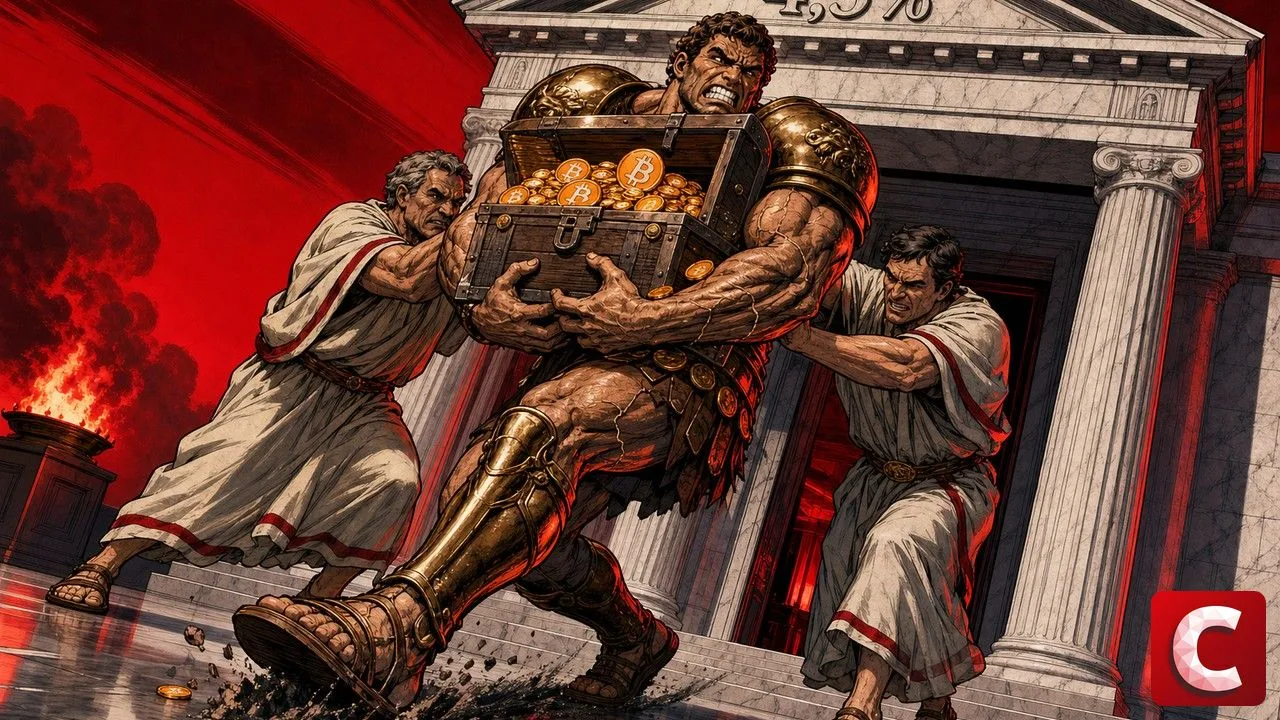
MSCI has opened a consultation on a screen that would push companies built around hoarding non-operating assets out of its equity indexes. Run against May 2026 data, it would have deleted three names from the MSCI ACWI IMI, including Strategy and its 840,447 bitcoin. Feedback closes September 30 and the verdict lands on or before October 16. The stock gave up 4.3% on Friday.
Key Takeaways
- MSCI proposes a two-step screen that would delete Strategy, Metaplanet and Yellow Cake from the MSCI ACWI IMI.
- The consultation runs through September 30, with results announced on or before October 16.
- Strategy answers that index providers should measure markets, not decide which assets a company may own.
Get an AI Summary of This Article
ChatGPTA Two-Step Screen Aimed at Balance Sheets Without a Business
The proposed mechanics work in two stages. MSCI first checks whether an issuer’s operating assets clear 50% of total assets. Anything above that line stays eligible with no further review.
Whatever falls below moves to a second gate. MSCI lays out the five ratios in the consultation paper it circulated to institutional investors: operating asset intensity, expense intensity, cash flow, fair value intensity and capital dependence. Failing four of those five ratios is enough to make an issuer ineligible.
The index provider describes its target without naming it: firms that create value by accumulating and holding non-operating assets, generate minimal cash from operations and lean on outside capital to grow. That description maps onto the corporate bitcoin treasury model, the one Metaplanet pushed as far as a $170M purchase that carried it to 43,000 BTC.
Three names would leave the MSCI ACWI IMI had the screen run on May 2026 figures: Strategy, Metaplanet and uranium holder Yellow Cake. Three more issuers would land on a new public watchlist.
MSCI built in a buffer to keep turnover down. An existing constituent would have to fail the screen across two consecutive periods before an actual deletion. The clause does not soften the verdict, it delays the execution.

Strategy Challenges the Index Provider’s Standing
The company answered fast. Strategy argued that digital assets are assets like any other, and that index providers should measure markets rather than decide which assets a company is allowed to own.
The case runs deeper than that line. The firm frames itself as an operating company rather than an investment vehicle, pointing to its software business and to active treasury management. That management is a matter of record: it sold 1,638 BTC to fund the dividend on its preferred shares.
The standoff is not new. Strategy formally objected in December 2025 to a first draft that targeted companies where digital assets made up at least half of total assets. That version named 39 firms and was shelved after industry pushback.
The new approach sidesteps that obstacle by changing the battleground. It no longer talks about crypto, it talks about financial ratios, which makes it defensible in front of an investment committee and far harder to attack as sector discrimination. The uranium name swept up alongside proves it.
Markets ruled on Friday without waiting for the consultation to close. The stock shed 4.3% while bitcoin slid to $62,600. That correlation cuts both ways for a company whose valuation rides on a balance sheet asset, an imbalance visible back when it paused its purchases ahead of first quarter earnings.
One piece of its case does hold up against these ratios. A firm able to retire debt without touching its reserves keeps options a fully capital-markets-dependent structure never has, as when $1.5 billion in convertible debt was cleared without selling a single bitcoin. That is exactly the capital dependence ratio the screen intends to measure.
Also on Cryptonomic:
- Trezor Breach Exposes 13,689 Buyers Through Its Shipper
- SEC Pulls Its Reg Crypto Meeting With No New Date
- Bitwise Cuts 14% of Staff After a 31% Asset Drop
What a November Deletion Would Mean for Shareholders
The near-term effect is mechanical. Index funds tracking the MSCI ACWI IMI do not pick their holdings: they buy what the index contains and sell what it drops. A deletion therefore triggers forced selling, indifferent to price and packed into a handful of sessions.
The calendar leaves room to position. Feedback stays open until September 30, the decision lands on or before October 16, and implementation would wait for the November 2026 index review at the earliest. Three dates exposed managers will be watching closely.
Further out, the question reaches past one company. If the largest index provider rules that a bitcoin-heavy balance sheet pushes a firm out of mainstream equity benchmarks, the treasury model loses its most convenient selling point: bitcoin exposure wrapped in an ordinary listed instrument.
Sector doctrine already shifted once this year, when the “Never Sell” principle gave way to a more flexible treasury policy. An index deletion would push in the same direction, toward a model willing to sell in order to stay fundable.
Imitators carry the most risk. A company buying bitcoin with no real operating business fails the five ratios far more easily than one still booking revenue. The screen ends up rewarding treasuries attached to an actual trade, and leaves the copies with nothing to argue.
Yellow Cake’s presence on the list deserves a second look. A uranium holder has nothing to do with crypto, and its capture by the same screen shows MSCI is targeting an accounting category rather than a sector. That apparent neutrality makes the pushback far harder to build.
The consultation calendar still leaves a real window. Six weeks separate today from the close of feedback, enough time for an issuer to document its operating business and try to climb back above the 50% threshold before the October review.
Passive money is what makes the outcome matter. Benchmark-tracking funds now hold a decisive share of the float in large listed companies, which means an index decision reaches further into the shareholder base than most corporate announcements ever do.
MSCI has effectively found the framing that survives contact with a legal team. It is not ruling on bitcoin, it is ruling on what an operating company looks like, and that is a question no issuer can answer by pointing at its treasury.
Follow the story on Cryptonomic.