

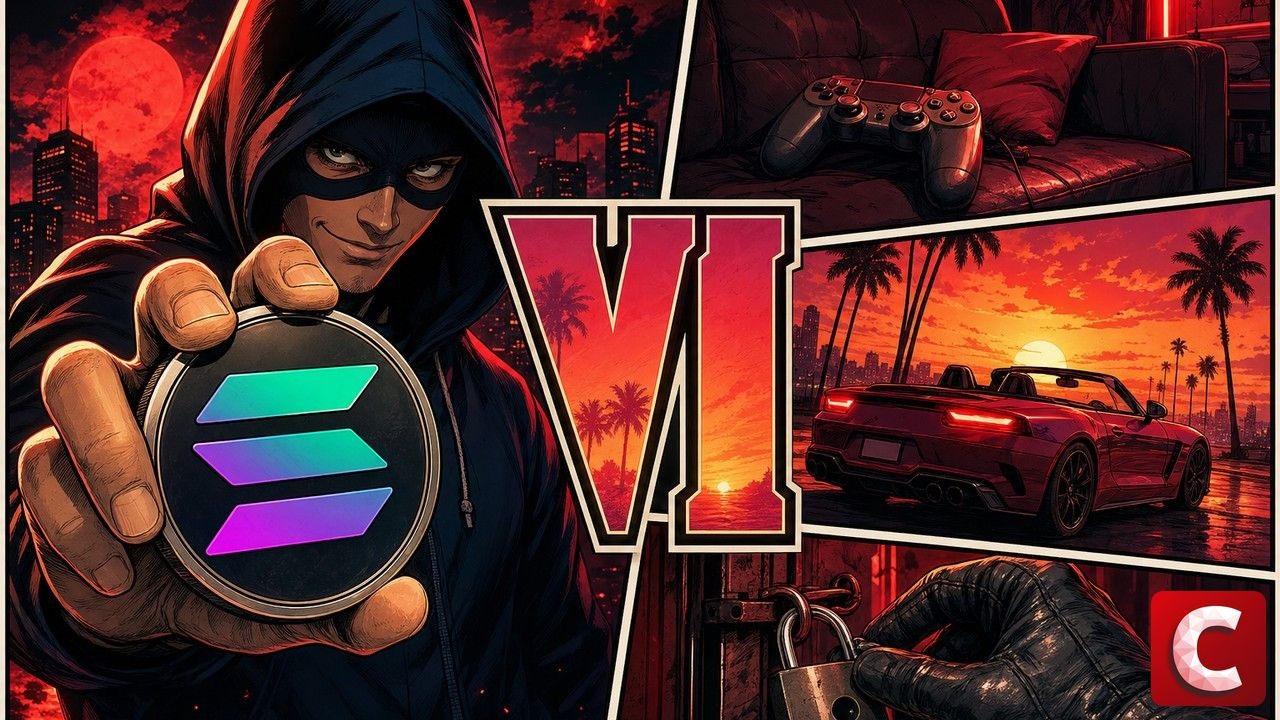
Gameplay footage and map material from GTA 6 circulated online ahead of the game’s November release from Rockstar Games. The group claiming the leak calls itself CYBERLEEK, and it launched a token of the same name on Solana. On August 19 that token traded near $0.0015 after a 2,830% gain in twenty-four hours. The images it published carried QR codes and links pointing straight at the coin.
Key Takeaways
- The CYBERLEEK token gained 2,830% in a single day on Solana.
- Its creator can still alter the contract, disable sells and mint without limit.
- Stop Killing Games told supporters not to send money to the people behind the leak.
Get an AI Summary of This Article
ChatGPTCrypto QR Codes Pasted Onto Stolen Game Footage
The leak from GTA 6 covers gameplay and pieces of the map, the material a community wants most in the weeks before a release. Publishing was not the end of it. The group attached crypto links and QR codes to the images, then asked for payment to unlock what came next.
The structure fits in one sentence. Scarce content works as the lure and the token works as the till. What separates this case from the usual celebrity coin is ownership of the goods, because the material driving the attention belongs to Rockstar rather than to whoever is monetising it.
Pay-to-unlock is the part worth pausing on. Asking for money before releasing the next batch turns each drop into a transaction rather than a disclosure, which changes what the campaign is. A whistleblower publishes and takes the consequences. This operation meters the release rate against incoming payments, and the material from GTA 6 functions as inventory rather than as evidence of anything.
That distinction has a price consequence. Every further image released is both a sales argument and a piece of evidence, so the fuel under this token is an alleged crime. A holder is therefore exposed to a takedown timeline and a legal process, not only to the order book.
Solana was not an accidental choice. The network concentrates cheap, near-instant token issuance, which makes it the natural ground for campaigns built on a short attention window. Its launch market had already absorbed $1.98B of unlocks in July, with the PUMP mechanic at the centre of the flow.

A Contract Its Creator Can Still Rewrite at Will
The most serious warning here is not about price. It sits in the contract. CoinGecko carries a risk notice on the token’s page stating that the creator retains the ability to change contract metadata.
The retained powers form a complete set. Disabling sells, adjusting fees, minting new tokens without restriction, transferring holdings. Each one alone is a red flag. Gathered on a single contract, they hand one address control over the market for its own asset.
In practice a holder can find themselves unable to sell without any network rule being broken. The ability to disable sells is not a bug, it is a function written into the code that someone chose to keep. The exit depends on a unilateral decision taken by a party nobody has identified.
Unlimited minting creates the second problem. A creator able to issue new units can dilute existing holders at will, which makes any market value reading unstable by construction. The 2,830% figure therefore applies to a float nobody can guarantee will stay fixed.
Anyone reading that chart as a performance number is reading the wrong instrument. A percentage gain describes what happened to a price, and it says nothing about whether the asset behind it can be sold. On this contract, those are two separate questions.
The short-term risk is concentration of timing. Attention around GTA 6 has a hard expiry date, because the game ships in November and the leaked material stops being scarce the moment Rockstar publishes it officially. A token whose entire demand rests on that window inherits the window’s deadline, with no product, treasury or revenue line underneath to carry it past the release.
Also on Cryptonomic:
- Bitcoin Hits $75,500 as Traders Lose $4B in Bets
- Trump Backs a Hyperliquid US Entry, Token Jumps 25%
- Coldcard Hack: Block Says It Found the Thief
The Manifesto Attacks Preorders, the Activists Refuse the Money
The group published a statement of intent. It attacks three practices in the games industry: digital preorders, paid single-player content already sitting in the game files, and servers shut down abruptly.
Those grievances overlap with an existing and legitimate campaign, which explains the sharpest reaction in the whole affair. Stop Killing Games, the preservation movement founded by Ross Scott, publicly distanced itself and told people not to send money to these individuals, whatever sympathy they might feel.
So the rejection comes from inside the camp the manifesto claims to defend. That is the detail an investor should weigh above the chart. When the activists whose fight is being borrowed refuse the money raised in their name, the story holds together only through price.
Scott’s campaign has spent two years building a case through petitions, legislative work and documentation of dead games. Walking away from a funding source that arrived unasked is a costly move for a movement of that size, and it tells you how the people closest to the cause read the operation. Their assessment carries more weight than any chart pattern, because they have nothing to gain from making it.
There is a wider question here, and it lands on the market rather than on Rockstar. A leak manufactures a short, intense attention window, which is exactly the shape a token launch wants. As long as that window converts into volume, the incentive to repeat the exercise on another franchise stays fully intact.
Over the next few months the interesting variable is whether anyone copies the template. Publishers already hold the legal tools to pull stolen assets down, and takedowns landed quickly here. What no publisher controls is the token that outlives the images, since it keeps trading on venues with no relationship to the material and no obligation to act on a copyright claim.
Solana ends up carrying the reputational cost either way. The network nearly halted after a hosting provider outage this month, and the resilience conversation around it now covers what gets deployed on top as much as the chain itself. Three DeFi protocols were drained of $35M in six hours in July, on infrastructure far more scrutinised than a launchpad token.
Follow the story on Cryptonomic.