

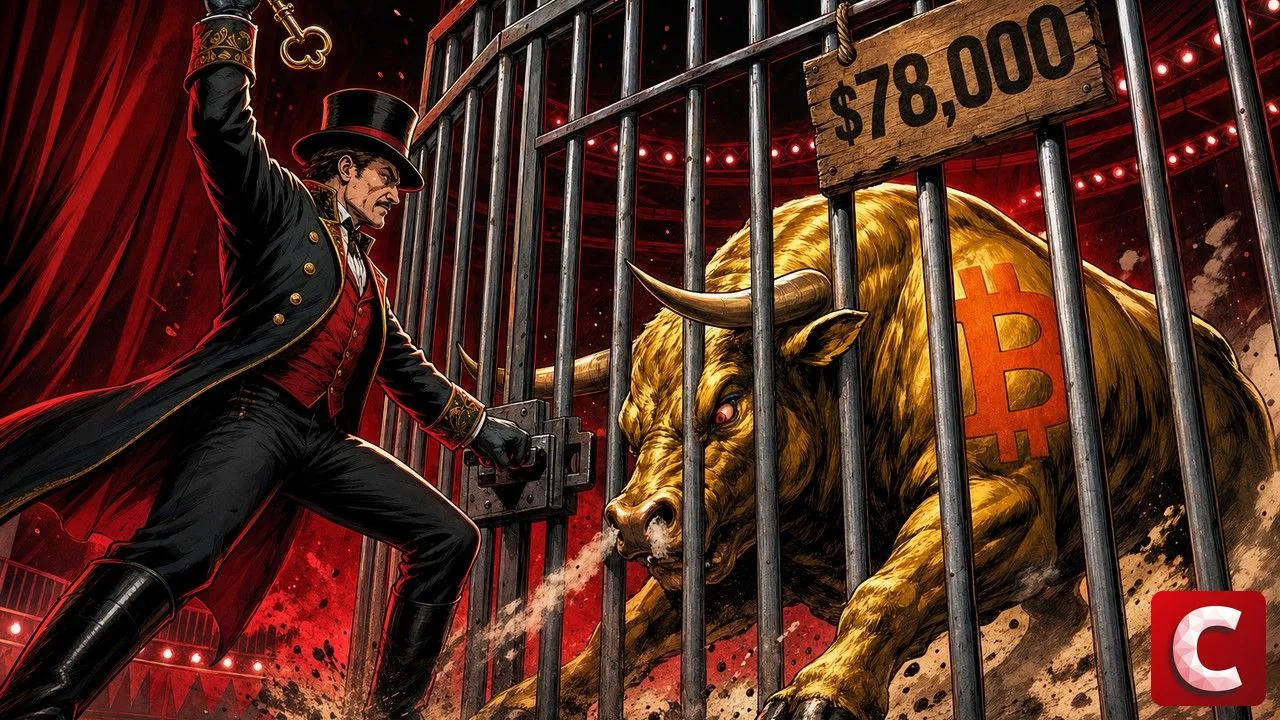
Bitcoin slides into the weekend at $77,557, down 3.39%, after touching a session low of $76,877. The trigger was one line from Fed Chair Kevin Warsh at Jackson Hole, who placed 65 months of elevated inflation squarely at the central bank’s own door. Rate markets repriced within hours: the odds of a September 16 hike moved from 35.4% to 59.7% in a single session. Crypto markets wiped out $481 million in positions over 24 hours.
Key Takeaways
- Bitcoin traveled from $81,455 to $76,877 on Friday before settling at $77,557
- September hike odds jumped from 35.4% to 59.7% on the back of the speech alone
- $481 million liquidated in 24 hours, with more than $360 million sitting on the long side
Get an AI Summary of This Article
ChatGPTWarsh Hands the Fed the Bill for 65 Months of Inflation
The speech markets had circled all week landed Friday morning. Kevin Warsh, marking his hundredth day as Fed Chair that same day, opened by naming who owns the inflation record of the past five years, and the answer was his own institution.
The wording sits verbatim in the full text of the remarks the Fed published the same morning: responsibility for 65 months of sustained, elevated inflation belongs to the central bank. He then set the exit condition, namely confidence that underlying inflation is moving to target clearly and at sufficient speed. Short of that, the Fed still has work to do.
The contrast with July is hard to miss. Warsh pivoted dovish back then, and Bitcoin reclaimed $60,000 within hours of that pivot. Six weeks later the same chair has shut the door he had cracked open.
The number driving that stance is the PCE price index, running at 3.7% annually. The Fed’s target remains 2%. That is not a rounding gap, it is nearly double the mandate.
This is also not the first time Warsh has cut short the easing narrative. Back in June he explicitly ruled out rate cuts and Bitcoin fell back to $58,000. Crypto desks have needed fourteen months to price in that this Fed does not behave like the last one.

Rate Traders Flip to 59.7% Odds of a September Hike
The cleanest read on the day was not in crypto prices but in rate contracts. On Thursday, traders assigned 35.4% odds to a quarter-point hike at the September 15 to 16 meeting. By Friday evening that same probability printed 59.7%.
A week earlier the figure stood at 39.9% in the CME Group FedWatch tool that aggregates positioning across rate futures. The repricing therefore happened inside one session, off a speech, with no macro print in between.
That is the part holders should sit with. When Bitcoin slides on a rate signal rather than on anything crypto-native, the driver sits outside the asset entirely. Markets are no longer arguing about the timing of a cut, they are pricing the odds of further tightening. Moving between those two regimes changes the entire opportunity cost of holding an asset that pays no yield.
The timing stung more because the week had opened the other way. Bitcoin was stalling at $77,000 waiting on this exact speech, having led the climb off the $60,000 floor that held for much of the summer.
Worth noting that Warsh gave no numeric path and said as much himself. Traders rebuilt a probability out of a diagnosis rather than a commitment. Repricing built on tone unwinds as fast as it forms if the next inflation print comes in soft.
Also on Cryptonomic:
- Dormant Bitcoin Wallets Move $40M in Ten Days
- A Bitcoin Transaction Now Resists Quantum Computers
- Iran Crypto Becomes a US Sanctions Target
$481 Million Liquidated on a $6.4 Billion Options Expiry
The price move ran straight into an unusually loaded market structure. Friday was also the expiry of 81,700 options contracts on Deribit, $6.4 billion in notional, split between 44,639 calls and 37,061 puts.
The put-to-call ratio came in at 0.83, which reflects positioning tilted bullish going into the expiry. That imbalance accounts for part of the swing, since dealers short those calls have to hedge by selling spot as the price rolls over.
The liquidation split confirms which way the crowd was leaning. Of $481 million erased in 24 hours, more than $360 million came from long positions. The rally that carried Bitcoin from $60,000 to $81,455 had built heavy leverage. Once Bitcoin slides 5% inside a few hours, those positions unwind in sequence with no discretionary seller involved.
The sequence echoes May, when Bitcoin ETFs bled $1 billion as BTC broke under $77,000. The price level is nearly identical, but the mechanics differ: institutional demand has not pulled out this time.
US spot ETFs booked $2.8 billion in net inflows across eight straight sessions through Wednesday. That flow predates the speech and says nothing about how allocators read it, yet it sets a demand floor that Friday’s drop had no time to eat into.
On the Myriad prediction market, 77% of positions still pointed to a move back toward $84,000 rather than a slide to $55,000. Friday cleared out excess leverage without breaking the structure built since August 17.
Follow the story on Cryptonomic.