

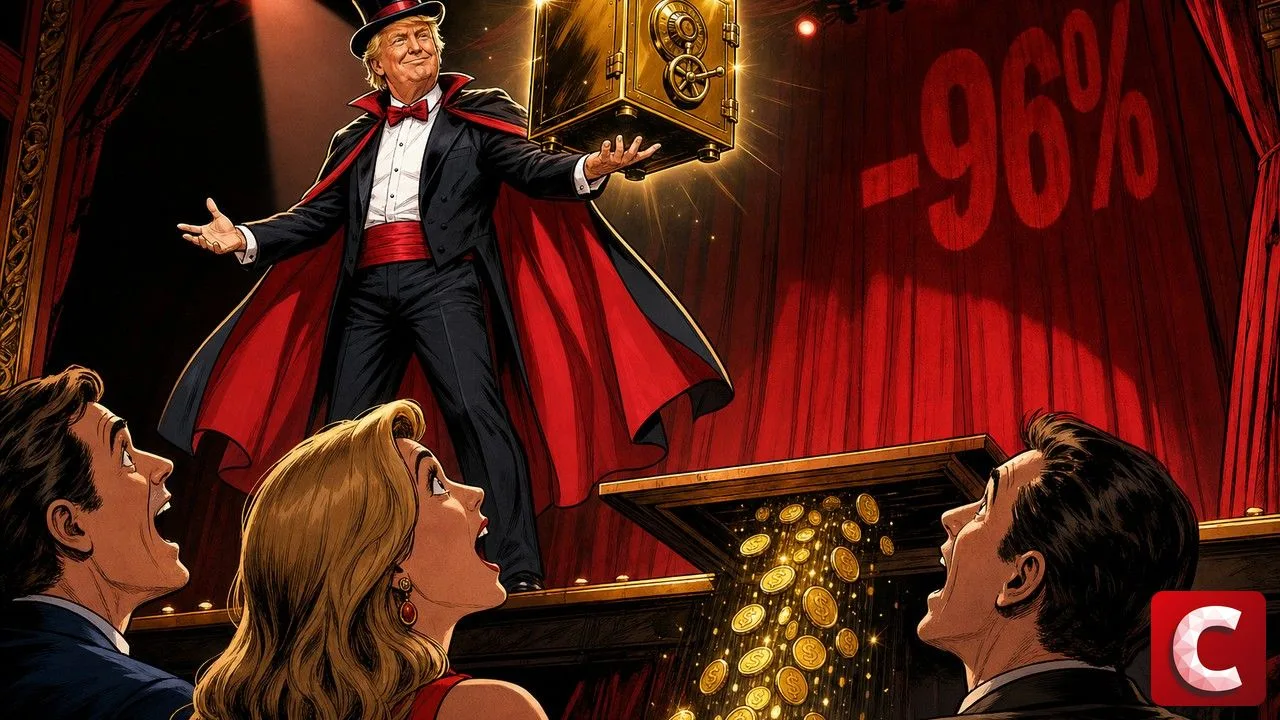
Consumer advocacy group Public Citizen has put a number on what Trump crypto products have cost the people who bought them: at least $4.7 billion in losses, overwhelmingly unrealized. The TRUMP memecoin alone accounts for $3.2 billion of that total, spread across close to one million retail wallets. Over the same stretch, Trump reported at least $1.4 billion in crypto-related income for 2025. The gap between those two figures is what the report is about.
Key Takeaways
- $4.7 billion in cumulative losses across five Trump-linked crypto products, $3.2 billion of it on the TRUMP memecoin
- The TRUMP token went from $73.43 in January 2025 to roughly $2.73 on Friday
- Trump reported $1.4 billion in crypto income for 2025 while those positions deteriorated
Get an AI Summary of This Article
ChatGPTThe TRUMP Memecoin Carries $3.2 Billion of the Damage
The report breaks out five separate products and treats each on its own terms, which is what makes it possible to see where the money actually went. One line item carries more than two thirds of the total.
Public Citizen walks through its methodology in the document it published covering the family’s five crypto products. The group rebuilds entry prices from on-chain transactions, then marks them against current valuations. What comes out is a paper loss figure, not a tally of realized damage.
The TRUMP memecoin, launched in January 2025, accounts for $3.2 billion in losses across roughly one million retail wallets. The token hit $73.43 in the days following launch. It changed hands around $2.73 on Friday, some 96% below that peak.
The report’s own framing of how those losses distributed is worth quoting directly: the earliest buyers were positioned for extraordinary gains, while the far larger waves that bought during and after the surge are left holding tokens worth a fraction of what they paid. That is a clinical description of a wealth transfer rather than a value destruction.
None of this pattern is new to anyone tracking the file. Back in February, one analyst argued publicly that Donald Trump had damaged the crypto ecosystem by importing a launch mechanic that drains retail buyers to the benefit of insiders.
The Trump Digital Trading Cards close out the list at a minimum of $9.3 million in losses across three collections. The amount barely registers next to the rest, yet it completes the picture: every format the family tested, from NFT to governance token, produced the same return profile for the late buyer.
One methodological point deserves attention. Public Citizen works off positions that are still open, marked at the current price. Wallets that sold near the January 2025 top drop out of the count, and so do their gains.
That convention cuts both ways. It leaves out the profits banked by early sellers, which understates the real transfer between the two groups. It also folds in paper losses that would shrink if prices recovered, which inflates the headline number at any given moment.

World Liberty Adds $1 Billion and Wins a Bank Charter
The second line item is World Liberty Financial’s governance token, credited with close to $1 billion in losses for its holders. It is also the product whose institutional trajectory diverges most sharply from its token performance.
While the token slid, the entity secured something no other Trump crypto product has. World Liberty won its US bank charter on August 14, in the form of preliminary conditional approval from the national bank regulator.
The permitted scope is spelled out in the chartering decision the OCC released in August: the institution will limit itself to trust activities and will not extend credit to the public. Its operational job will be issuing, redeeming and custodying the USD1 stablecoin.
USD1 now carries a $4 billion market cap and ranks fourth among stablecoins globally. That line never shows up in the loss column for a simple reason: a dollar-backed stablecoin does not lose money for its holder, it earns money for its issuer through reserve yield.
The ownership structure of the bank holding company drew separate scrutiny in late August. An Abu Dhabi investment vehicle holds 49%, a Trump family affiliate holds 38%. Congressional Democrats have requested hearings on the arrangement.
The price on that stake was set well in advance. The Emirati entity signed a $500 million deal for 49% of World Liberty Financial in January 2025, four days before the inauguration, with $263 million of it routed to entities the Trump family controls.
That timeline is what separates World Liberty from the other four. Governance token buyers came in after the public announcement, on an open market. The equity in the structure had already changed hands upstream, at a privately negotiated price.
There is a structural lesson buried in this second line item. The speculative token carries the risk, the infrastructure collects the rent. Governance token buyers absorb the $1 billion, while the regulated piece that will generate recurring revenue stays with the shareholders.
Also on Cryptonomic:
- Bitcoin Slides Below $78K as the Fed Signals Higher Rates
- Dormant Bitcoin Wallets Move $40M in Ten Days
- A Bitcoin Transaction Now Resists Quantum Computers
$1.4 Billion Booked on One Side, $4.7 Billion Lost on the Other
The third line item covers Trump Media, with roughly $450 million in unrealized losses on its bitcoin holdings. The company built a digital asset treasury when prices sat considerably higher.
That project was partly dismantled over the summer. Trump Media scrapped its $6.42 billion Crypto.com treasury deal in early August, closing out the group’s broadest ambition in digital asset reserves.
The same group had already retreated on another front. Truth Social pulled its three crypto ETFs for lack of demand in the spring, after a launch that never found its audience.
Against those $4.7 billion, Trump’s financial disclosure reports at least $1.4 billion in crypto-related income for 2025 alone. The two numbers do not net out in any accounting sense, they describe opposite sides of the same transactions.
That is the underlying mechanic the report documents. Issuer revenue comes from launch fees, reserved allocations and initial valuation, all collected at the moment demand peaks. Buyer losses show up afterward, once that demand recedes.
For a holder, the practical takeaway sits in the entry timing rather than in the projects themselves. None of the five products failed technically. They delivered exactly what they promised, and the value pooled in positions opened before the public announcement.
At market scale the immediate effect of the Trump crypto drawdown is small. $4.7 billion is thin against daily volumes, and those positions sit across a million wallets with little reason to sell at these levels. Residual selling pressure is therefore limited.
The six-month effect lands somewhere else, on retail trust. A million wallets that now associate a political brand with a 96% drawdown is a precedent every future celebrity-backed launch will have to work against.
One file stays open, the strategic reserve. A federal Bitcoin reserve announcement was billed as imminent back in May, and it is the only crypto strand of the presidency that would put the state’s balance sheet on the line rather than retail buyers’. Public Citizen does not cover it, which leaves the scope question wide open: the $4.7 billion measures the private sphere only.
Follow the story on Cryptonomic.