

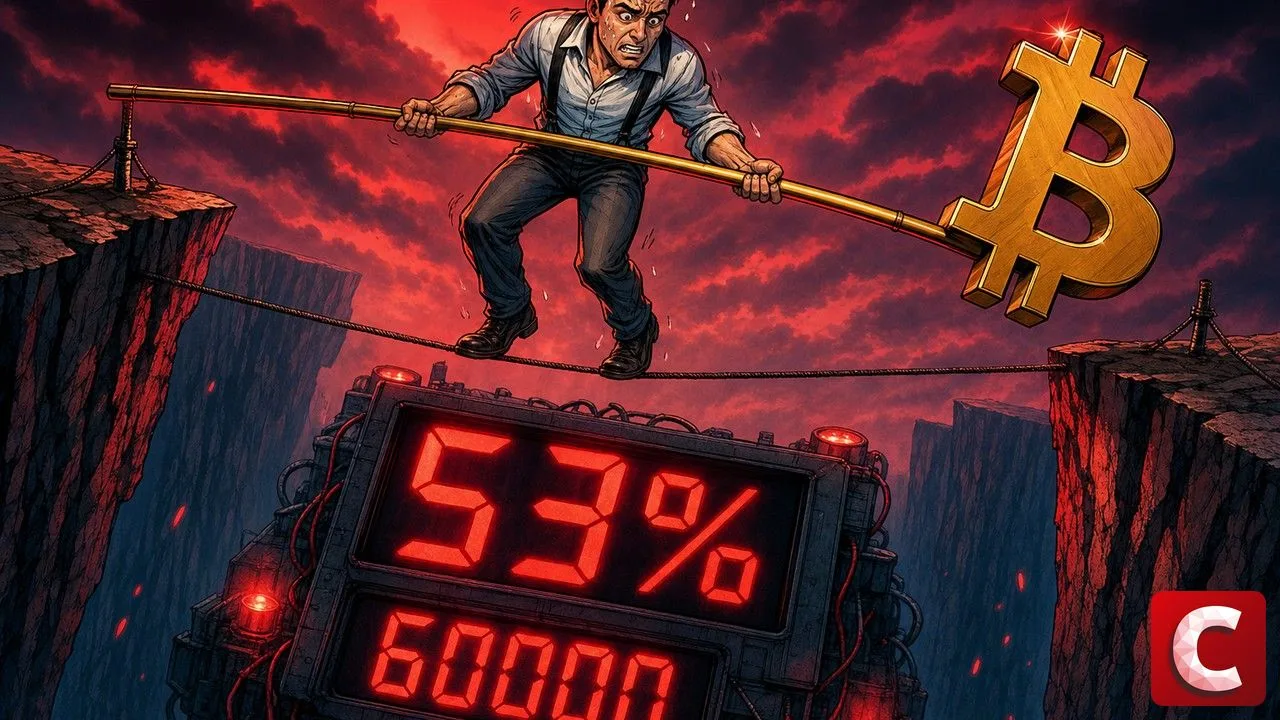
Bitcoin loss is hitting a new threshold: according to on-chain data compiled by Watcher Guru and relayed by Cryptoast, more than half of all Bitcoin in circulation (53%) are now held at an unrealized loss. BTC has fallen back below 60,000 dollars and is posting its weakest sentiment readings since the late 2024 bottom. The disengagement is becoming durable, and it is reshaping how the market trades.
Key Takeaways
- 53% of Bitcoin supply sits below the average holder cost basis.
- BTC dropped under 60,000 dollars after touching 58,200 in Asian trading.
- Retail interest has fallen to a 12-month low according to Google Trends.
Get an AI Summary of This Article
ChatGPTOne Holder Out of Two Is in the Red
The 50% threshold has been crossed. For the first time since late 2024, Bitcoin loss has spread to more than half of all supply in circulation. The reading comes from Watcher Guru, which relies on average UTXO acquisition costs. 53% translates to roughly 10.5 million BTC whose current market value sits below what their holder paid.
This metric is anything but anecdotal. It measures the psychological pressure weighing on holders. The higher the share of coins underwater, the stronger the urge to sell into any rebound. This is the mechanism that turns a temporary downturn into a structural bear market.
The last time this threshold was crossed was August 2024, in a fairly different context. Back then, BTC had just corrected after a post-ETF euphoria phase. The market absorbed the pressure within weeks. This time, the situation has been dragging on since October, and each leg down pushes new cohorts into the red.
Recent buyers are the most exposed. Anyone who bought BTC since late November 2025, when Bitcoin traded above 90,000 dollars, is now underwater. That cohort is the most likely to capitulate.

Price Breaks Below 60,000 Dollars
Bitcoin touched 58,206 dollars in Asian trading before climbing back to around 59,800. On the month, the drawdown is approaching 20%. On the quarter, BTC is already posting its third consecutive quarterly decline, following losses of 23% and 22% in the previous two quarters.
The immediate trigger came from Asian equity markets. South Korea’s Kospi lost 8% and tripped its circuit breaker. Japan’s Nikkei shed 3%. The selloff in risk assets spilled into crypto, which often serves as the swing variable when liquidity tightens.
Bitcoin spot ETFs recorded a record 30-day outflow of 6.4 billion dollars. This is one of the longest redemption streaks since the products launched. Institutional investors are stepping back from BTC, and the weekly average of net flows has now settled firmly in negative territory.
The US backdrop is not helping. The Fed under Kevin Warsh confirmed a hawkish bias in recent communications, and fed funds futures now price in an 80% probability of another rate hike before year-end 2026.
Also on Cryptonomic:
- Binance France Misses MiCA Deadline, Restrictions July 1
- Solana Falls to $64, Down 75% Since September
- Ethlabs: Former Ethereum Foundation Members Launch R&D Lab
Sentiment at Rock Bottom, Capitulation Not Yet Done
The Google Trends index for the Bitcoin keyword has fallen to a 12-month low. Retail interest is evaporating, the exact opposite of what we saw in late 2024 when every price rally triggered a search wave. This signal of popular disengagement is usually read as a precursor to a cycle bottom, but it can persist for months before any reversal kicks in.
Across the industry, cost cuts are stacking up. The players most exposed to retail volumes are starting to lay off staff, bracing for a thin summer and autumn on the commission front. This contraction reinforces bearish sentiment without producing a systemic collapse, given the absence of excessive leverage among major actors.
Bitcoin miners have been operating below their production cost for five months, which mechanically reduces the structural selling pressure because those still profitable hodl while waiting for a better price. But the dynamic carries a cost too: miner bankruptcies, forced sales of reserves, episodic capitulation waves.
The question analysts keep asking: is the 53% Bitcoin loss threshold a bottom signal or an intermediate stage? In previous cycles, final capitulation often coincided with a ratio above 60%. That leaves room to the downside, and room for collective psychology to clear a few more painful steps before any turnaround.
Follow the story on Cryptonomic.