

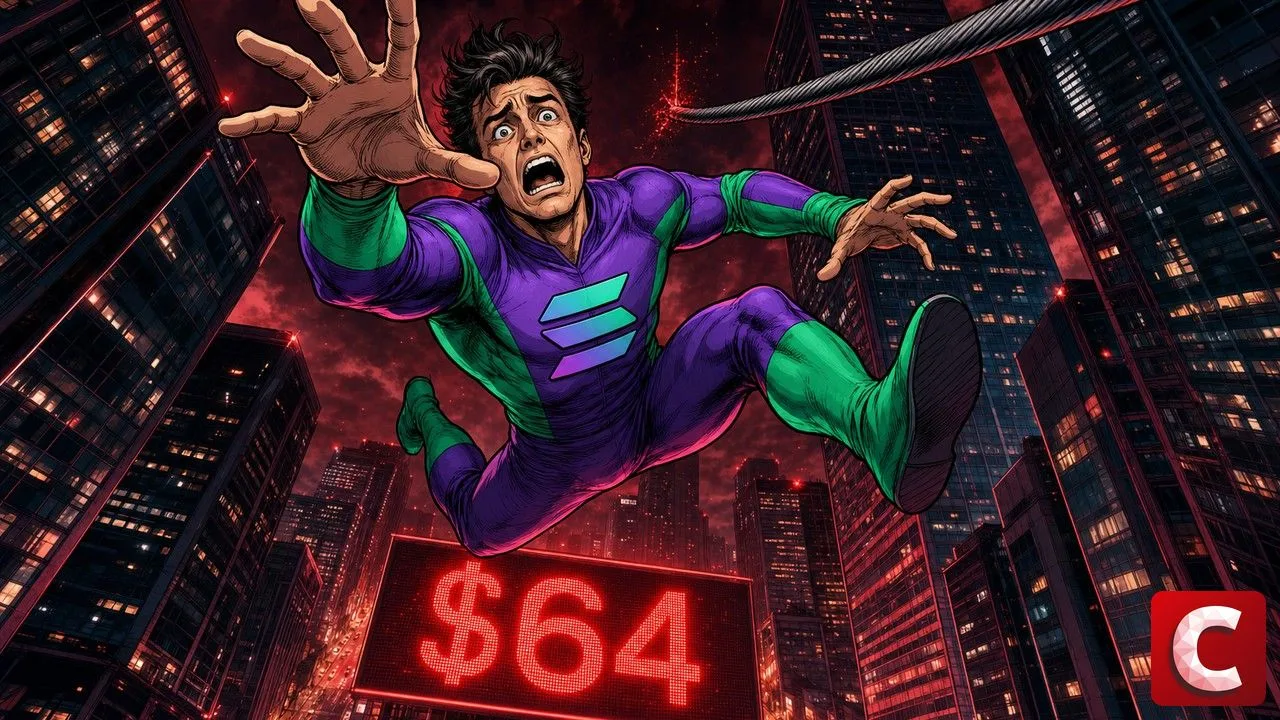
Solana tagged $64 on Wednesday evening, its lowest print since December 2023. That low completes a 75% slide from the token’s September 2025 peak. The session wiped out close to one billion dollars in crypto futures positions across the market, with $585 million liquidated on altcoin pairs alone. Bitcoin, setting the tone, dipped below $60,000 overnight before clawing back some ground on Thursday morning.
Key Takeaways
- Solana crashed to $64 on June 24, its weakest level since late 2023
- Nearly one billion dollars in futures positions were liquidated within 24 hours
- Derivatives signals remain bearish despite Thursday’s technical bounce
Get an AI Summary of This Article
ChatGPTA capitulation that completes a 75% drawdown
The break below $65 is not a routine correction. It marks Solana’s first return to levels last seen in December 2023, a period when the token was still proving its ecosystem could survive the FTX implosion. Since the September 2025 peak, SOL has shed three quarters of its value, tracking the same pattern as other major altcoins hit by capital rotation toward AI and semiconductor stocks. The full picture is available in Solana’s State of the Network report for February 2026.
The June 24 session unfolded in two stages. The first shock landed in the US afternoon, when Bitcoin slid to $59,175, its lowest print since October 2024. Solana followed immediately, losing its key support near $70 and continuing the descent to $64. The bounce came later that evening, fueled by Micron’s earnings beat that restored some appetite for risk assets tied to the AI trade.
By Thursday morning, SOL had recovered partially, trading between $67 and $68. But the move looked more like short covering than a genuine reversal. Funding rates stayed negative across major derivatives venues, a sign that traders kept positioning short even after the capitulation low. Bitcoin futures open interest jumped to 763,000 BTC, indicating heavy exposure on both sides of the book.
The institutional angle no longer cushions Solana the way it did earlier this year. Spot Solana ETFs launched under the Trump administration have seen flows slow sharply since April, and recent announcements around staking products failed to reverse the selling tide.

Liquidations cascade across altcoins
Across the 24-hour window, nearly one billion dollars in futures positions were erased market-wide. The breakdown matters: $585 million came from altcoin pairs alone, against roughly $430 million on Bitcoin-tracked contracts. That ratio shows where the selling pressure concentrated.
HYPE, the Hyperliquid token, lost 11.7% on the week, among the worst performances in the top 20. The contrast is sharp with the $75 billion valuation peak the protocol reached the previous week. Dogecoin also dropped 11.9% over seven days, confirming that memecoin fatigue now spares no name in the segment.
Ether followed the move with a 7.9% weekly decline, finishing the session around $1,644 after dipping to $1,550. Total crypto market capitalization slipped under $2.2 trillion, its key psychological support zone. Bitcoin dominance held high at 56%, the classic signature of a cycle where altcoins suffer more than the market reference.
The Cumulative Volume Delta on derivatives shows consistent selling pressure for the past 72 hours. In practice, traders taking the initiative are paying up to open short positions, which mechanically weighs on prices until that flow reverses. Analysts cited by CoinDesk note that this kind of setup typically precedes either a final capitulation or a violent short squeeze when traders are forced to cover.
Also on Cryptonomic:
- Ethlabs: Former Ethereum Foundation Members Launch R&D Lab
- Digital Euro: EU Parliament Votes Yes, Launch by 2029
- Bitcoin Oman: State-Mandated Mining Pool Goes Live
Bear market exit or crypto winter opener
The debate now centers on the 200-week moving average, an indicator analysts watch in periods of structural doubt. Bitcoin is now trading right next to this historic line. The three previous times this level was tested produced weakness phases lasting 9 months in 2015, 6 months in 2018, and roughly six quarters after the 2022 collapse.
This reading aligns with 21Shares’ mid-year report published June 24, which maintains a $100,000 year-end base case for Bitcoin. That target implies a rebound of more than 65% from current levels, but spread over months rather than weeks. For Solana, the path forward depends largely on Bitcoin: until the market benchmark stabilizes, no altcoin can hope for a durable bounce.
The macro backdrop weighs heavily on this equation. The Core PCE reading due Thursday is expected at 3.4% year-on-year, a level Bank of America says justifies three Fed rate hikes before year-end 2026. This hawkish scenario neutralizes the Bitcoin-as-inflation-hedge case, just as gold and the dollar are becoming the preferred destinations for capital seeking safety.
Continued outflows from US Bitcoin ETFs, which now total $5.94 billion in net redemptions over six weeks, confirm that institutional investors are not in accumulation mode. As long as that flow does not reverse, altcoins like Solana will stay vulnerable, a pattern central to the altcoin season 2026 dynamic that has reshaped Hyperliquid, Solana and XRP positioning.
Follow the story on Cryptonomic.



Pingback: Solana Votes to Burn Ten Times More Tokens a Day - Cryptonomic
Pingback: Altcoin Cycle Signal at 86 Is a False Altseason Reading - Cryptonomic
Pingback: Solana Records Its 7th Consecutive Monthly Decline