

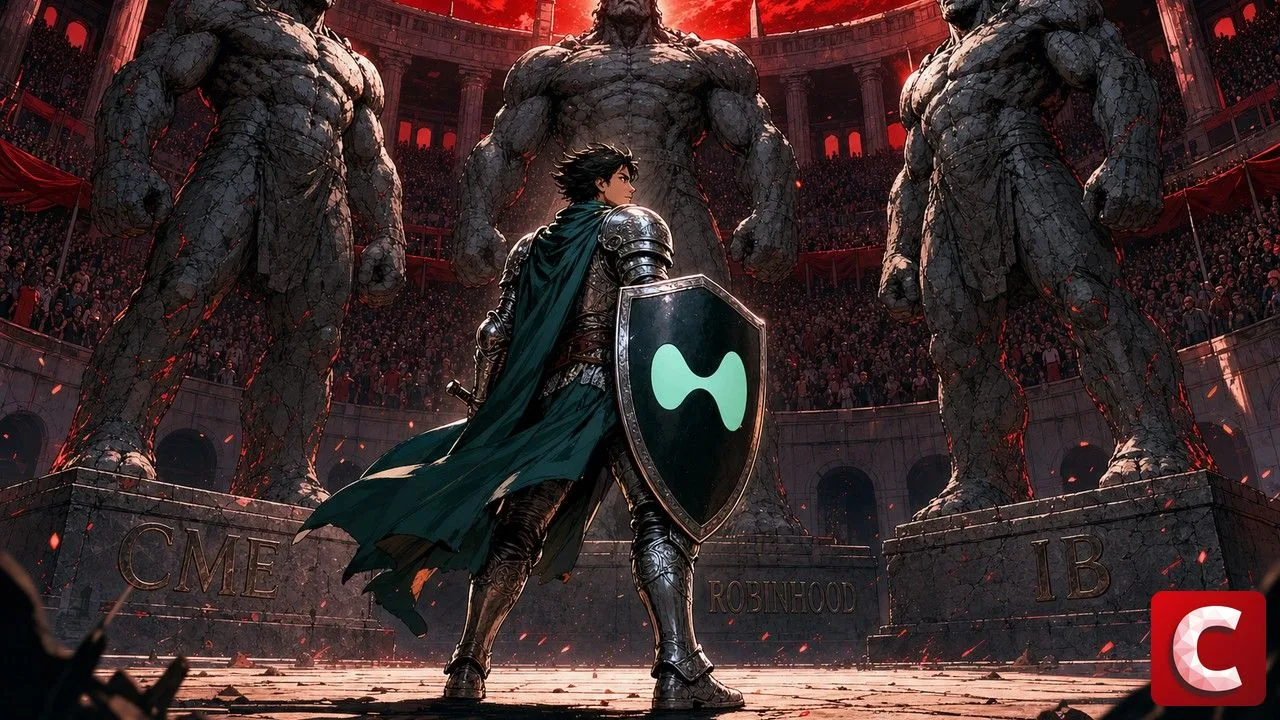
The Hyperliquid valuation reached $75 billion on a fully diluted basis before the recent HYPE pullback. Hyperion DeFi CEO Hyunsu Jung compares that level directly to the market capitalizations of CME Group, Interactive Brokers and Robinhood, three pillars of listed American finance. HYPE trades around $67.14 after a 10% drop on Thursday, but the token is still up more than 150% year to date, while Bitcoin is down nearly 30% over the same window. The message is simple: the market is starting to lift Hyperliquid out of the “crypto DEX” box and put it somewhere else entirely.
Key Takeaways
- Hyperliquid valuation tagged $75B fully diluted, comparable to CME, Interactive Brokers and Robinhood.
- HYPE is up 150% YTD while Bitcoin is down 30% over the same period.
- HIP-3 perp on SpaceX shares generated $1.4 billion in volume on IPO day.
Get an AI Summary of This Article
ChatGPTA Valuation Knocking on the Door of Listed Giants
The $75 billion figure is not background noise. It places Hyperliquid at the level of the largest market infrastructures listed on Wall Street. CME Group, the dominant operator of US derivatives, sits in the same zone. Robinhood, the most visible retail broker of the decade, also. Interactive Brokers, the institutional trading reference, completes the trio. For context, see our earlier piece on Cryptonomic: Hyperliquid HYPE Hits New All-Time High Above $60.
The comparison is not just stylistic. It reframes how a traditional investor can read the Hyperliquid valuation: no longer one crypto platform among others, but a market infrastructure playing in the same league as the historic derivatives exchanges.
According to Hyperion DeFi CEO Hyunsu Jung, investors keep underestimating the transformation underway. The market still values Hyperliquid like a DEX, when the protocol is building a full blockchain ecosystem, capable of hosting products that exist nowhere else in traditional finance.
The recent pullback in HYPE, down 10% on Thursday to close at $67.14, is read by Jung as an entry window rather than a reversal. It fits the normal breathing pattern of an asset that remains massively bullish on the year.

HYPE Holds Ground While Bitcoin Slides
The contrast with the rest of the market is striking. Year to date, HYPE prints over 150% positive performance, while Bitcoin is down nearly 30% in the same stretch. The divergence is wide enough to attract attention far beyond the circle of legacy holders.
This atypical behavior reflects a precise market logic. When macro weighs on the entire sector, the assets that stay standing are those that bring a clear narrative and a working product. Hyperliquid checks both boxes: a perpetual trading protocol that captures real volume, and a tokenized economy that redistributes value to holders.
This momentum was partially offset last week by ETF outflows, as we covered in our analysis of $172 million in weekly outflows on the HYPE ETF. The institutional wrapper corrected, but the underlying did not follow with the same intensity.
The lesson: the Hyperliquid valuation keeps its own traction, independent of the institutional arbitrage that can shake the ETF vehicles. That is what allows the token to defy its classic correlation with Bitcoin.
Cautious analysts point out that this kind of gap always closes eventually. The open question is which way. Either the market lifts its valuation toward the multiple implied by the CME comparison, or the pullback extends and HYPE drifts back to the lower end of its range.
Also on Cryptonomic:
- Bitcoin Miners Spent 5 Months Below Production Cost
- Ethereum Foundation Faces Funding Crisis in 9 Months
- Binance MiCA: ECB to Decide Fate of 37M EU Clients
The Bet on Becoming More Than a DEX
Hyperliquid no longer reduces to a perpetual order book. The deployment of the HIP-3 standard, which opens up the creation of derivative products on any underlying asset, fundamentally changes the picture. The perp on SpaceX shares generated $1.4 billion in volume on IPO day alone, proving the platform’s ability to capture flows that would otherwise have gone to traditional exchanges. That HIP-3 push is what the SpaceX perp shows in practice, $1.4 billion traded on IPO day,
This product extension feeds Jung’s thesis. For him, comparing Hyperliquid to a DEX is like comparing Amazon to an online bookstore in the mid-2000s. The protocol has already started to become the execution layer for asset classes crypto users previously had no access to.
Over the medium term, the bet rides on capturing a growing share of global derivatives volume. CME processes trillions of dollars in notional per year. Hyperliquid is not yet at equivalent volumes, but its growth curve remains vertical, and every new product listed on HIP-3 adds another layer of user retention.
The main uncertainty stays regulatory. As long as the SEC and CFTC have not clearly ruled on the legality of stock perps backed by blockchain contracts, US institutional players stay on the sidelines. That is the next critical step for the Hyperliquid valuation: turning its technological lead into regulated access to US markets.
Follow the story on Cryptonomic.



Pingback: Trump Backs a Hyperliquid US Entry, Token Jumps 25% - Cryptonomic
Pingback: Bitcoin Slides as US Strikes on Iran Push Oil to $74 - Cryptonomic