

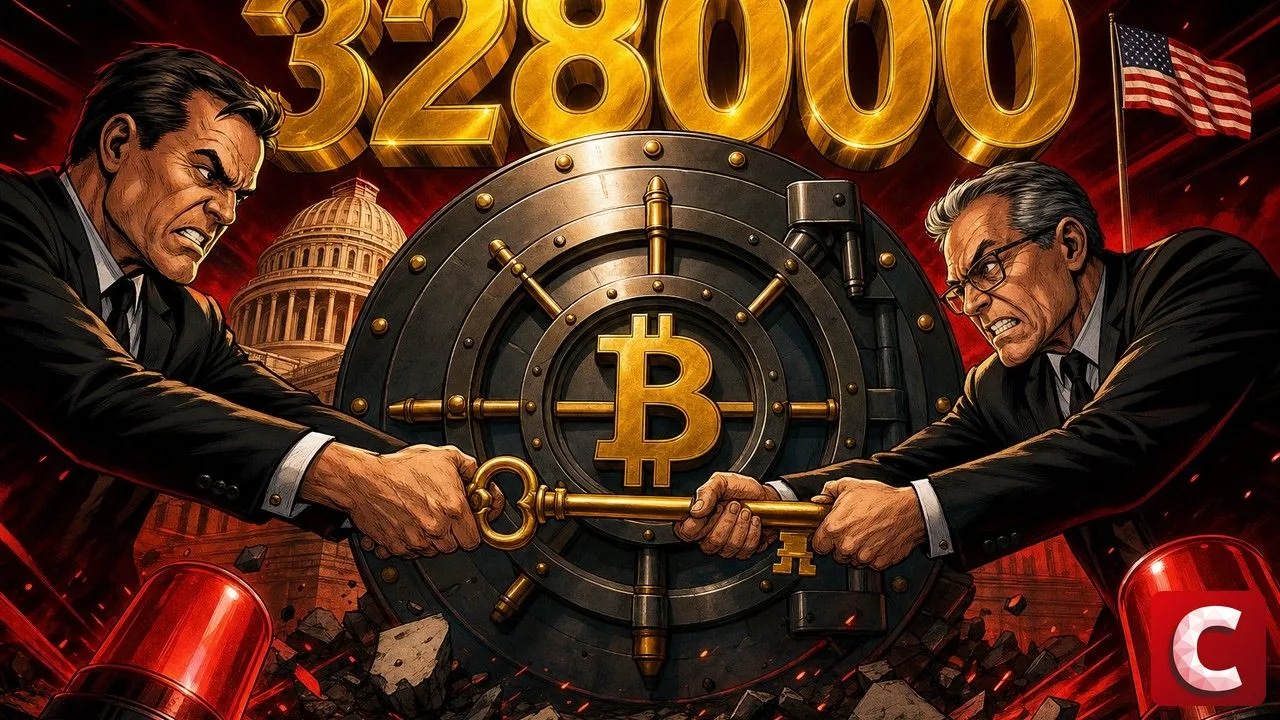
Sixteen months after the executive order signed by Donald Trump in March 2025, the US Strategic Bitcoin Reserve still has no validated home. The Treasury Department and the Commerce Department are trading responsibility, unable to agree on which agency has legal authority to custody the coins. Roughly 328,000 BTC in seized assets, worth around $21B at current price, sit in limbo. The DOJ Office of Legal Counsel is now mediating, and Congress is stepping in to codify the reserve through legislation.
Key Takeaways
- The US Strategic Bitcoin Reserve has not acquired a single new BTC since the executive order of March 2025.
- Treasury and Commerce disagree on the legal authority to hold bitcoin in a federal reserve.
- The BITCOIN Act and the American Reserve Modernization Act try to settle the question through Congress.
Get an AI Summary of This Article
ChatGPTSixteen months of executive order with nothing built
The Trump administration signed the executive order creating the Strategic Bitcoin Reserve in March 2025. The stated goal was to consolidate BTC seized by the federal government into a long-term structure, modeled on the way gold sits in Fort Knox.
Sixteen months later, the operational balance sheet is empty. No managing agency has been formally designated. Holdings have not been published in a consolidated public report. And most tellingly, not a single additional satoshi has been acquired since the signature.
The stock inside the reserve stays massive despite the administrative freeze. Public trackers put the reserve at around 328,000 BTC inherited from federal seizures over the past decade, worth close to $21B at current spot near $64,000.
For an investor who has followed the storyline since 2025, the contrast is sharp. Markets read the executive order as a signal of structural retention on the stock. The reality, sixteen months in, is an administrative freeze that keeps the question open. The rollout had been billed as imminent, Trump promising a Bitcoin reserve close at hand.
The article Cryptonomic published this morning on the dominant US position with 2.8x more BTC than the rest of the world combined laid out the static picture. Today’s file adds the dynamic side, the institutional deadlock that prevents the doctrine from actually deploying.

Treasury and Commerce trade the power to custody bitcoin
The core of the freeze is administrative. The initial plan handed the reserve to the Treasury Department. Conversations have since pivoted, and placement with the Commerce Department is now on the table.
The question Treasury officials are raising is foundational. Do existing statutes actually give them the legal authority to custody and actively manage digital assets acquired via enforcement seizures? The answer is not obvious, and the department’s internal legal counsel has not locked in a firm position.
The Commerce Department, floated as a fallback for months, also refuses to shoulder the responsibility on its own. No one wants to own a mandate that could turn out to be legally shaky six months down the road.
The DOJ Office of Legal Counsel stepped in as mediator. The office indicated it is working with both departments to identify the legally available options for executing the presidential policy. That level of involvement signals the file has moved past ordinary bureaucratic friction.
Another concern is circulating in the corridors. Some officials are examining whether the federal government can legally hold bitcoin indefinitely, given the asset’s volatility. That reading opens a crack in the “reserve equals no sale” doctrine that is vital to the holder thesis for the market.
Also on Cryptonomic:
- MiCA Regulation Sets a Single Crypto Framework Across Europe
- US Bitcoin Reserves Are 2.8x The Rest of the World Combined
- Mt Gox Moves 47,228 BTC to Bitstamp as Repayments Ramp
Congress steps in with two bills on the table
Faced with executive inertia, Congress is stepping in. Two bills now try to codify the reserve through the legislative route rather than executive order alone.
The first is the BITCOIN Act, notably sponsored by Senator Cynthia Lummis (R-WY) and Representative Nick Begich (R-AK). The text proposes to formally house the Strategic Bitcoin Reserve inside Treasury, resolving the legal ambiguity that fuels the current freeze.
The second is the American Reserve Modernization Act, introduced in May 2026 on a bipartisan footing. Its angle is broader: it lays out a general framework for federal administration of reserves that include digital assets, without limiting the scope to bitcoin alone.
Neither bill has reached a definitive resolution. They progress in parallel inside a legislative agenda already loaded on the crypto side, with the CLARITY Act and the GENIUS rules monopolizing floor time.
On the administration side, White House spokeswoman Liz Huston said the administration “continues to evaluate the best structure” for the reserve. At this stage, that language reads more like a holding response than an operational signal.
For markets, the read-through stays clear. The article published this morning on MicroStrategy selling $216M in bitcoin to fund dividends shows the role played by corporate treasuries while the federal reserve stays parked. In parallel, Metaplanet pushed its stack to 43,000 BTC with an added $170M buy. The space left vacant by the US freeze is actively filled by private actors.
Follow the story on Cryptonomic.