

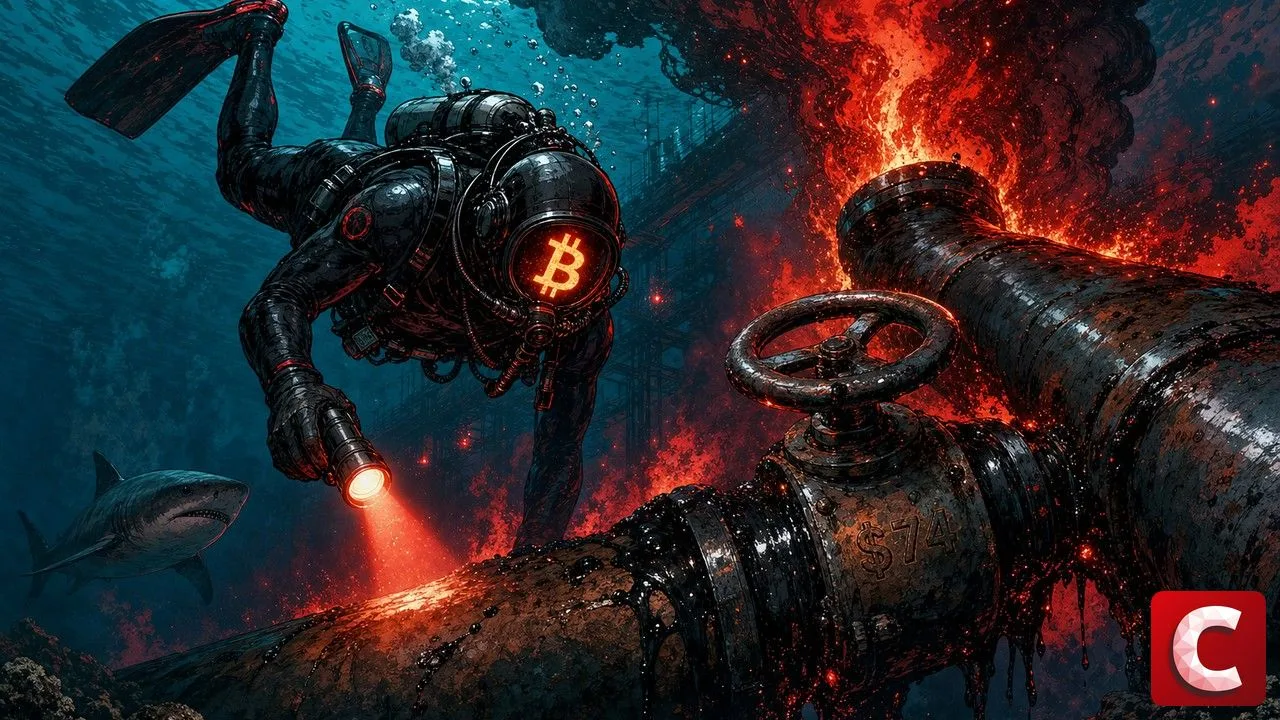
American forces carried out a series of strikes against Iran in response to attacks on three commercial vessels in the Strait of Hormuz. The US Treasury revoked the general license that allowed Tehran to sell its oil, reviving the scenario of a broader energy supply disruption. Crude prices climb, European futures open in the red and Bitcoin gives up ground, caught between risk-off flows and already thin ETF demand.
Key Takeaways
- US strikes Iran after three commercial vessels hit at Hormuz, Treasury revokes Iranian oil sales license.
- WTI jumps 2% to $72, Brent rises 3% toward $74, European futures open lower across the board.
- Bitcoin slips below $63,000 after a two-week high at $64,500, open interest and ETF flows both cool.
Get an AI Summary of This Article
ChatGPTIran strikes and the Treasury pulls the oil license
US forces launched a series of strikes against Iran overnight into Wednesday. The response directly targets the attacks conducted earlier in the week against three commercial vessels in the Strait of Hormuz, the choke point through which a large share of global oil exports transit every day.
The Treasury followed within hours, revoking the general license that let Tehran ship its crude to international buyers under an agreement signed the previous month. Several traders viewed that document as the main valve preventing a sudden price shock in the physical market.
The signal sent to markets is straightforward. Washington is not just escalating militarily, it is squeezing a core revenue stream for Iran at the same time. For financial actors, the immediate consequence is the return of geopolitics as the dominant driver in the short run, ahead of the macro releases scheduled later in the day.
This is not the first time the Iran-Hormuz thread hits crypto this year. An earlier episode already dragged Bitcoin lower when the Iran-US deal wobbled over its Lebanon leg, and the cycle is starting again just two weeks later on more strained ground.
The Fed also releases the June meeting minutes on Wednesday, and the calendar is not helping. Investors now have to digest two contradictory catalysts in a single session, an oil shock feeding inflation on one side, the rate path on the other.

Oil climbs, European futures open in the red
WTI rebounded more than 2% after the strikes were reported and trades above $72 per barrel. Brent tracks the same move with a 3% gain, flirting with $74, a level that puts imported inflation back on European central bankers’ desks.
Futures on major European benchmarks open in the red. The CAC 40 is set to lose 0.52%, the DAX 0.47%, the FTSE 0.34% and the Stoxx 600 0.39%. In the US, S&P 500 futures shed 0.1% and Dow contracts slip 0.3%.
The pattern is textbook. A Middle East escalation triggers a multi-asset risk-off move, with rotation into gold and the dollar, and an immediate risk premium on every cyclical name. Energy names benefit alone from the shock, which softens the index correction but does not cancel it.
The context matters because the S&P 500 just posted its best first half since 2020, and the Dow crossed 53,000 points for the first time on Monday. Tuesday already started to correct, with the Nasdaq down more than 1% under semiconductor pressure. Overnight strikes reinforce that profit-taking case.
The key question for allocators today is whether the oil move is a flow shock or the start of a durable regime. A persistent geopolitical premium on Brent would reshape the read on the Fed minutes, reactivating the fear of a delayed inflation peak.
Also on Cryptonomic:
- US Strategic Bitcoin Reserve Remains Stuck After 16 Months
- MiCA Regulation Sets a Single Crypto Framework Across Europe
- US Bitcoin Reserves Are 2.8x The Rest of the World Combined
Bitcoin gives up ground, risk appetite retreats
Bitcoin traded near $62,616 after touching $64,500 on Monday, a two-week high that was already fading before the new escalation. Total crypto market cap sits at $2.16 trillion, up 8.4% since July 1 but now on softer footing.
Under the surface, several derivatives readings raise flags. Bitcoin futures open interest dropped back to 740,000 BTC, down from a 776,000 BTC peak on July 3. More than $500 million of leveraged positions were liquidated in 24 hours, and 30-day implied volatility (BVIV) climbed to 40%.
Multiple desks had already tagged the early-July bounce as a relief rally, driven more by a short squeeze than by fresh buying conviction. Spot ETF flows stayed weak and the Coinbase premium, a proxy for US demand, has been negative for more than fifty consecutive sessions. That set of signals takes on a different color when geopolitics flips against the thesis.
Ether is holding a little better, up 13.5% on the week versus 6.75% for Bitcoin. The relative-strength story favors ETH on that window, helped by rebounding DeFi activity (Hyperliquid’s valuation near $75B remains an anchor for institutional appetite in perpetuals).
Longer term, whale behavior keeps muddying the signal. They absorbed 270,000 BTC in two weeks while ETFs bled more than $4 billion on the same window, a rare decoupling between the institutional wrapper channel and large onchain wallets. If the geopolitical episode extends, that accumulation pocket gives the market a potential floor before the next US macro prints.
The next tell is whether Wednesday’s strikes stay isolated or trigger a visible Iranian response on the energy front. In the first case, the oil premium deflates within a few sessions. In the second, Bitcoin shifts regime for weeks, with a broader risk-off scenario and forced decorrelation from equity indices.
Follow the story on Cryptonomic.