

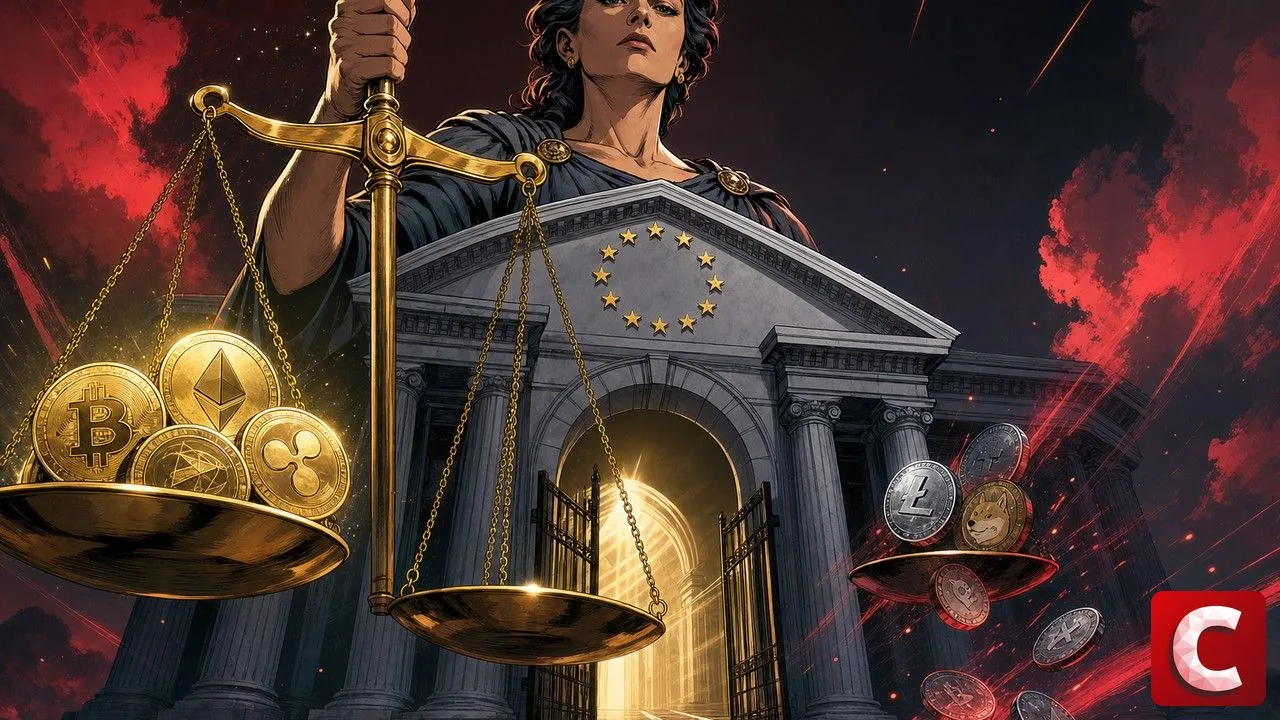
One year into full application, MiCA has delivered its first set of hard numbers. Europe’s regulation has grown a market of licensed providers, but stablecoin issuance is still tiny and whole swaths of crypto sit outside the framework. This report takes stock of what MiCA actually changed, where its blind spots are, and how it stacks up against other regulatory powers. The verdict is neither triumph nor failure, but a half-built site.
Key Takeaways
- The EU counts 102 MiCA-licensed crypto providers, including 12 credit institutions.
- On the stablecoin side, issuance caps out at 30 players, a still underdeveloped market.
- DeFi, on-chain lending and NFTs remain outside the regulation’s scope.
Get an AI Summary of This Article
ChatGPTContents
One year of MiCA: what the regulation actually built
Banks in the room, the quiet turn of the year
Stablecoins, the framework’s moment of truth
The blind spots: DeFi, NFTs and multi-issuance
MiCA against the rest of the world and the July cliff

One year of MiCA: what the regulation actually built
MiCA became fully applicable in December 2024. The first review therefore covers a full year, the first in which Europe’s crypto sector operated under a unified framework rather than a patchwork of national rules. That year of hindsight is what makes the picture readable.
The most telling figure is the provider count. As of December 2025, the EU had 102 licensed crypto-asset service providers under MiCA. These CASPs, for Crypto-Asset Service Providers, are the exchanges, custodians and intermediaries that secured a full authorization, not a mere transitional reprieve.
Supervision follows a two-tier architecture. Licenses are granted by each member state’s national regulator, but the whole is coordinated at the European level, with a public register that lists the providers actually authorized. That centralization of information changes things for a user: checking that a platform is properly licensed becomes possible by consulting a single source, where opacity used to rule.
One detail of that population deserves attention. Of those 102 licenses, 12 are held by credit institutions, in other words banks. Their presence signals that crypto is no longer ground reserved for native players. Banks are entering the regulated field, with the compliance resources that implies, and that may be the deepest structural change of this first year.
The contrast with the pre-MiCA world shows the scale of the change. Until then, a crypto player that wanted to cover several European countries had to juggle as many national regimes, sometimes contradictory, often vague. The regulation replaces that patchwork with a single license valid across the Union, the so-called passport, which lets a provider licensed in one member state operate in the others. That mutual-recognition mechanism is what made the 102 licenses genuinely useful rather than purely symbolic.
What MiCA built, then, is a mandatory gateway. To understand the full mechanics of these licenses and how the regime works, our guide to the European MiCA crypto framework details the categories of players and the obligations that fall on each. The core point here fits in one idea: operating legally in the EU now requires a passport that 102 players have earned.
Still, that base of 102 licensees is a snapshot, not an endpoint. The transitional regime that let pre-existing players keep operating is coming to an end, and the real stress test of the setup turns precisely on that switch, which we cover below.
Also on Cryptonomic:
- Hyperliquid Unlocks $817M in HYPE on Fed Day
- Bitcoin Miners Bet on AI as Difficulty Keeps Falling
- Satsuma Sells All 668 BTC and Delists in London
Banks in the room, the quiet turn of the year
The figure of 12 licensed credit institutions deserves a closer look. Against the 102 CASPs it looks modest, but it says something the headlines largely missed. For the first time, regulated banks run crypto under the same legal roof as their traditional activities, with no exotic subsidiary and no offshore jurisdiction in between.
The stakes go past the symbol. A bank that secures a CASP license can offer custody, exchange, or order execution in crypto to its existing client base, under the same capital, internal control, and reporting requirements as the rest of its balance sheet. That is exactly what MiCA set out to trigger: bring crypto inside the prudential perimeter rather than leave it on the edge.
That move sends a signal to the rest of the market. When a licensed bank offers a service, it implicitly validates the framework for a cautious clientele, the kind that would never have touched a native platform. Compliance becomes a selling point rather than only a burden, which flips the logic that prevailed before MiCA.
The flip side exists all the same. Bringing banks in also imports their caution and their pace. An institution under a prudential regime moves carefully, reserves its offerings for the most established assets, and steers clear of segments where the law is still blurry. The arrival of banks legitimizes the framework, but it does nothing to fill its gray zones, which remain many.
Stablecoins, the framework’s moment of truth
While service providers poured in, stablecoin issuance tells the opposite story. The market stays clearly underdeveloped on that side, with only 30 active issuers on record. The contrast with the 102 CASPs is striking: MiCA managed to frame intermediaries far faster than it grew issuers.
Part of the explanation lies in how strict the framework is. MiCA imposes reserve, transparency and licensing requirements on currency-backed tokens that deter issuers used to lighter jurisdictions. The regulation also clearly bans paying interest on those stablecoins, a sharper stance than the one seen elsewhere.
That rigor has a visible side effect on behavior. Faced with rules perceived as constraining, a share of users would rather take direct control of their assets again. In Europe, a large share of funds withdrawn from platforms heads to self-custody, a signal that the framework drives compliance as much as it drives an exit from the regulated system for those who want to avoid it.
The interest ban captures the European philosophy well. Where other regimes tolerate arrangements that pass a yield back through intermediaries, MiCA shuts the door more firmly. It is a consumer-protection choice, but also a competitive drag against ecosystems where the yield-bearing stablecoin pulls in capital.
The framework also splits stablecoins into two families, and that architecture weighs on supply. E-money tokens, pegged to a single currency, follow a regime close to that of classic electronic money. Asset-referenced tokens, tied to a basket of assets, face even heavier requirements. In both cases, the issuer must hold adequate reserves, publish regular disclosures, and submit to tight supervision, a level of demand that largely explains why only 30 players stepped up.
The result, one year on, is a European stablecoin market at half-strength. The framework exists, it is solid, but it has not yet created the champions it could house. Legal certainty was not enough to attract issuance, and that is one of the open questions the second year will have to settle.
The blind spots: DeFi, NFTs and multi-issuance
The one-year review also reveals what MiCA does not cover. Three gray zones remain, and they are not minor. The first, and the most discussed, concerns decentralized finance. DeFi, on-chain lending protocols and NFTs stay largely outside the regulation’s scope.
That void is not an oversight, it is a postponed job. The European Commission still has to decide how to approach these activities, whose decentralized nature fits poorly with a regime built for identifiable, accountable players. Regulating a protocol with no clear issuer is a problem MiCA has not solved, and it remains wide open.
The second gray zone touches a technical mechanism with real consequences: multi-issuance. The framework sets no explicit rule for identical stablecoins issued at the same time across several jurisdictions, under different regulatory regimes. That opens a debate about reserve adequacy and holder protection when a single token lives under two sets of rules.
The third gap is interest paid through intermediaries. While MiCA clearly bans direct remuneration, the door stays ajar elsewhere in the world, which creates a regulatory arbitrage. A European user can be tempted by foreign products that skirt the spirit of the regulation without breaking its letter on European soil.
These blind spots are not theoretical. A European user can today interact with a decentralized lending protocol, trade NFTs, or hold a foreign stablecoin without any of it falling clearly under the regulation. The framework governs the entry and exit of the regulated system, but leaves a vast middle territory where MiCA protections do not apply.
These three blind spots share the same root. MiCA was designed for classic assets and players transposed to crypto, and it excels on that ground. It stalls the moment the technology drifts from the identifiable-issuer model. The second generation of the text will be decided precisely on those frontiers.
MiCA against the rest of the world and the July cliff
MiCA cannot be read in a vacuum. Its first year coincides with a global regulatory awakening, and the comparison lights up its strengths as much as its limits. In the United States, a dedicated framework for dollar-pegged stablecoins has emerged, with an approach different from Europe’s ban on interest.
That transatlantic divergence is defining. Washington seeks to anchor the dominance of the digital dollar, while Brussels prioritizes consumer protection and stability. The two takes on the stablecoin, as the tight timeline of the GENIUS Act on the U.S. side shows, sketch two competing models that issuers will arbitrate on a global scale.
Across the Channel, the United Kingdom moves at its own pace. Its regulator has opened consultations on crypto-asset oversight and on a regime specific to systemic stablecoins. London watches MiCA closely, without aligning mechanically, which could turn the British market into an alternative for players put off by continental rigor.
It is against this backdrop that the calendar’s heaviest deadline lands. The transitional regime, which gave pre-existing players time to comply, ends on July 1, 2026. Past that date, operating without a MiCA license is no longer possible to provide crypto services in the Union, with no transitional net left.
That switch is the real arbiter. It will show how many players clear the licensing bar and how many leave the European market rather than bend to it. The base of 102 licensed CASPs is about to be tested at full scale, and that is where the framework’s real pull will be measured.
The international comparison adds a deeper stake. A framework that is too strict protects the consumer but can push innovation and capital toward lighter jurisdictions, a phenomenon European regulators watch closely. A framework that is too permissive would import the very risks MiCA set out to contain. The whole difficulty of year two sits in that balance: stay demanding enough to protect, open enough not to hollow out the market.
Year two also carries a concrete to-do list. The Commission has to decide how, or whether, to bring DeFi, lending and NFTs into scope, close the multi-issuance gap, and watch how the July cliff reshapes the provider map. Each of those choices will either extend MiCA’s reach or confirm its limits. The first year proved the framework can structure a market. The second will show whether it can keep pace with one.
The verdict on this first year is therefore a deliberate half-measure. MiCA managed to structure intermediaries and bring banks in, a real regulatory feat. It has failed, for now, to spark stablecoin issuance and to embrace DeFi. The year ahead will say whether the European framework becomes a global reference or a solid model too narrow for crypto as it keeps evolving.
Follow the story on Cryptonomic.