

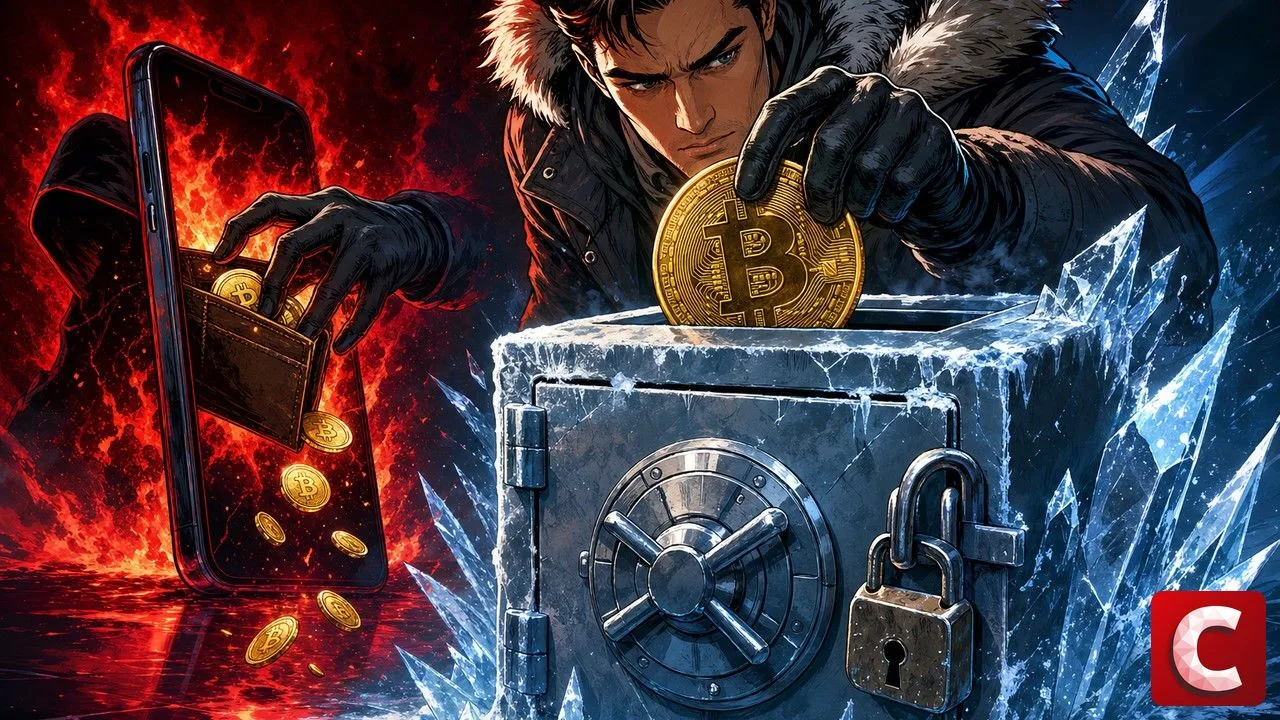
A hot wallet stays connected to the internet and handles everything day to day. A cold wallet keeps your keys offline and protects what you want to hold for the long run. The real debate is not picking one over the other, but deciding how much to keep in each. This guide lays out the mechanics, the real costs, and the rule experienced holders follow.
Key Takeaways
- A hot wallet is free and convenient, but permanently exposed to the network.
- A cold wallet costs $79 to $400 and keeps your keys out of a hacker’s reach.
- Above $1,000 in crypto, a cold wallet becomes the base of your security.
Get an AI Summary of This Article
ChatGPTContents
The real divide between the two
How each type protects (or exposes) your keys
What it costs and what it is for
The pro rule: both, never one or the other
The mistakes that drain a wallet
Frequently Asked Questions

The real divide between the two
A crypto wallet does not really store your tokens. It holds your private keys, the cryptographic proof that lets you move funds recorded on the blockchain. So the whole security question comes down to a single point: are those keys exposed to the internet, or not.
A hot wallet is a wallet connected to the network at all times. A mobile app, a browser extension, an exchange-hosted wallet: the moment it sits online to sign a transaction in one click, it falls into this category. That is what makes it convenient, and it is also what makes it vulnerable.
A cold wallet does the opposite. It keeps private keys on a device that never connects directly to the internet. With no link to the network, an attacker cannot reach the funds remotely, even if the computer the device plugs into is infected with malware.
The distinction is therefore not about brand or price, but about exposure. A hot wallet lives in a connected, exposed environment. A cold wallet lives offline and signs transactions off to the side. Everything else follows from that.
Also on Cryptonomic:
- Hyperliquid Unlocks $817M in HYPE on Fed Day
- Bitcoin Miners Bet on AI as Difficulty Keeps Falling
- Satsuma Sells All 668 BTC and Delists in London
How each type protects (or exposes) your keys
With a hot wallet, the private key sits on a device in constant contact with the network. That permanent availability is exactly the attack vector. Phishing, malware and spoofed sites all chase the same goal: intercept the key or trick the user into signing a fraudulent transaction.
There is no shortage of incidents to prove it. A flaw in a consumer-grade wallet can drain thousands of accounts in a few hours, with victims making no visible mistake. The risk is structural: whatever is connected can be attacked.
A cold wallet breaks that chain. When you approve a transaction, it is prepared on the connected computer, then sent to the offline device that signs it internally. Only the signed transaction goes back to the network. The private key itself never leaves the device. Spyware on the computer only sees data that is already signed, useless for stealing the rest.
That physical barrier does not make a cold wallet foolproof. The recovery phrase (the 12 or 24 words that regenerate access) remains the true weak point. If it is photographed, saved to a cloud, or read out to a fake support agent, going offline no longer helps. Hardware security never replaces discipline around the seed.
That is also why the self-custody wave has gathered pace. In Europe, a growing share of funds is leaving platforms for self-custody, a move that puts control of the keys back at the center, and where the cold wallet becomes the reference tool.
What it costs and what it is for
A hot wallet is free in the vast majority of cases. You download it, install it, use it. Its real cost is not monetary, it is risk: the more value you leave in it, the more surface you offer an attacker.
A cold wallet costs money. A serious device runs from $79 to $400 depending on the model, the screen, the connectivity options, and the certification level. That is a modest entry ticket against the sums it protects, but a real psychological hurdle for a beginner still unsure about investing.
Use settles the question better than price. The hot wallet is built for movement: trading, interacting with decentralized applications, paying several times a day, testing a protocol. The cold wallet is built for stillness: holding capital over time that you do not plan to move every week.
A concrete example helps set the threshold. Below $1,000 in crypto, a well-kept hot wallet can do the job to start, as long as you stay careful. Above that, the logic flips: the expert consensus is that from $1,000, a cold wallet becomes advisable, and it becomes clearly essential as the sum climbs.
The same reasoning applies to what you do with your assets. Tokens put to work in on-chain strategies, such as liquid staking and its yield mechanics, necessarily pass through a connected environment at some point. Here too, the good practice is to expose only the share actually in play and keep the rest cold.
The pro rule: both, never one or the other
The starting question (cold or hot) is really the wrong one. Experienced holders, institutions and security specialists do not pick a side. They run both in parallel, each for what it does best.
The model that holds up over time is simple. The cold wallet acts as the vault: it concentrates the bulk of the capital, the part you rarely touch. The hot wallet acts as the spending purse: it holds only what you need in the short term, an amount you accept losing in a worst case.
That split turns an incident into a manageable annoyance. If the hot wallet is compromised, the loss is capped at the small spending balance. The bulk of the holdings, kept offline on the cold wallet, does not move. It is exactly the logic followed by those who have already seen what a single mistake can cost.
Staying informed is part of the same hygiene. Understanding why a price moves, how a project manages its supply, or what investigations into hardware wallet security reveal about real threats helps you calibrate your own defense. Crypto security is not a one-time purchase, it is a habit.
The right reflex for 2026 comes down to one line: a hot wallet for movement, a cold wallet for capital, and never more value online than you can afford to lose. The rest is just a matter of dosage specific to each profile.
The mistakes that drain a wallet
Picking the right type of wallet protects nothing if the basics are wrong. The vast majority of losses do not come from a cryptographic flaw, but from a human error in how the keys are handled. The weak link is almost always the user, not the technology.
The first mistake, and the most common, involves the recovery phrase. Photographing it, saving it to a cloud, typing it into a phone note, or pasting it into an email cancels the whole point of a cold wallet. Those 12 or 24 words must stay offline, on a physical medium, known only to you. Whoever gets them gets the funds, with no need for the device.
The second mistake is trusting fake support. No legitimate team will ever ask for your recovery phrase, not by message, not by phone, not through a form. Anyone who requests it is a scammer, no exception. That rule is absolute and admits no special case, even when the urgency feels real.
The third mistake is signing without reading. When interacting with a decentralized application, you sometimes approve a permission that gives a contract lasting access to your tokens. Checking what you sign, revoking unnecessary permissions, and distrusting sites that push you to approve fast are reflexes that prevent a large share of wallet drains, including on a properly configured hot wallet.
Frequently Asked Questions
Do I really need a cold wallet for a small portfolio?
Below $1,000, a well-secured hot wallet can be enough to start, as long as you stay vigilant about phishing and how you handle your recovery phrase. The threshold where a cold wallet becomes advisable sits around $1,000, and it clearly takes over beyond that. The real question is not portfolio size, but your tolerance for losing the sum in an incident.
What happens if I lose my cold wallet?
Losing the device does not mean losing the funds. Your assets live on the blockchain, not inside the box. As long as you keep your recovery phrase somewhere safe, you restore access on a new compatible device. The reverse is the real danger: if someone gets your recovery phrase, they get your funds, device or not.
Can a hot wallet be made secure enough?
You can cut its risk without ever removing it. Strong passwords, two-factor authentication, systematic checks of addresses and of the permissions granted to apps all limit exposure. But as long as the key lives in a connected environment, the attack surface exists. That is why the hot wallet stays reserved for amounts you accept putting at risk.
Follow the story on Cryptonomic.