

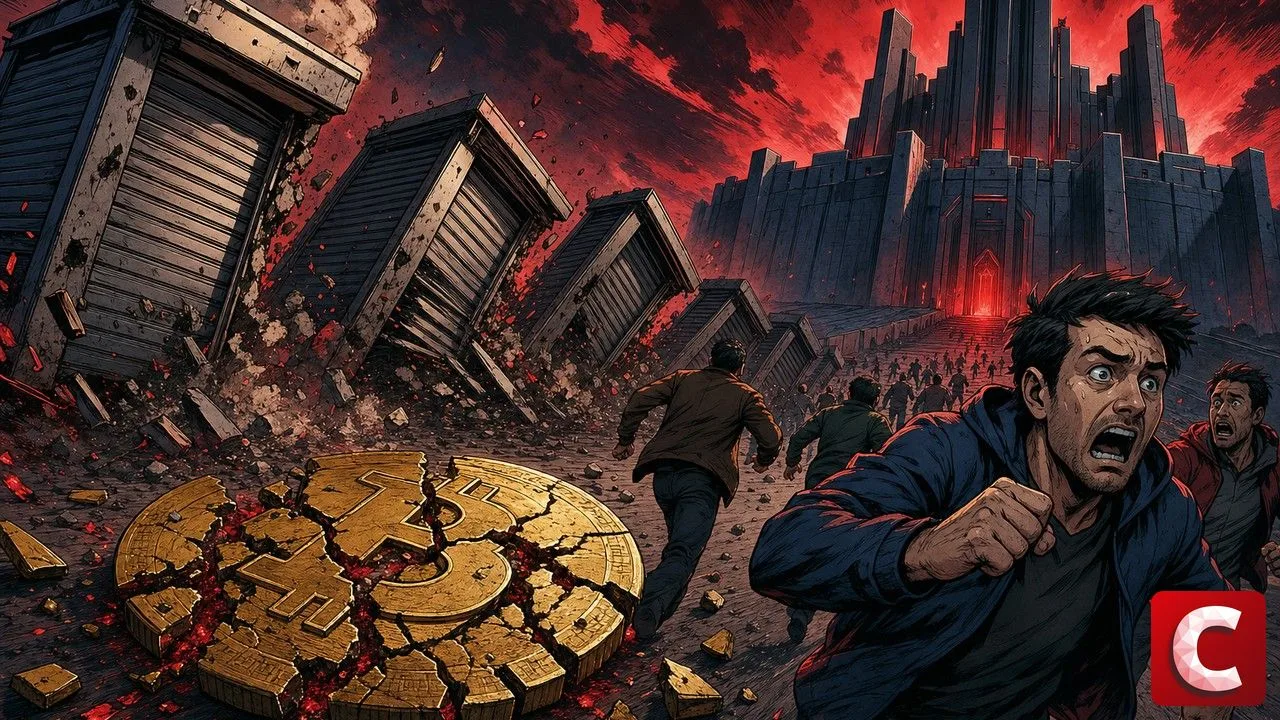
In a single month, three platforms announced they were closing: AscendEX in early July, then BitMEX and BitMart three days apart. The crypto exchange shutdowns keep coming, and yet 2026 is on track to be the quietest year in eight for platforms disappearing. This report puts the numbers back in order and explains what is really pushing these venues toward the exit.
Key Takeaways
- Three exchanges folded in one month (AscendEX, BitMEX, BitMart), but only nine have closed across all of 2026.
- Two forces converge: collapsing trading volume and a compliance bill that jumps as the MiCA transition period ends.
- The move looks like consolidation toward the biggest venues, not a systemic collapse of the sector.
Get an AI Summary of This Article
ChatGPTContents
Three platforms fall in one month
BitMEX, the end of a derivatives pioneer
The real driver: volume that is collapsing
MiCA reshuffles the compliance deck
Verdict: consolidation, not a wreck

Three platforms fall in one month
The sequence is striking. On July 1, 2026, AscendEX ceased operations after eight years in business, cutting trading, deposits, staking and swap services all at once. Three weeks later, on July 23, BitMEX notified users it was ending the platform entirely. On July 26, BitMart followed with a phased shutdown schedule.
The AscendEX case is the most alarming of the three. The platform, live since 2018, placed all remaining withdrawals under mandatory manual review, with no timeline and no guarantee that funds would be returned. It named two causes: the full enforcement of the EU’s MiCA regulation and the failure of a strategic transaction meant to bring in liquidity, after a counterparty did not perform.
The reserve figures trace a brutal path. AscendEX’s total balance dropped by more than $240M on June 20, 2026, six days before the first public warning. By July 8, the platform’s labeled address held only about $13.45M in assets, more than $12M of it in illiquid tokens. For its users, the shutdown carries a real risk to deposited funds.
Each announcement also left a mark on the in-house tokens. BitMEX’s BMEX token crashed 98% on the news, and BitMart’s BMX lost close to 58% right after. Those drops reflect a blunt reality: an exchange token is only worth something while the platform stays alive.
BitMEX spelled out its timeline. The platform halted new sign-ups right away and plans to cease all operations on September 23, 2026 at 04:00 UTC, after eleven years in business. Parent company HDR Global Trading pointed to a strategic review of the business, without giving a specific reason. The full exit sits in our coverage of the day BitMEX shut down for good after eleven years.
BitMart chose a gradual wind-down. The platform suspended registrations, deposits and new orders on July 26, plans to end all trading on August 26, and keeps withdrawals open until January 31, 2027, subject to tighter compliance checks. Nine years of history close out in three steps, with users treated more carefully than at AscendEX.
This cluster of announcements creates the sense of a losing streak. It deserves perspective, though, because the yearly count tells a different story, one this report returns to later.
Also on Cryptonomic:
- Clarity Act Delay: Senate Puts the Bill on Hold
- MiCA One Year On: The Real Verdict on Europe’s Crypto Rules
- Cold Wallet vs Hot Wallet: Which to Choose in 2026
BitMEX, the end of a derivatives pioneer
BitMEX is not just another platform. Launched in 2014, it popularized the perpetual contract, the leveraged instrument that now dominates crypto derivatives trading. For years, the BitMEX name was shorthand for advanced Bitcoin speculation.
Its decline played out on several fronts. Competition from Binance, Bybit and OKX captured most of the volume, while BitMEX struggled to stay relevant. The pioneer ended up outrun by the venues it inspired.
The regulatory baggage weighed heavily. In October 2020, the Department of Justice and the CFTC charged founders Arthur Hayes, Ben Delo and Samuel Reed with running an unregistered platform and breaching the Bank Secrecy Act. All three pleaded guilty, and Donald Trump pardoned them in 2025. But the damage was done, and serious players had already migrated to platforms with cleaner regulatory records.
The final signal came from inside. The departure of several key executives in early 2026, including the chief executive, the chief financial officer and the head of growth, betrayed a deep restructuring. A leadership team that empties out rarely precedes a comeback.
The symbolism runs beyond BitMEX itself. Watching the inventor of the perpetual swap disappear just as that product trades more than ever says something about the shift underway. The volume still exists, it has simply changed hands and, often, changed venue.
The real driver: volume that is collapsing
Behind each shutdown sits the same underlying problem. Mid-sized centralized exchanges live on a steady flow of new users to feed their fee income. That flow dried up sharply, and liquidity concentrated at the largest venues.
The volume figures show the scale of the shock. Aggregate spot volume across major centralized exchanges fell from about $2.36T in August 2025 to $951.8B in April 2026, its lowest level in 25 months. That is a drop of roughly 60% over eight months, and 63% below the all-time monthly peak of $2.6T set in December 2024.
The retreat of retail traders is the heart of the problem. In South Korea, volume at the top five platforms fell 88%. Derivatives now make up more than 70% of centralized exchange activity, a sign that the remaining participants are mostly institutional or professional players hedging positions, not retail traders chasing momentum.
Even listed exchanges took the hit. In early 2026, shares of Coinbase, Gemini and Bullish slid, with some losses topping 55%, amid a retail exodus and plunging volumes. When well-capitalized, publicly traded players hurt this much, mid-sized venues have no margin left.
Part of the volume also moved to different ground. Derivatives are migrating to decentralized platforms, where fees are lower and finality is near instant. That shift of trading on-chain strips centralized exchanges of one of their most profitable segments, at the exact moment they need it most.
The scale of that shift is measurable. Perpetual exchanges built on Solana handled a record $183.2B in volume in the second quarter of 2026, up 42% on the quarter. Volume is not leaving the market, then, it is leaving centralized order books for decentralized protocols that keep eating into the historic exchanges’ core business.
The pressure reaches even the giants on their side activities. Binance, for instance, chose to shut down some peripheral services, as it did when Binance wound down its NFT marketplace in a month. When the market leader trims, weaker players often have no choice but to leave, and crypto exchange shutdowns become the logical outcome of a market that keeps contracting.
MiCA reshuffles the compliance deck
The second driver is regulatory. In Europe, the transition period for the MiCA regulation ended on July 1, 2026. From that date, a platform must be licensed to keep operating legally, or it has to withdraw from the market.
Compliance now carries a real cost of entry. AscendEX said so plainly, naming its lack of authorization as a direct reason for closing, alongside its liquidity failure. For a mid-sized player already under strain, the price of full compliance can outrun what its declining revenue can support.
That deadline directly disrupted European access to certain platforms, a topic already covered when MiCA threatened access for 10 million Europeans to their exchange. The European framework protects users, but it also works as a filter that pushes undercapitalized players out.
The result is a rising barrier to entry everywhere. Analysts put it simply: only large, well-capitalized platforms with transparent reserves and diversified services stand a good chance of surviving. Regulation does not kill the market, it redraws the map of the survivors.
Verdict: consolidation, not a wreck
The number that resets the perspective is right there. Across all of 2026, only nine exchanges announced or completed a shutdown, the lowest yearly total in at least eight years. July’s run is dramatic in how it clusters, not in its real scale over the year.
The broader context stays tough, that said. Since the start of the year, close to a hundred crypto projects have ceased operations, spanning exchanges, decentralized finance services, NFT marketplaces and blockchain projects. Alongside July’s three platforms, players like Movement Labs and Storj Labs also disappeared, in a mix of bankruptcies, bear market and regulatory costs.
The flip side of these crypto exchange shutdowns is the rise of the leaders. Binance now handles close to 39% of centralized spot trading, its widest lead in years. Every platform that closes redistributes its clients and liquidity toward that core, which speeds up the concentration further.
The survivors are not just waiting. Several large platforms are turning into hybrid brokerages to keep capital that is tempted to flee toward traditional markets. The tokenized Treasury market, which reached $14.6B, shows the growing overlap between crypto and mainstream finance, and pushes exchanges to widen their offering well beyond plain token trading.
That turn toward diversified services is not cosmetic. It answers the analysts’ verdict directly: an exchange that depends on retail trading alone no longer has a viable model. The business is reinventing itself around custody, brokerage and tokenized assets, while single-product players fade out for lack of volume.
For investors, the lesson is concrete. Holding funds on a mid-sized exchange with a fragile balance sheet becomes a risk in its own right, separate from market risk. The AscendEX case, with its frozen funds and near-empty reserves, is a reminder that the in-house token is not the only thing to watch.
The sector’s direction reads clearly. The market is tightening around a core of large, compliant platforms, while speculative volume slips on-chain. These crypto exchange shutdowns do not mark the end of centralized venues, but the end of those that lived on a constant inflow of new traders without ever reaching critical scale.
The next stage will turn on how well the survivors absorb the orphaned users. The move feeds on itself, since each exit reinforces the leaders a little more, and nothing suggests it stops in the short term.
Follow the story on Cryptonomic.