

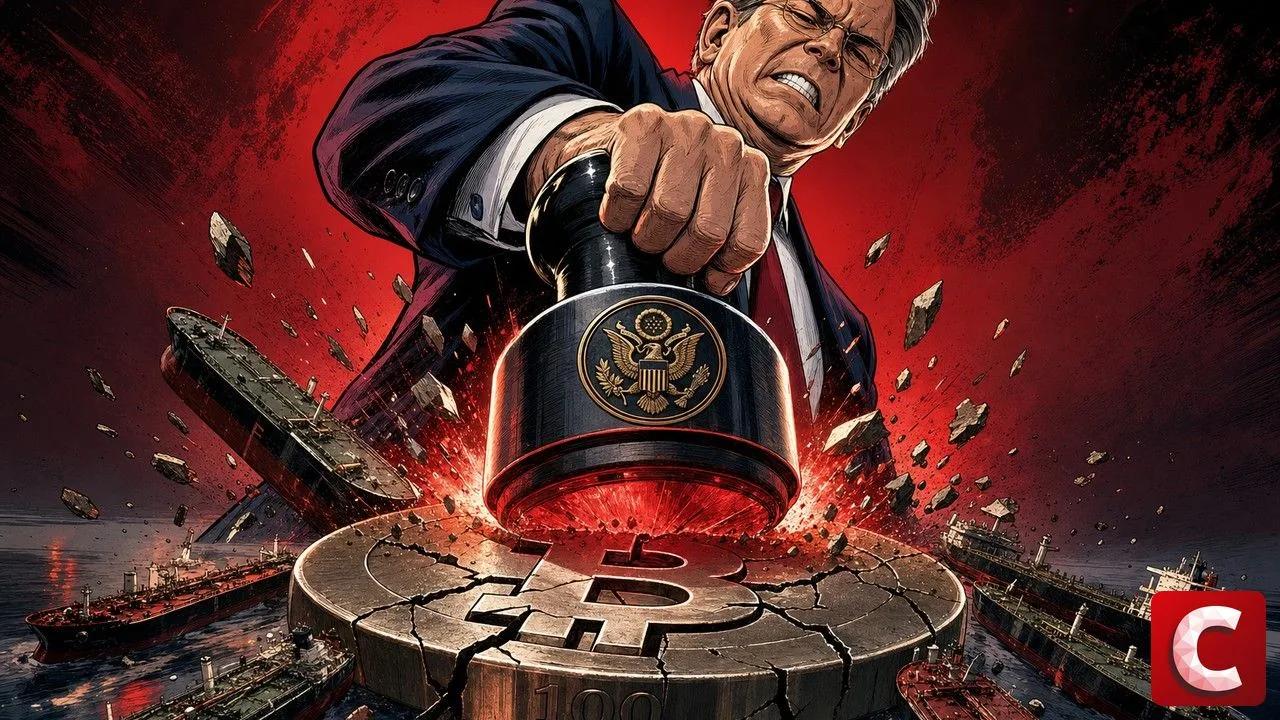
The US Treasury has pulled Iran crypto into its sanctions architecture. A determination signed on August 24 puts digital assets on the same footing as gold, aviation and shipping among the sectors of Iran’s economy now exposed to American measures. Close to 60 entities, individuals and vessels were designated in the same sweep.
Key Takeaways
- Washington named digital assets a sanctionable sector of Iran’s economy for the first time.
- Ivan Obukhov allegedly processed more than $100M in crypto payments for the Quds Force since 2023.
- Treasury puts the running total of seized Iranian crypto at roughly $1B.
Get an AI Summary of This Article
ChatGPTFive Iranian Sectors Move Into Sanctions Range at Once
On August 24, the Treasury launched Operation Economic Outcast, a whole-of-government economic campaign aimed at the Islamic Republic and the intermediaries that keep it funded. The action covers five sectors of Iran’s economy: digital assets, technology, gold, aviation and shipping. The full designation list sits in the recent actions notice OFAC published the same day.
The first of those five is what changes the picture. Until now, Iran crypto surfaced in American files case by case, platform by platform, designation by designation. It becomes an entire sector of the targeted economy, which opens the door to measures against any foreign person operating in it or supporting it.
The shift in scale is real. An exchange is no longer caught because it served one sanctioned client, but because it does business in a sector that is now sanctionable in itself. The burden of proof moves to the intermediary.
Close to 60 entities, individuals and vessels were designated alongside the determination. The networks named span nuclear and missile procurement, cyber operations and oil revenue generation, three tracks that earlier rounds handled separately. Oil remains the spine of the pressure campaign, as the US strikes that pushed crude to $74 and knocked bitcoin lower this summer already showed.
Treasury Secretary Scott Bessent framed the operation as a binary choice put to Tehran. He set full global isolation and a subsistence economy against a gradual return to the international economic circuit, with nothing in between. The framing runs through the Treasury statement issued alongside the launch of the campaign.

Ivan Obukhov and the $100M Routed Through the Quds Force
The best documented designation of the round targets Ivan Obukhov, a Ukrainian national based in the United Arab Emirates. Treasury attributes more than $100M in cryptocurrency payments processed since 2023, tied to Iranian oil sales carried out on behalf of the Quds Force of the Islamic Revolutionary Guard Corps.
Foscom FZE, the UAE-registered company Obukhov bought in 2022 and runs as owner and general manager, falls under the same measure. Both designations lean on Executive Order 13224, the counterterrorism instrument Washington reserves for material and financial supporters of designated organizations. The mechanism echoes the one that broke Telegram’s t.me links for users worldwide after an OFAC decision.
Obukhov’s profile says a lot about the structure. He is neither Iranian nor based in Iran, and that is exactly what makes the arrangement useful to Tehran. The foreign broker absorbs the sanctions risk while the oil finds a buyer and the proceeds come back in stablecoins.
That circuit explains why stablecoin issuers sit at the center of the Iran crypto file. The freeze of roughly $344M in Tron-based USDT, carried out by Tether in coordination with OFAC, supplied most of the jump in American seizures this spring. The issuer is meanwhile operating with a reserve buffer that halved over the second quarter.
Also on Cryptonomic:
- Solana Votes to Burn Ten Times More Tokens a Day
- Bitcoin Breaks $80,000 in Its Best Week Since 2023
- Bitcoin Pauses at $77K Before the New Fed Chair Speaks
Eight Months of Designations and Roughly $1B Seized
The sector determination did not come out of nowhere. In January 2026, OFAC designated Zedcex and Zedxion, two UK-registered platforms, in what amounted to the first exchange designations. On June 3, Nobitex, the country’s largest platform, went down with four other exchanges.
The sequence tightened over the summer. On August 7, Shelbit and Aban Tether were designated in turn, for a combined $5M in digital assets. One round roughly every two months, with no ambiguity about the direction of travel. What the August 24 determination adds is scope rather than tempo.
Bessent puts the running total of seized Iranian crypto at roughly $1B, a figure that has doubled from the some $500M counted at the end of April. The climb owes less to a proliferation of cases than to a handful of large operations, the Tether freeze among them. Diplomatic thaws have not reversed the trend, including when a deal between Washington and Tehran carried bitcoin to $65,000.
In the near term, the weight falls on platform compliance desks. A sector designation forces a rescan of counterparties, registration jurisdictions and inbound flows, well past the named list itself. Gulf-registered exchanges will feel it first, since that is where most of the brokerage layer around Iran crypto has settled over the past three years.
Over three to six months, the open question is how far the extraterritorial reach runs. A sector determination explicitly targets foreign persons, which exposes operators who have never touched American soil. The contrast with the domestic loosening Washington is running in parallel could hardly be sharper.
Follow the story on Cryptonomic.