
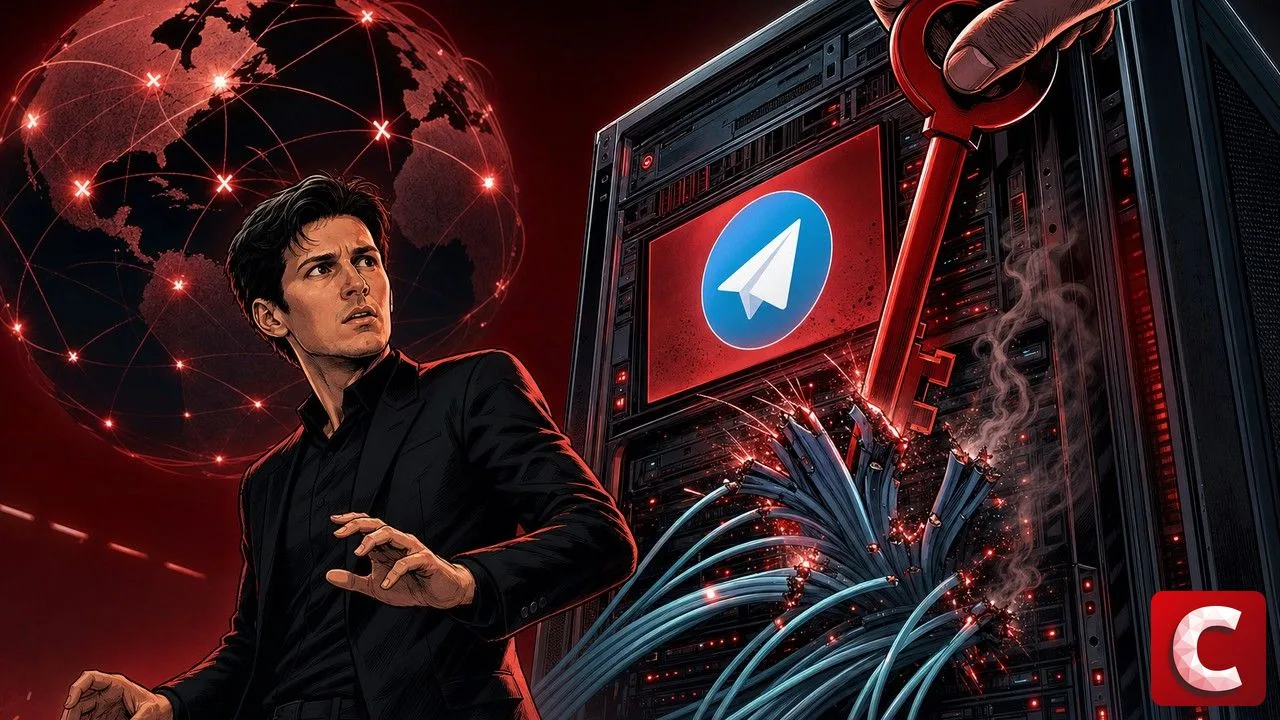
Telegram’s t.me domain entered serverHold at the .me registry on July 13, removing it from global DNS resolution and breaking every t.me link worldwide. The Telegram app itself keeps running, but the main consumer on-ramp into its crypto ecosystem is offline. No official statement from Telegram, Identity Digital or the .me registry has clarified the reason.
Key Takeaways
- The .me registry placed t.me on serverHold, pulling the domain out of the global DNS.
- Several reports point to a US OFAC compliance requirement, with no official confirmation.
- The TON ecosystem, valued around $4.3B, loses its main consumer on-ramp.
Get an AI Summary of This Article
ChatGPTThe .me Registry Puts t.me on serverHold Without Notice
serverHold is a registry-level suspension that stops a domain from being published in the DNS. Once it is set, no resolver anywhere can find the address, regardless of the provider. The status flipped on July 13, and end users had zero warning.
The .me registry is operated on the back end by Identity Digital. Neither Identity Digital nor the .me operator has issued a public communication explaining the move. Telegram also stayed silent for hours after the outage.
The absence of any advance notice is the real anomaly. Registries typically warn the domain operator before acting so aggressively, leaving a window to fix compliance issues or to negotiate. Here, the flip happened with no visible dialogue, and Pavel Durov ended up asking the registry publicly on X for an explanation.
The t.me domain sits in a very specific place in Telegram’s history. The platform and the .me registry have partnered for years, with a technical integration deep enough to make t.me the messaging service’s official short-link. Severing that link changes the geometry of the entire service.
The event also breaks a pattern for the wider crypto industry. Domain infrastructure has stayed mostly out of the compliance spotlight, in contrast with exchanges or KYC rails. A registry-level action turns DNS itself into a lever, and every project that relies on a single vanity domain now has to re-examine its exposure.

OFAC or Pure Compliance, the Cause Stays Opaque
Multiple channels have pointed to a compliance obligation tied to the US Office of Foreign Assets Control. OFAC administers sanctions lists and regularly pushes technical intermediaries to block access to entities or services considered risky. This remains the most likely trigger, but it is still conditional.
The US Treasury, Identity Digital and Telegram have not confirmed the connection in writing. No official document accompanies the registry’s action. The community following the situation leans on social posts and technical DNS status readings, not on a legal filing.
The opacity echoes an older file, when France opened judicial proceedings targeting Pavel Durov in person. The founder remains under judicial oversight in France, and the timing between that pressure and the registry’s move fuels speculation about a convergence of regulatory dossiers rather than a single trigger.
The registry option is worth flagging for a different reason. If OFAC really sits behind the call, restoring the domain will require a direct dialogue between Telegram and Treasury, likely stretched over weeks. If the reason is something else (a payment dispute, a technical compliance failure, a policy breach with the registrar), a fast reversal is realistic.
The whole file hangs on a single regulatory thread. What matters for TON is how long the resolution stays broken and how the on-ramp problem is triaged in the meantime.
Also on Cryptonomic:
- Bitcoin Halvings: How 4 Cycles Reshaped the Market
- Saylor Teases Again One Week After the $216M Bitcoin Sale
- Bitcoin Whale Moves $188M After 8 Years of Silence
TON Ecosystem Cut Off From Its Main On-Ramp
t.me links are not just group invites. They are the entrance to the Wallet built into Telegram, to TON mini-apps, to collectible usernames and to OTC channels used by crypto traders every day. The outage cuts more than a billion Telegram users off from their usual path into a token ecosystem estimated around $4.3B.
Toncoin rallied violently a few months back when Telegram came back as the main validator, a dynamic we already covered in the analysis of TON’s 115% surge in seven days. The mechanism worked precisely because the messaging app served as the distribution pipe. Removing the pipe stress-tests the token thesis.
Mini-app operators feel the impact immediately. Onboardings routed via a shared link no longer convert. Creators who directed audiences to a channel through t.me have to switch to telegram.me or to a backup, assuming they had one queued.
The event sits inside a broader series of shutdowns narrowing retail access to crypto. Binance recently announced the closure of its NFT marketplace with a one-month withdrawal window, and the MiCA transition left ten million European users without an approved crypto platform. Every brick removed weighs on end-user simplicity.
For OTC desks and community leaders, the workaround exists but it is friction. Publishing telegram.me links, embedding QR codes, or migrating community entry points to a different social platform all take time. Some desks will simply lose flow during the outage window.
The next checkpoint plays on two fronts. An official statement from Telegram or the registry would clear the doubt about the underlying cause. A fast DNS restoration would show the move was procedural. A prolonged hold would signal a heavier regulatory dossier and would force TON to find another path to its billion-strong latent audience.
Follow the story on Cryptonomic.