

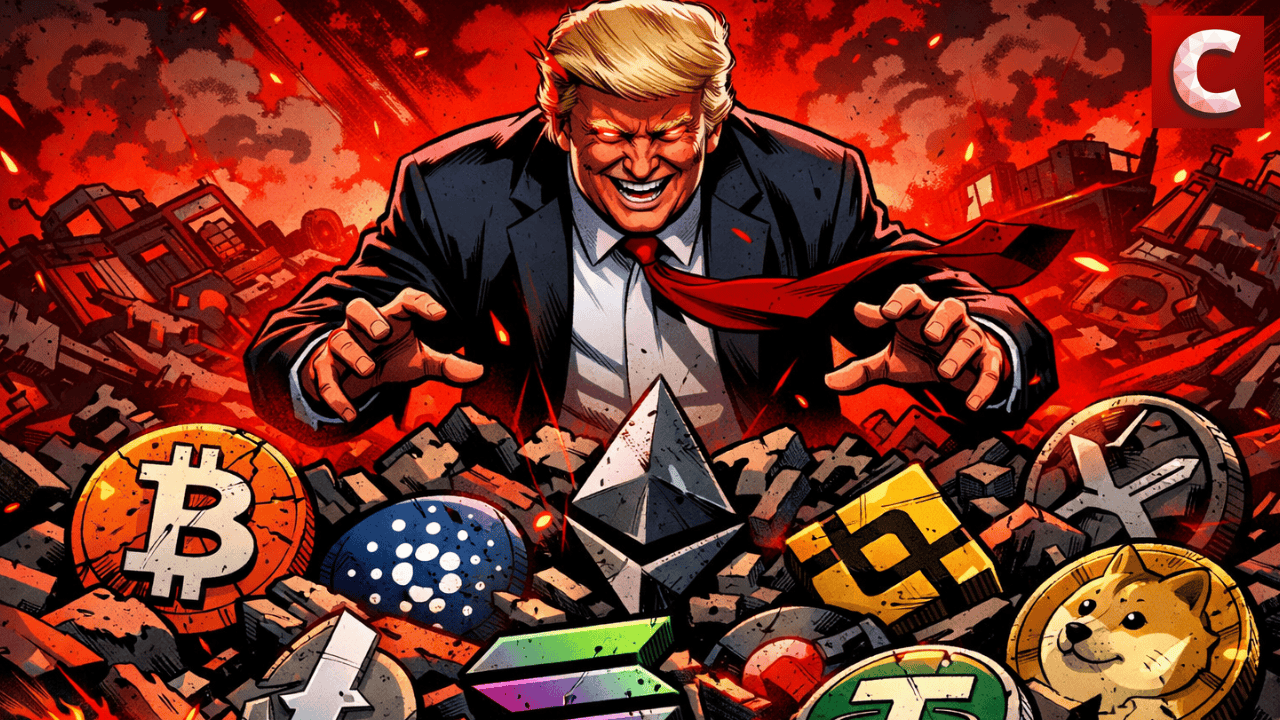
Since his return to the political spotlight, Donald Trump has positioned himself as a central figure in the crypto debate in the United States. Between pro-crypto speeches, family-backed projects, and legislative initiatives, he has become deeply polarizing. And for some observers in the industry, the conclusion is harsh: far from protecting crypto, Trump may have actually weakened its foundations.
Get an AI Summary of This Article
ChatGPTTo summarize
- The connection between Trump and crypto raises serious conflicts of interest.
- A new legislative proposal aims to block crypto profits for political leaders.
- For several experts, Trump’s political impact has damaged the credibility of the ecosystem.
Disillusionment from a major blockchain figure
When Charles Hoskinson speaks, it is never insignificant.
As the founder of Cardano and co-founder of Ethereum, he is one of the key figures who helped shape the modern crypto ecosystem.
And precisely because of that, his perspective on the recent evolution of crypto in the United States carries weight.
According to him, the crypto policy surrounding Donald Trump has failed to deliver on its promises.
Worse, it may have weakened the entire sector, not through open hostility, but through a series of poorly calibrated decisions.
At first, the intention seemed positive.
Less regulatory pressure, more openness, and finally a real dialogue with institutions.
But over time, that momentum deteriorated, eventually reaching a very specific breaking point in Hoskinson’s view.
And he identifies that moment clearly.
The TRUMP memecoin as a symbolic turning point
For Charles Hoskinson, the launch of the TRUMP memecoin is not a trivial episode.
He sees it as a powerful symbol of a shift, where crypto stops being perceived as neutral infrastructure and becomes a fully political object.
The issue is not simply the existence of yet another speculative token.
What raises concern is the direct association between a sitting president and a crypto asset, in a country that is already deeply polarized.
From that moment on, crypto ceases to be a technical or economic subject and becomes an ideological marker.
Hoskinson explains that this shift had an immediate impact on public debate.
For part of the American political class, crypto and Trump are now intertwined.
And in that context, any attempt at regulation becomes far more contentious, if not impossible to carry out on a bipartisan basis.
According to him, this dynamic has given easy arguments to crypto’s opponents, while discouraging those who were previously willing to support a clearer regulatory framework.
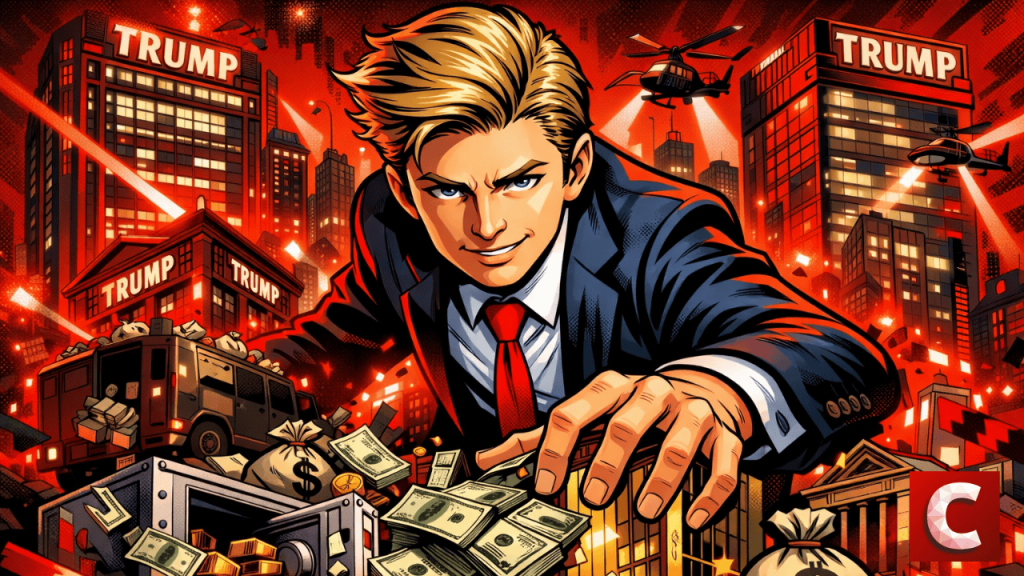
Has Donald Trump damaged crypto?
For a long time, Donald Trump cultivated the image of a crypto-friendly president. That pro-crypto stance was on display everywhere, Trump even preparing a major Bitcoin reserve announcement.
His positioning stood in contrast to previous administrations, which were often seen as too hostile or too slow to adapt to innovation.
But as more facts accumulate, that image is beginning to crack.
Because behind the favorable rhetoric, several signals have raised concerns within the community.
First, the direct involvement of the Trump family in crypto-related projects, through private structures, tokens, and financial initiatives that have generated significant revenue.
Then, a more political reality emerges.
Some of the legislative efforts supported or promoted under Trump have been perceived as benefiting specific actors, rather than fostering an open and competitive ecosystem. Proximity to power attracts requests, even Sam Bankman-Fried filing a pardon request to Trump.
And this is where the narrative shifts.
For some experts, the issue is not regulation itself, but the way it has become intertwined with private interests.
Also worth checking on Cryptonomic:
- More than half of cryptocurrencies are already dead
- Be careful if you hold the ONDO cryptocurrency
- Did the US government lose $40 million in Bitcoin?!
A bill that changes the landscape
It is within this context that a new legislative proposal has marked a turning point.
An amendment, introduced as part of the broader debate around crypto regulation in the United States, aims to prevent high-ranking political figures from personally profiting from cryptocurrencies while in office.
In practical terms, this could directly apply to Donald Trump.
The objective is clear.
To avoid any confusion between political power and personal enrichment, in an industry that is already fragile in terms of trust.
This proposal does not come out of nowhere.
It reflects growing concerns that regulatory decisions could be influenced, consciously or not, by direct financial interests.
For some observers, the initiative comes late.
But more importantly, it reveals a deeper issue: the credibility of crypto in the United States is now tied to ethical concerns that go far beyond the technology itself.

Conflicts of interest that are hard to ignore
The most sensitive issue remains the question of conflicts of interest.
The Trump family has been associated with several crypto initiatives generating substantial revenue, at the same time as the administration was working on key regulatory frameworks for the sector.
Even without proven wrongdoing, perception matters.
And that perception has fueled lasting distrust within the crypto community.
For many experts, this situation has sent the wrong signal.
That of an ecosystem where the rules could benefit those who write them.
This is precisely what the crypto movement has been trying to avoid for over a decade.
Saying that Donald Trump has “destroyed” the crypto ecosystem would likely be an exaggeration.
The technology still works. Networks are still running. Innovation has not stopped.
But for some observers, the real issue lies elsewhere.
The growing politicization of the sector, combined with suspicions of conflicts of interest and regulatory instability, has weakened trust, which is a fundamental pillar of any mature market.
This is not a sudden collapse.
It is a slow erosion, harder to measure, but very real.
And today, the debate goes far beyond Trump himself.
It raises a deeper question: can the United States regulate crypto without distorting it, supervise it without capturing it, and support it without exploiting it?
What happens next will depend not only on the laws that are passed, but also on how they are applied.
But one thing is certain: the American crypto ecosystem cannot rebuild without clearly defining the boundary between political power and private interests.
And that is precisely where the future of the sector now lies.
One of the most common criticisms raised by experts is this: political uncertainty has damaged the clarity of the American crypto market.
Every announcement, every rumor of legislation, every presidential statement has created waves of interpretation.
Not about the strength of the protocols, but about the true intentions of those in power.
For an ecosystem built on decentralization and neutrality, this creates a fundamental problem.
When crypto becomes a political tool, it loses part of its DNA.
Some industry players even believe that this period has slowed serious institutional adoption.
Not because of fear of the technology, but because of concerns about an unstable, shifting, and politicized framework.
And in the end, it is long-term users and investors who have paid the price.



Pingback: Trump Crypto Investors Lost at Least $4.7B - Cryptonomic