

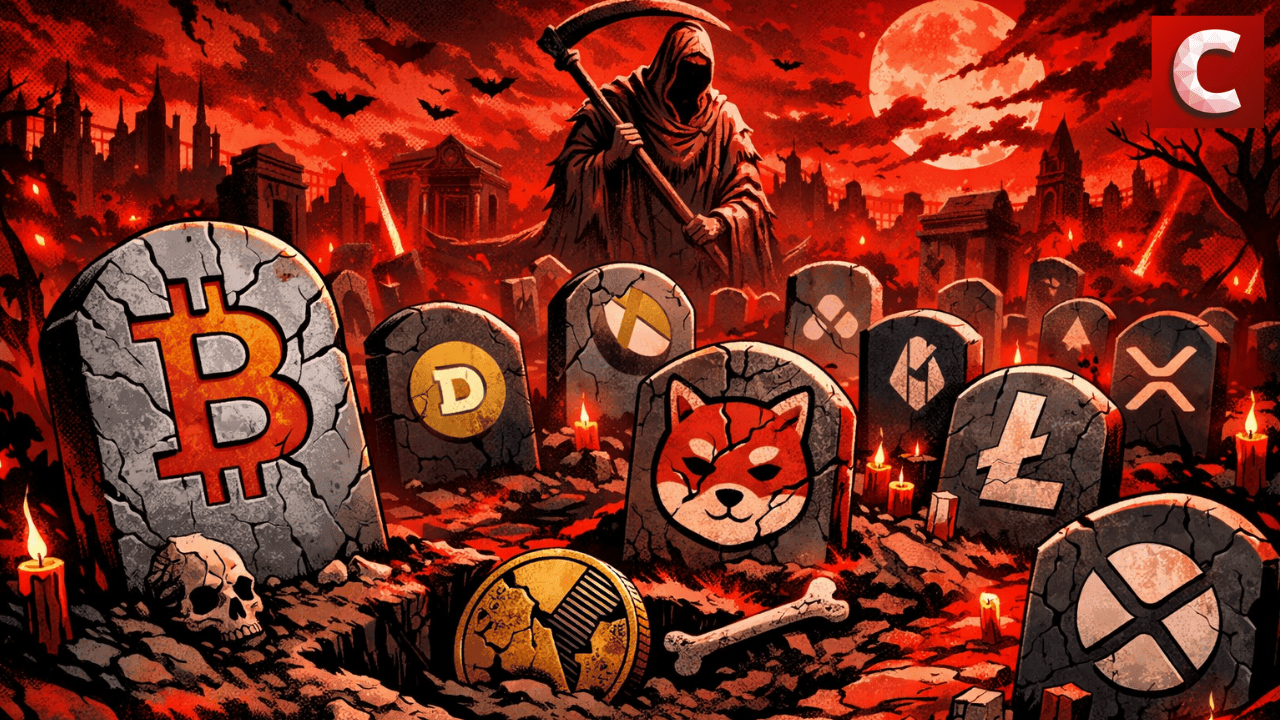
For a long time, people acted as if the crypto market was growing cleanly, project after project, use case after use case. But behind the scenes, most tokens never made it, sometimes not even for a few weeks. And 2025 acted as a brutal, almost statistical reality check on what many preferred to ignore.
Get an AI Summary of This Article
ChatGPTTo summarize
- More than half of the tokens launched since 2021 are no longer trading.
- The year 2025 accounts for the vast majority of observed failures.
- Token creation became too easy, and liquidity ultimately decided who survives.
A bloodbath, but above all a mechanism
The number is shocking, yes.
But more than anything, it reflects a simple reality: creating a token has become so easy that the market ended up looking like a highway with no speed limits, where there are too many vehicles and not enough fuel for everyone.
According to an analysis based on tokens listed on a major on-chain tracking platform, 53.2% of projects observed between 2021 and the end of 2025 are now considered dead, meaning they are no longer traded at all.
So this is not about a handful of anecdotal failures.
This is mass mortality in a market trying to stabilize. The skeptics feel vindicated, Elon Musk bluntly calling crypto a scam.
And the most telling detail is the distribution.
The year 2025 alone concentrates the majority of these disappearances, with 11.6 million tokens classified as failed during that single year, and the fourth quarter alone accounting for 7.7 million of those failures.
This is not just bad timing.
It is a saturation effect that eventually broke the system.

Why so many tokens disappear
The first reason can be summed up in one word: abundance.
Between 2021 and 2025, the number of listed projects went from around 428,000 to more than 20 million.
That alone sets the stage.
Too much supply, not enough sustainable demand, and a majority of tokens created without a real reason to exist.
Then there is the role of token factories.
Launchpads have made token creation almost instantaneous, sometimes in just minutes, following a very simple logic: launch, test, hope, and move on.
In that kind of system, failure becomes normal.
It becomes almost built into the process itself.
Another factor, more brutal: liquidity.
When the market is euphoric, even weak projects can survive for a while, because money flows freely and risk feels almost nonexistent.
But when the market tightens, selection becomes immediate. Even the larger names are not spared, Solana logging a 7th straight monthly decline.
Order books dry up, volumes shrink, and thousands of tokens quietly turn into ghost assets, often without making any noise at all.
Finally, there is the domino effect during periods of stress.
The analysis also links the acceleration of failures to a major market turbulence phase, including a cascade of liquidations that wiped out $19 billion in leveraged positions in just 24 hours. Those shakeouts echoed one of the worst months crypto had ever recorded.
In moments like these, the market stops thinking.
It cuts positions instantly.
And the weakest tokens are always the first to disappear.
Also worth checking on Cryptonomic:
- Why Is Vitalik Buterin Selling All His Ethereum?
- Be careful if you hold the ONDO cryptocurrency
- Did the US government lose $40 million in Bitcoin?!
A clear and unavoidable conclusion
The key takeaway is not that crypto is dying.
It is that the market has entered a new phase.
Today, being launched means nothing.
Being listed doesn’t mean much either.
But surviving, on the other hand, is becoming a signal in itself.
When millions of tokens appear and then disappear, overall performance becomes misleading, because most projects don’t live long enough to truly matter.
What we are seeing is a market that is growing in numbers, but concentrating in capital, where a small number of assets capture attention, liquidity, and ultimately credibility.
And in the end, one simple question remains.
If creation stays this easy, and liquidity remains this selective, will the next cycle actually save millions of tokens, or will it simply accelerate the same mechanism at an even larger scale?
We’ll come back to it on Cryptonomic.



Pingback: Elon Musk Says Crypto Is a Scam