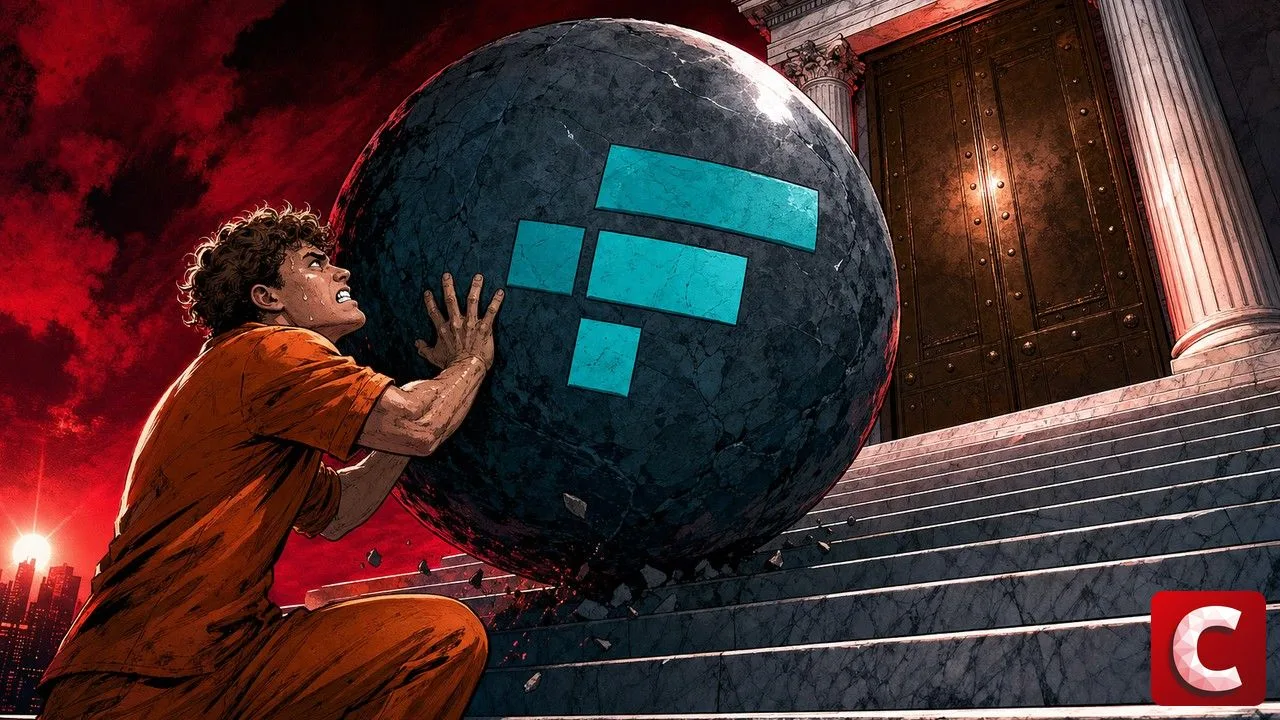
SBF has petitioned the US Supreme Court for a new trial and for the $11B forfeiture order against him to be thrown out. Sam Bankman-Fried, the FTX founder, has been serving a 25-year sentence since 2024, handed down after a conviction on seven counts spanning fraud, conspiracy and money laundering. A three-judge panel of the Second Circuit affirmed that conviction in June 2026. The petition goes after the conduct of the trial and the size of the financial penalty at the same time.
Key Takeaways
- SBF wants a new trial and the cancellation of an $11B forfeiture order.
- He claims the trial court blocked him from showing that FTX held enough assets to repay customers.
- The forfeiture is challenged under the Eighth Amendment, which bars excessive fines.
Get an AI Summary of This Article
ChatGPTSBF Attacks the Trial and the $11B in One Filing
The petition filed with the Supreme Court is not chasing one outcome. One half attacks the validity of the trial that produced the conviction. The other half attacks the amount of the forfeiture ordered at sentencing. The two rest on different legal grounds, which means either one could succeed on its own.
The procedural history is short. SBF was found guilty on seven counts covering fraud, conspiracy to commit fraud and money laundering. The sentence, delivered in 2024, runs to 25 years in prison.
Prosecutors argued throughout that billions of dollars left the FTX exchange for Alameda Research, the trading firm Bankman-Fried controlled. That money went into risky positions, political donations and personal spending.
The second half of the filing targets the $11B he has been ordered to hand back. The petition argues that the figure amounts to an excessive fine under the Eighth Amendment. That is a separate question from guilt, and it does not require overturning the conviction to land.
The timing follows from the calendar. In June 2026, a three-judge panel of the US Court of Appeals for the Second Circuit affirmed the conviction. With the ordinary appeal routes exhausted, the Supreme Court was the only door left.
One detail gets skipped in most commentary and it matters. The Supreme Court does not automatically take up the merits. It first decides whether to hear the case at all, and the overwhelming majority of petitions like the one SBF filed are turned away without any review of the substance.
Courts are not the only track in play. Back in June 2026, SBF had already filed a formal pardon request with Donald Trump, an executive-branch route that moves on its own timeline and owes nothing to the judiciary.
Running both at once has a logic to it. A pardon wipes out the criminal consequences without conceding any judicial error. A Supreme Court ruling would do the opposite. Only the second one restores any part of his account of what happened.

The Argument the Trial Court Kept Out: Illiquid, Not Insolvent
The heart of the petition is an accounting distinction that has turned into a legal question. SBF maintains that FTX and Alameda were temporarily illiquid in November 2022, while still holding enough assets to make customers and investors whole.
The complaint against the trial court follows from that. Lawyers for SBF say he was barred from putting the evidence for that claim in front of the jury. The argument is therefore not about how the facts were read, but about what the jury was never allowed to hear.
The filing adds something the original trial could not have known. It states that customers have since been repaid, and repaid with substantial interest. That assertion belongs to the defense document itself, not to any finding by a court.
In legal terms the split between illiquid and insolvent is not a word game. An illiquid firm runs short of ready cash against a wave of withdrawals. An insolvent firm owes more than it owns. Time fixes the first condition and never fixes the second.
The weak spot in the construction is easy to see. The money moved to Alameda belonged to exchange customers, and a repayment that arrived later says nothing about intent at the moment of the transfers. Crypto fraud cases decided over recent months, among them the guilty verdict against Rodney Burton in the $1.8B HyperFund case, show US courts weighing the mechanism rather than the closing balance.
For creditors, this part of the case is mostly symbolic. Recovery work runs through the bankruptcy court and does not hang on the outcome of a criminal petition. A win in Washington would not reopen how the estate is divided.
What is really at stake is the story rather than the money. Getting a court to accept that FTX was solvent would, for SBF, retroactively turn a fraudulent collapse into a liquidity accident, and that reading is exactly what the defense has pushed since day one.
Also on Cryptonomic:
- US Prosecutors Freeze $52M on a Telegram Scam Market
- MetaMask Splits From Consensys and Revives Token Talk
- MicroStrategy’s Bitcoin Treasury Sells to Pay Dividends
Kousisis Is the Precedent Blocking the Main Route
To affirm the conviction in June, the Second Circuit leaned on a recent decision from the Supreme Court itself. Kousisis v. United States, handed down in 2025, holds that conduct can amount to wire fraud even where the defendant never intended net economic harm.
Applied to FTX, that lands hard. If fraud does not require proof of net harm, then showing that assets covered liabilities no longer clears the offence. The defense loses most of its force the moment that precedent applies.
The problem for SBF is structural. He is asking the Supreme Court to walk back a reading the Supreme Court endorsed a year earlier. Courts rarely revisit a precedent that fresh, and the calendar works against him here.
The forfeiture question sits on looser ground. US law puts no number on the point at which a sum becomes an excessive fine, and the issue keeps coming back to the higher courts. That is the half of the petition with a realistic chance of drawing attention.
The wider backdrop offers the defense no comfort either. US authorities have hardened their handling of illicit crypto flows, and moves such as the $52M freeze on a Telegram-hosted marketplace point to a doctrine that favours wide seizure over finely calibrated penalties.
Over the coming months the pivot will be procedural before it is legal. The Court will say whether it takes the case, and that decision alone carries a signal. A refusal would close the judicial route for SBF for good and leave the pardon as the only remaining path.
For the industry, the stakes run past one man. Were the Court to take up the net-harm question, it would reopen a debate touching every prosecution brought against a platform that kept operating while out of balance. Plenty of live cases are watching this filing for that reason.
Follow the story on Cryptonomic.