

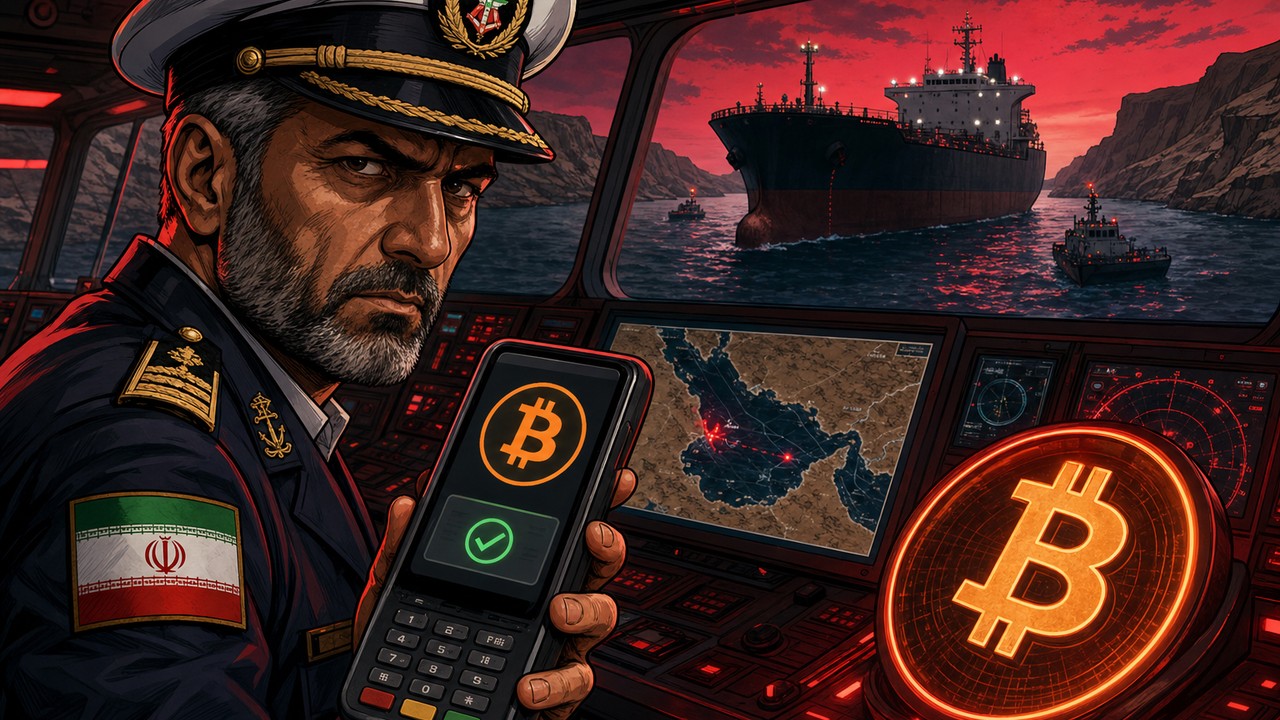
Iran’s economy ministry is working on a platform called Hormuz Safe: maritime insurance for oil tankers transiting the Strait of Hormuz, with premiums settled in Bitcoin. The goal is explicit: generate revenue outside the dollar system, where U.S. sanctions lose their grip. Iran is reportedly demanding up to $2 million per vessel. CoinDesk could not verify whether the platform is already live, but its technical framework is documented.
Key Takeaways
- Iran is building Hormuz Safe, a Bitcoin-settled maritime insurance platform for tankers crossing the Strait of Hormuz
- The charge can reach $2 million per vessel, calculated at $1 per barrel of oil
- Any operator using the platform faces real U.S. sanctions exposure
The Strait of Hormuz as a Bitcoin Revenue Stream
Twenty percent of global oil traffic passes through the Strait of Hormuz. For Iran, that geographic chokepoint is a substantial lever, and for months Tehran has been looking for ways to monetize it without going through traditional banking circuits, which U.S. sanctions have cut off.
The first monetization attempts surfaced in early April 2026. The Financial Times reported that Iran was demanding cryptocurrency payments for tankers to cross the strait, with amounts potentially reaching $2 million per vessel. Shortly after, scammers moved in: unidentified entities demanded Bitcoin and USDT transit fees from shipowners, and at least one vessel was reportedly conned. The full picture is available in the State Department’s proposal to secure the Strait of Hormuz.
Hormuz Safe follows the same logic with a more sophisticated wrapper. Rather than a direct toll, which would be politically awkward to justify, the platform offers “insurance.” On paper, shipowners are not paying for passage; they are buying coverage for their cargo in waters Tehran claims it can secure.
Bitcoin is the natural instrument for this operation. Censorship-resistant, not confiscable by U.S. executive order, and settleable without bank intermediaries, it answers each constraint imposed by the sanctions regime. Iran has already been using cryptocurrencies for oil exports for several years, making Hormuz Safe less of a rupture than a formalization.

How Hormuz Safe Works
The operational process described in sources is precise. Cargo owners notify Iranian authorities of their shipment details by email. The premium is then calculated at $1 per barrel of oil. Once Iran completes its assessment, the shipowner has a few seconds to pay in Bitcoin.
In return, the platform issues a cryptographically verifiable insurance policy, activated upon payment confirmation. A signed digital receipt is transmitted to the cargo owner. The whole process runs without bank intermediaries, without dollars, without SWIFT.
Policies would cover vessels transiting the Persian Gulf, the Strait of Hormuz, and surrounding waterways. Full policy terms, exclusions, and claims procedures are not yet public. The platform currently appears to show only a landing page without complete documentation. CoinDesk could not confirm whether Hormuz Safe is operational or whether any shipowner has used it.
That ambiguity may be deliberate. Float the concept, gauge the reaction from markets and governments, then deploy once the response has been measured. The strategy looks more like a market test than an official launch.
Also on Cryptonomic:
- Strategy Buries « Never Sell »: Saylor Rewrites the Bitcoin Treasury Playbook
- Chainlink Wins Big: Kraken Dumps LayerZero After $292M Hack
- XRP Goes Solo: Whale Accumulation Record, ETFs on Fire and JPMorgan
A Sanctions Risk for Operators, a Strong Signal for Bitcoin
For shipowners and traders, the legal picture is unambiguous. Dealing with any Iran state-linked entity, even via Bitcoin, creates exposure under U.S. sanctions law. Payments to sanctioned Iranian entities remain illegal whether they flow through banks, stablecoins, or Bitcoin. Any serious operator would need a full legal review before considering Hormuz Safe.
In the short term, institutional shipowners are unlikely to take the risk. The legal exposure in the U.S. is real, and traditional insurance companies cannot co-sign such an arrangement. However, operators with less exposure to Western regulation, particularly in Central Asia and the Far East, may apply less rigorous compliance standards.
Over the medium term, if Hormuz Safe gains real adoption, it would be a strong signal for the thesis of Bitcoin as a reserve currency for sanctioned states. After Russia, North Korea, and Venezuela, Iran would confirm that Bitcoin has become the financial infrastructure of last resort for regimes cut off from the dollar system. That precedent would significantly reinforce the “censorship-resistant money” narrative championed by Bitcoin maximalists for years, and give it concrete geopolitical reality.
Tensions in the Strait of Hormuz are escalating. This is not only an oil story. It is a Bitcoin story.
Follow the story on Cryptonomic.



Pingback: US Treasury Sanctions an Iranian Bitcoin Exchange - Cryptonomic