
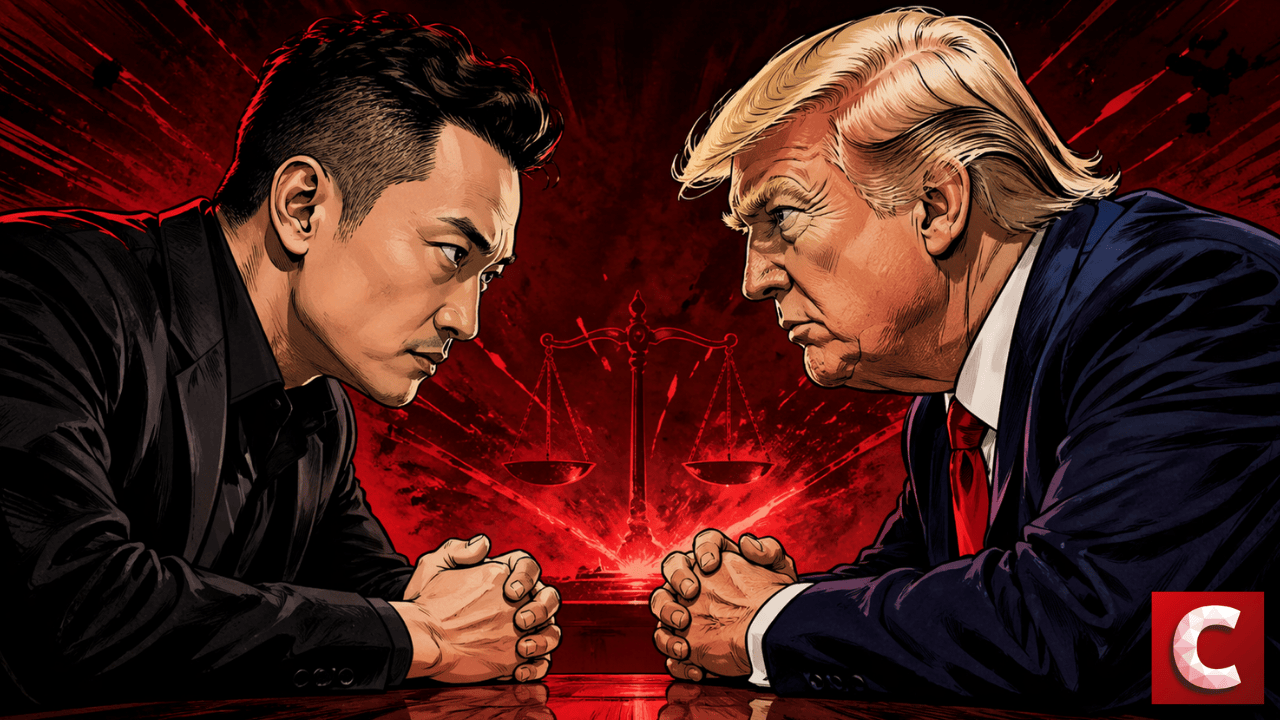
Tron founder Justin Sun filed a federal lawsuit in California on April 22 against World Liberty Financial, the crypto project backed by the Trump family. Sun, who invested $75 million in WLFI, accuses the team of unlawfully freezing his tokens, stripping his voting rights, and threatening to permanently burn his assets. WLFI’s response was immediate: “See you in court.”
Key Takeaways
- Justin Sun invested $75 million in WLFI between November 2024 and January 2025
- WLFI froze his tokens, revoked his governance rights, and threatened to burn them
- Lawsuit filed April 22 in a California federal court
Get an AI Summary of This Article
ChatGPTA $75 Million Investment, Then a Token Freeze
Justin Sun invested $30 million in World Liberty Financial in November 2024, shortly after the project’s launch. He announced an additional $45 million tranche in January 2025, bringing his total commitment to $75 million.
Sun became the single largest individual investor in WLFI, a project presented by the Trump family as a flagship DeFi platform and a showcase for the administration’s pro-crypto stance.
The relationship deteriorated quickly. World Liberty Financial blacklisted an Ethereum wallet linked to Justin Sun after he transferred WLFI tokens from it, then froze his entire holdings in the protocol.
Sun alleges that WLFI embedded a privileged backdoor in the token’s smart contracts, giving a single entity the ability to unilaterally freeze any holder’s assets without consent or public justification.
The official rationale cited by WLFI for the freeze involves KYC irregularities.
Sun disputes this and frames it as retaliation for refusing to keep investing and for declining to mint WLFI’s USD1 stablecoin on the team’s terms. In his account, it was his refusal to act as the project’s “personal ATM” that triggered the measures taken against him.
WLFI-linked wallets reportedly deposited approximately 5 billion WLFI tokens on the Dolomite protocol, borrowed $75 million in USD1 and USDC, and transferred more than $40 million to Coinbase Prime.
Sun cites these operations as evidence that the protocol is being used in ways that run counter to the interests of token holders.

The April 15 Governance Proposal: Escalation
The immediate trigger was a governance proposal submitted on April 15. WLFI proposed locking founder and advisor tokens for two years, followed by a gradual release over three additional years, alongside burning 10% of advisory tokens. Holders unwilling to accept the new terms would face indefinite lockup.
Justin Sun denounced the proposal as an “absurd governance scam” and challenged the concentration of voting power within the protocol.
According to his statements, 76% of WLFI voting tokens are held by just ten wallets, making any organized resistance by minority holders structurally impossible against a majority already controlled by the founding team.
Sun further alleged that WLFI structured its governance infrastructure around a single externally owned account holding guardian rights over the multisig, giving one entity unilateral power to freeze any token holder without going through a governance vote.
This architecture, he argues, is what made the arbitrary freeze of his holdings possible.
World Liberty Financial’s response to these accusations was blunt. In a statement published in April, the team declared: “We have the contracts. We have the evidence. We have the truth. See you in court.” Sun’s April 22 filing follows that exchange directly.
Also worth checking on Cryptonomic:
- Why Is Vitalik Buterin Selling All His Ethereum?
- Be careful if you hold the ONDO cryptocurrency
- Did the US government lose $40 million in Bitcoin?!
Implications for WLFI and Politically Connected Crypto Projects
The federal complaint exposes World Liberty Financial to a lengthy and public legal proceeding.
he allegations cover token freezing, governance exclusion, threatened token burning, and a threat to report Sun to US authorities over disputed KYC issues.
The legal stakes reach far beyond the $75 million invested if smart contracts containing undisclosed privileged access come under judicial scrutiny as part of the case.
In the short term, the dispute puts WLFI in a difficult position at the precise moment the Crypto Clarity Act is advancing in the Senate. Lawmakers and regulators looking to distinguish serious institutional actors from opportunistic structures will scrutinize politically connected projects closely.
A public federal lawsuit between WLFI and its largest individual investor does not help that positioning, and the direct association with the Trump family ensures every development receives outsized media attention.
For other WLFI token holders, the case raises an immediate practical question: if smart contracts allow a unilateral freeze that bypasses governance votes, what protection do they actually have over their assets? How WLFI responds to this question will shape market confidence well beyond the Sun dispute alone.
Over the medium term, this episode is part of a broader debate about investor protections in politically connected DeFi projects. US courts could establish a precedent on the legitimacy of freeze mechanisms embedded in smart contracts, with direct implications for any protocol using architectures similar to WLFI’s. The saga feeds a wider critique, some arguing Trump has damaged the crypto ecosystem.
Follow the story on Cryptonomic.