

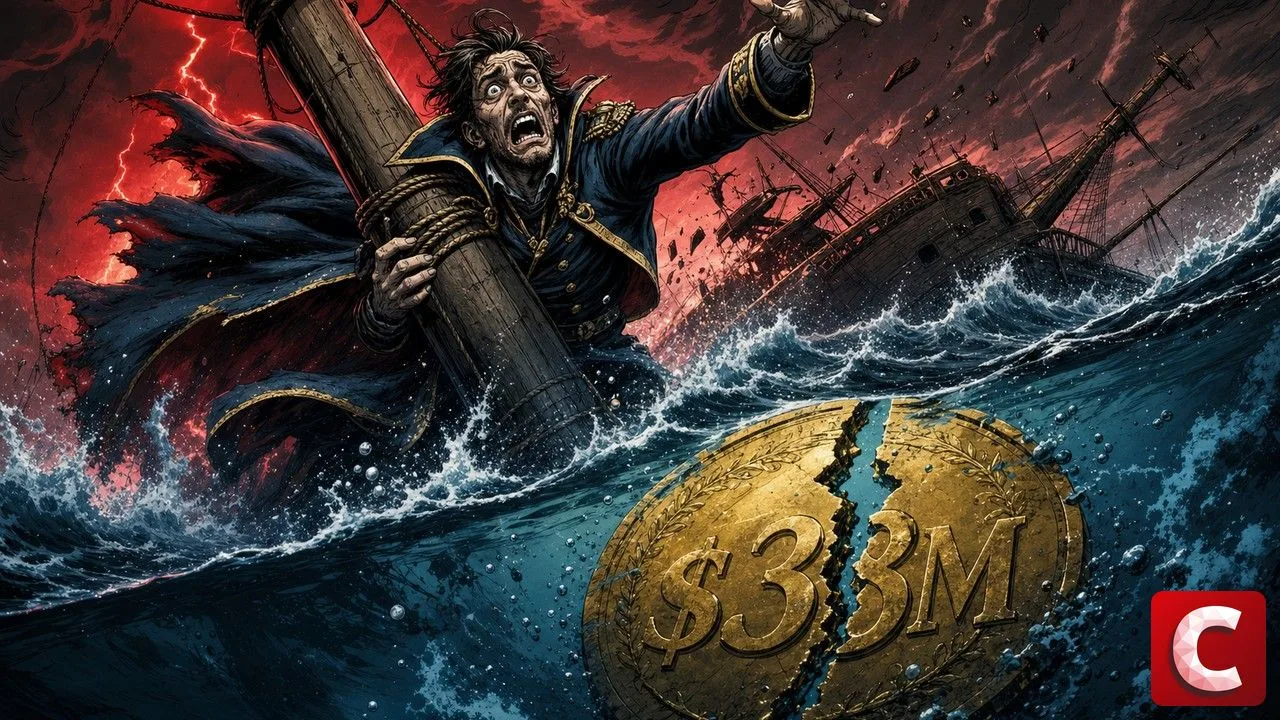
Movement Labs filed for Chapter 11 bankruptcy on July 21, 2026, eighteen months after the botched launch of its token. The filing shows less than $500,000 in assets against liabilities north of one million dollars. The largest unsecured claim belongs to ousted co-founder Rushi Manche. The move closes the book on one of the most talked-about market-making scandals of the last cycle.
Key Takeaways
- Movement Labs enters Chapter 11 bankruptcy, with assets under $500,000 and liabilities above one million dollars.
- The top claim, more than $1.6M, belongs to Rushi Manche, the co-founder pushed out in 2025.
- The whole affair traces back to a sale of 66 million MOVE that triggered a $38M selloff at launch.
Get an AI Summary of This Article
ChatGPTA Balance Sheet Under $500,000 Against Seven-Figure Debt
The petition was filed on July 21, 2026 in Delaware under U.S. Chapter 11. The document lists fewer than 1,000 creditors, assets between $100,000 and $500,000, and liabilities well past the million-dollar mark. For a project that still carried a nine-figure valuation at the peak of the last cycle, the gap measures the scale of the collapse.
The largest unsecured claim belongs to co-founder Rushi Manche, for an amount above $1.6M. The Delaware Division of Revenue and custodian Anchorage Digital also appear on the list. Notably, Manche kept a 34.25% equity stake in the company after his exit, which puts him among both the creditors and the shareholders of the sinking ship.
Chapter 11 sets up a reorganization rather than a straight liquidation. On paper, the entity can try to restructure its debt and start again. In practice, once the token that carried the entire investment thesis has already lost most of its value, the room to maneuver is thin, in a market where other major altcoins have also sold off hard. The bankruptcy reads more like an administrative death certificate than a pause before a rebound.
Movement is far from alone this cycle. The list of teams that wound down for lack of durable revenue keeps growing, and each filing is a reminder that cash on hand matters more than a technical promise. The market has ended up sorting projects on their ability to produce something beyond a narrative.

66 Million MOVE Sold in a Day, the Original Fault Line
It all starts in December 2024. The MOVE token makes its debut, and the very next day a market-making deal hands an obscure intermediary control of 66 million tokens. The sale that follows triggers a $38M selloff and breaks the price barely after birth. What was meant to smooth the market ended up draining it.
The investigation that opens in spring 2025 uncovers a chain of intermediaries, including the firm Rentech and Chinese market maker Web3Port. Movement Labs says it was misled about the real nature of the deal, which gave a third party near-total control over a huge share of the circulating supply. Doubt then settles over the project’s internal governance.
The rest unfolds fast. In spring 2025, Rushi Manche and Movement Labs part ways, Binance bans the market-making account at the center of it, and the foundation launches a token buyback to try to steady the ecosystem. None of these steps restore the trust MOVE had lost, a fate shared by other tokens that never bounced back after a brutal drop.
This pattern is nothing new. Another token walked a similar path when a coin tied to an ambitious protocol crashed after a breach, leaving holders staring at raw losses. In both cases, the distribution mechanics came before the fall, and retail settled the bill last.
Also on Cryptonomic:
- Liquid Staking Explained: How It Works and the Risks
- JPYC: Logistics Firm Pays 2,300 Drivers in Stablecoin
- Bitcoin Volatility Falls Back to Its Usual Floor at 38%
What Movement’s Bankruptcy Says About Young L2 Risk
By June 2026, technical development had shifted to Move Industries, led by Torab Torabi, with a stated pivot toward stablecoin payments and a sovereign Layer 1 aimed at emerging markets. That entity stresses that it is not a party to the Movement Labs bankruptcy. The brand survives in theory, but cut off from the structure that carried the debt.
In the short term, MOVE holders take the hit. A token whose historical issuer files for bankruptcy loses its main engine of communication and development, and liquidity tends to dry up a little more with each announcement. The foundation’s buyback carries little weight against an open bankruptcy case.
In the medium term, the episode will shape how the market views young Layer 2s. Opaque market-making deals, long treated as a technical footnote, become a checkpoint investors scrutinize before any entry. Transparency about who holds what, and under which terms, turns into a survival criterion.
The paradox is that the sector is not short on money. Crypto apps still pulled in record fees despite the market drop, proof that real usage exists. Movement’s bankruptcy simply reminds everyone that usage cannot be declared from a whitepaper, it is built before the token launches, not after.
Follow the story on Cryptonomic.