

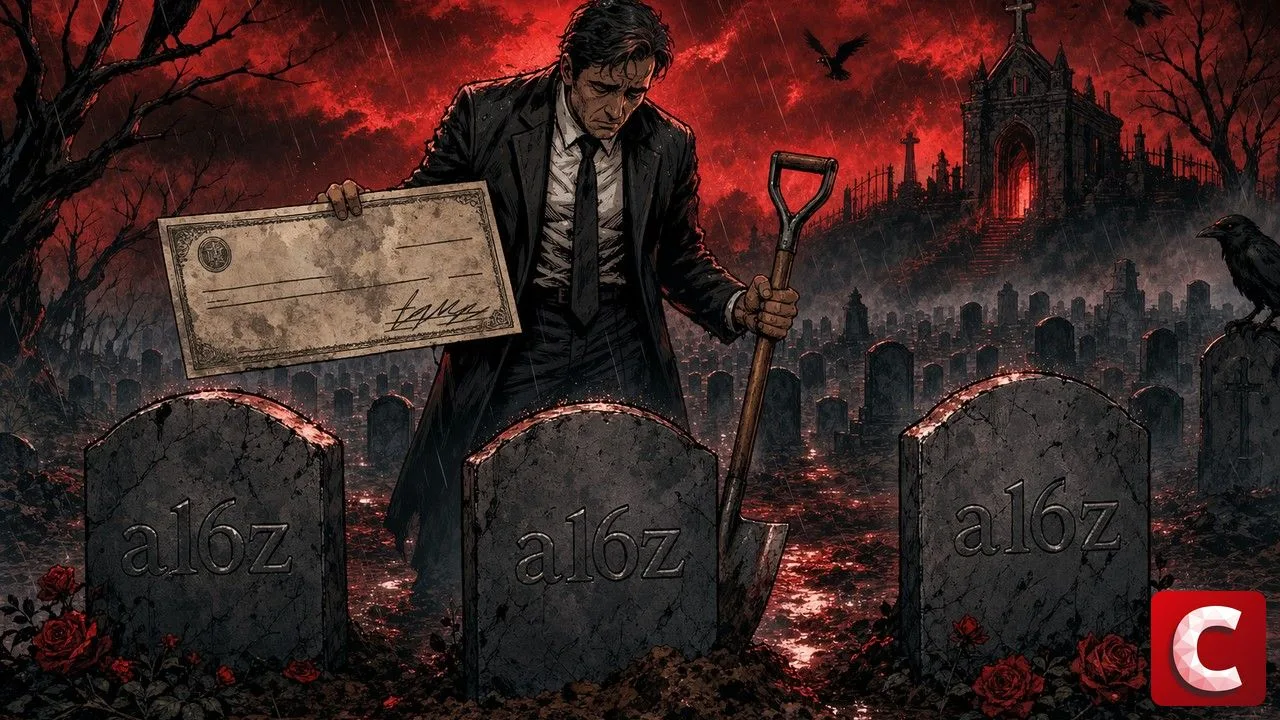
According to Rootdata, more than 60 crypto projects have announced their closure since the beginning of 2026, ten of which had raised over 10 million dollars. Three of those failures hit Andreessen Horowitz directly, the most active VC fund in the sector. The lesson is brutal for the LPs who thought the a16z signature guaranteed a trajectory. This year reminds the entire industry that no capital actually buys adoption.
Key Takeaways
- More than 60 crypto projects shut down between January and June 2026 according to Rootdata
- Three of the biggest casualties were backed by a16z (Yupp, Syndicate, Entropy)
- Cited causes combine security flaws, lack of adoption, and regulatory pressure
Get an AI Summary of This Article
ChatGPTA grim half year for crypto venture
The Rootdata count through late June 2026 leaves no room for spin. More than 60 crypto projects have announced their closure since January 1st. Ten of them had a serious financial track record, with more than 10 million dollars raised on private markets over the past two to three years.
The profile of the dead projects says a lot about the state of the sector. These are not anecdotal launches run by anonymous founders. They are companies that secured Series A and B rounds, sometimes alongside top tier co-investors, and whose pitches were on every major crypto conference circuit as recently as 2024.
The most uncomfortable data point hits the most visible name in the venture stack. Three of the biggest closures are direct Andreessen Horowitz investments, the firm that crypto media has long treated as the reference filter for institutional capital in the sector.
Yupp had raised 33 million dollars before shutting down, citing both regulatory and security challenges. Syndicate had secured 27.8 million dollars before realizing the absence of traction on its target market. Entropy is winding down with 26.95 million dollars on its books. Together those three lines erase more than 87 million dollars of capital deployed under the a16z signature.

The real causes behind the announcements
The reasons quoted by founders converge on the same structural diagnosis. Security breaches and exploits sit at the top. Several teams saw their real traction collapse after an on-chain incident, never recovering the user trust nor the acquisition rhythm they enjoyed before the event.
User adoption gaps are the second silent killer. Products that were technically remarkable saw their usage metrics plateau at a few thousand active addresses, far below the threshold that justifies a Series A valuation. The extended bear market made the picture worse by drying up the speculative liquidity that was artificially propping up vanity curves.
Regulatory pressure rounds out the trio. MiCA requirements in Europe, fragmented stablecoin frameworks in the United States, and the stricter Japanese rules have forced some teams to choose between a costly overhaul and a strategic retreat. Several picked the retreat.
A revenue base too thin to cover costs closes the diagnostic. Many projects were betting that a future token launch would serve as monetization lever. When the crypto environment tightens and listings become rare, the equation collapses without a fallback.
Industry commentators summed up the dynamic in plain words. No check, however large, buys the survival of a product that nobody uses. The line stings, but it captures with precision the mechanics observed across the 60 closures of the year.
Also on Cryptonomic:
- CZ Blames Crypto’s 2026 on AI, War and 4-Year Cycle
- XRP Plunges to $1.01, Down 43% Since January
- Tether Overtakes Ether at $186B Market Cap
What it means for holders and LPs
For holders sitting on tokens issued by those projects, the risk goes beyond a simple price drop. Several closures triggered an abrupt halt of product support, the loss of access to essential infrastructure, and in some cases the abandonment of on-chain liquidity. Recovery becomes complicated even when the tokens technically remain in a wallet.
For the LPs who finance crypto funds, the message is heavier. The triple wipeout of Yupp, Syndicate, and Entropy under the a16z umbrella signals that even the most respected name in the sector does not shield against execution risk. A meaningful share of the capital deployed in 2023 and 2024 has not survived the exit from the bull cycle. The expected return tables on 2023 vintage funds will have to integrate this disaster.
The dynamic will weigh on the next wave of funding rounds. VCs who need to justify their thesis to institutional LPs will need harder criteria than a capital signature alone. The discipline coming back to crypto investment committees mirrors what is observed in traditional venture after a major setback (rarely a good signal for fundraising cadence).
2026 did not invent crypto startup failure. The HyperFund case and Rodney Burton’s $1.8 billion fraud verdict already reminded the market that the sector also produces spectacular implosions. What is new is the concentration of closures on a single fiscal year and the simultaneous pressure from the three forces described above.
For the reader looking for a directional signal, the conclusion fits in a few words. Crypto venture is tightening. The survivors will be those who already hold users, revenue, and a regulatory framework that holds up. Everyone else will have to prove a lot more before the next check.
Follow the story on Cryptonomic.