

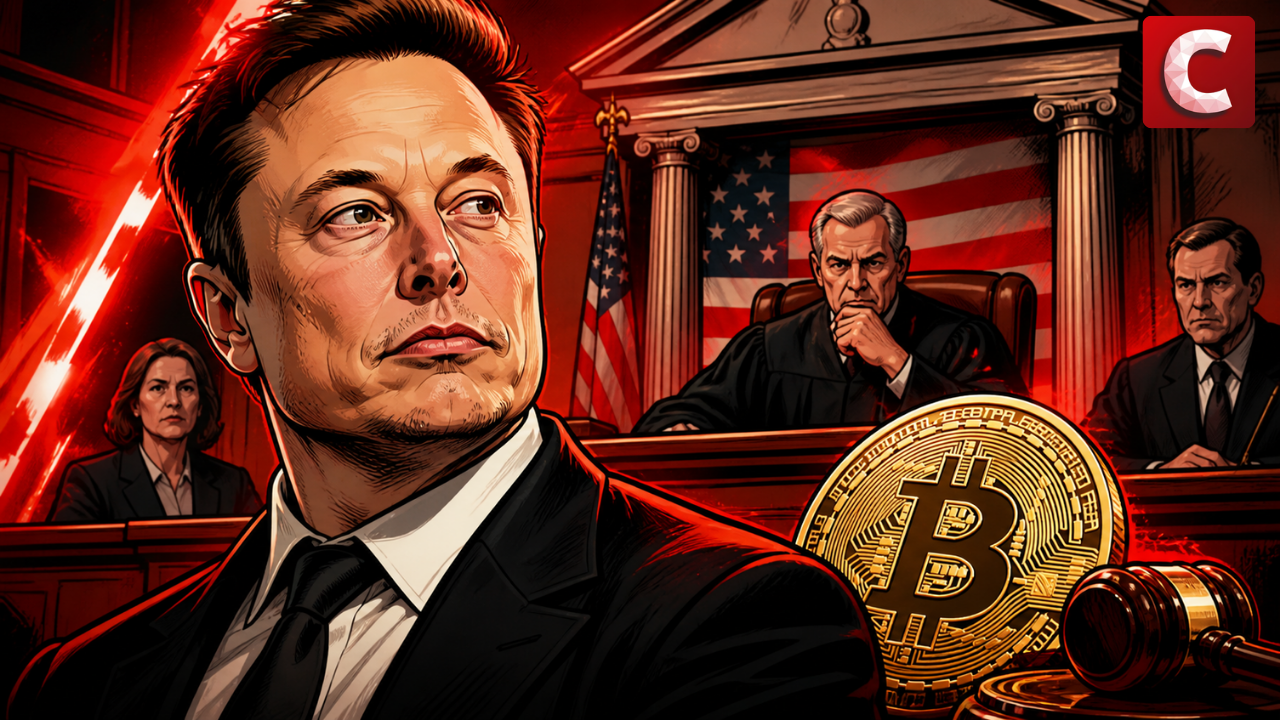
On April 30, 2026, Elon Musk testified before a jury in Oakland as part of his lawsuit against OpenAI. Asked about a failed ICO project from 2018, he dropped a line that immediately made the rounds across the industry: “Some of them have value, but most are scams.” The statement stands in sharp contrast to years of public support for the crypto space.
Get an AI Summary of This Article
ChatGPTTo summarize
• Musk told a jury that “most cryptos are scams”, during his lawsuit against OpenAI.
• Tesla still holds 11,509 BTC despite selling 75% of its reserves in 2022.
• At the same time, X was deploying Cashtags, a crypto trading tool built into the platform.
“Most of them are scams”
The statement comes out of a very specific legal context.
Elon Musk is on the stand in his civil lawsuit against OpenAI, the organization he co-founded in 2015 and accuses of betraying its founding mission by partnering with Microsoft and developing commercial products. During his deposition, a lawyer questions him about a 2018 episode: Sam Altman’s proposal to raise funds through an initial coin offering.
Musk had rejected the idea at the time without ambiguity, saying it would “simply result in a massive loss of credibility for OpenAI and all people associated with the ICO.” It is in this context that he made the statement reported by New York Times journalist Mike Isaac: “Some of them have value, but most are scams.”
OpenAI disputes the account and claims Musk supported the ICO project, which would have required the creation of a for-profit subsidiary. The jury trial is expected to last approximately three weeks.

A reversal with a history
This statement does not come out of nowhere. It fits into a gradual and well-documented shift.
Between 2020 and 2021, Musk is one of the most influential public supporters of crypto. His tweets about Dogecoin repeatedly send the meme coin to new highs. Tesla acquires $1.5 billion in Bitcoin in 2021, one of the first institutional investments of this scale to appear on the balance sheet of a major publicly traded company. Musk also confirms holding Bitcoin, Ethereum, and Dogecoin personally.
The turning point comes in 2022. Tesla sells approximately 75% of its Bitcoin reserves, with no detailed public explanation. The position is not fully liquidated: as of Q1 2026, the company still holds 11,509 BTC, valued at $879 million, after an accounting depreciation of $222 million.
Since then, Musk’s public statements on crypto have become rarer and more ambivalent. His declaration before the Oakland jury is the most direct he has made in years.
Also worth checking on Cryptonomic:
- Why Is Vitalik Buterin Selling All His Ethereum?
- Be careful if you hold the ONDO cryptocurrency
- Did the US government lose $40 million in Bitcoin?!
X launches Cashtags at the same time
The contradiction is hard to ignore.
The very day Musk calls most cryptos scams in a courtroom, his platform X deploys Cashtags. Nikita Bier, X’s head of product, announces the feature: stock and crypto $tickers become clickable real-time charts, accompanied by asset-specific post feeds.
The tool is presented as a way to position X as a central trading terminal. Anti-scam mechanisms are built in: smart contract address verification, account locking for new crypto posters. The stated goal is to filter out fraudulent tokens before they reach users.
This deployment is part of a broader financial strategy for X, which also includes payment features and trading functionality currently in pilot phase.
The distinction Musk is drawing is the following. He believes most cryptos are scams. But X is building a tool to make trading them easier, with filters designed to protect users from bad actors. The data lends him some cover, more than half of all cryptos already dead.
These are two positions that are not necessarily contradictory, as long as the tool is understood as being built precisely to separate the legitimate from the fraudulent.
Follow the story on Cryptonomic.



Pingback: More Than Half of Cryptocurrencies Are Already Dead