


Swapping bitcoin into stablecoins could trigger French capital gains tax from January 1, 2027. On October 16, the National Assembly adopted a stablecoin tax amendment that ends the deferral these swaps enjoy today, by 38 votes to 37. The formal vote on the revenue section of the 2027 budget, set for October 20, was then pushed back, so the measure is still pending.
Key Takeaways
- French lawmakers passed a stablecoin tax amendment by 38 votes to 37 on October 16.
- Gains would be taxed at the swap for operations from January 1, 2027.
- The formal vote on the budget’s revenue section, due October 20, was postponed.
Get an AI Summary of This Article
ChatGPTHow the Stablecoin Tax Passed by a Single Vote
Amendment I-3898 was adopted on Friday, October 16, during the debate on the first part of France’s 2027 finance bill. It was tabled by Nicolas Sansu, a member of the Democratic and Republican Left (GDR) group, together with sixteen co-signers.
Under article 150 VH bis of the French tax code, the gain on a swap between two crypto assets is deferred until the holder converts into euros or buys something. The text of amendment I-3898 published by the National Assembly removes that deferral for swaps that end in e-money tokens as defined by the EU’s MiCA regulation, the same framework under which the AMF gave crypto firms serving France until June 30 to secure a MiCA license.
The gain would then fall under France’s 31.4% flat tax, the same treatment as a sale into euros. The official transcript of the October 16 sitting records the example Sansu gave: a bitcoin bought for €180 ten years ago and swapped for a dollar-backed stablecoin such as Tether’s. He put the untaxed gain on that single trade at €74,000.
Only one vote separated the two camps. The official breakdown of public vote 8836 on the Sansu amendment shows 100 deputies voting, 75 votes cast, 38 in favor, 37 against and 25 abstentions. All 25 abstentions came from the National Rally, while 10 other National Rally members voted against.
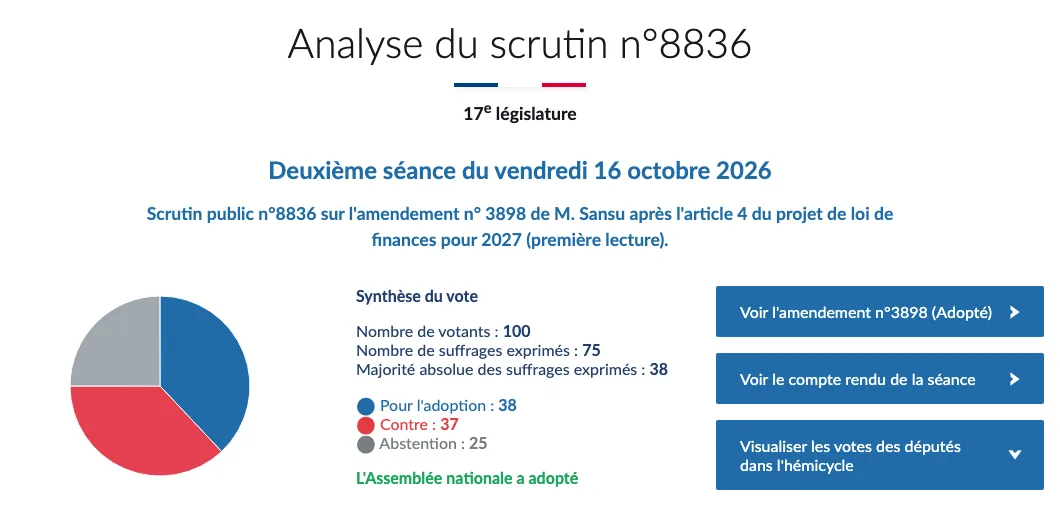
Most of the support came from La France insoumise (12), the Socialists (9), the Ecologists (8), the Democrats (4) and the GDR (3). Olivia Grégoire, the only yes vote from Ensemble pour la République, later said she had meant to vote against. Her vote still counts in favor in the published result.

Why the Minister Sees the Stablecoin Tax as Too Complex
Public Accounts Minister David Amiel asked for the amendment to be withdrawn and gave an unfavorable opinion otherwise. He conceded that crypto assets can be used for money laundering, but said the debate was not ripe yet and that the stablecoin tax would be too complex to apply as written.
His first objection is about definitions. Not every stablecoin is stable, whatever the name suggests, Amiel argued, pointing to pegs that sometimes fail. Before taxing anything, he wants the administration to define these tokens and to be able to trace a reallocation from crypto into stablecoins inside a single portfolio.
Philippe Juvin, general rapporteur of the finance committee, noted that the committee had adopted the stablecoin tax amendments. Speaking for himself, he called the deferral relevant given how volatile cryptocurrencies are.
The definition fight is already running at the European level. The ECB wants to ban multi-issuance stablecoins, arguing that MiCA does not allow them, while the European Parliament voted the other way. Sansu answered in the chamber that MiCA only authorizes stablecoins that are actually stable.
Fraud came up again and again in the stablecoin tax debate. Charles de Courson, who wrote the report of the parliamentary inquiry into the taxation of high wealth chaired by Jean-Paul Mattei, said 20,000 taxpayers declared €400 million in taxable crypto gains for 2021. Gains realized in France that year came to roughly €3.5 billion, based on the figures given to the report’s authors.
Courson put fraud at 90% of the total gains realized. He backs an amendment that would require crypto holders to report the value of their portfolio every December 31 from €100,000 in holdings, a threshold he said could drop to €50,000.
Sansu, for his part, estimates annual stablecoin flows at €2.1 trillion worldwide, €450 billion in Europe and €50 billion in France. He also says fewer than 1% of French holders declare their digital assets. Amiel reminded the chamber that assets already have to be reported on tax returns, an obligation some taxpayers ignore.
Both authors of the stablecoin tax amendments cite Italy and the United Kingdom as examples. London is adapting its rules and has settled on a tax deferral for DeFi loans and liquidity pools from April 2027, while Germany is scrapping its one-year crypto tax exemption from January 2027.
Also on Cryptonomic:
- South Korea Blocks 27 Crypto Platforms Including KuCoin
- Tampered Ledger Devices Cost Buyers Over $86M
- Seized Bitcoin: US Government Moves 833.6 BTC
What the Delay Means for Holders Before 2027
The formal vote on the first part of the budget, scheduled for Tuesday, October 20, did not take place. On October 16, National Rally deputy Emeric Salmon had already warned in the chamber that 3,015 amendments remained on that part. The Assembly has moved on to the Social Security budget, due to wrap up by October 27, before returning to revenue.
For anyone holding stablecoins, nothing changes yet. The stablecoin tax targets disposals and swaps from January 1, 2027, and it still has to clear the revenue vote, the overall first-reading vote due by November 17, and then the Senate.
A rejected revenue section would wipe the amendment out. The bill could then reach the Senate in the government’s original version, without any of the amendments adopted by deputies.
The stablecoin tax amendment also rewrites how gains are computed. The acquisition price would become the weighted average cost of crypto assets of the same kind, replacing today’s method based on the total acquisition price of the whole portfolio.
For assets bought before 2027, holders get two options: use the actual price of each asset, backed by any proof, or split the portfolio’s total acquisition price at December 31, 2026 in proportion to each asset’s value. That choice covers the entire portfolio and becomes irrevocable with the first return that reports a taxable disposal.
Another front is moving in parallel. Amiel pointed to France’s support for the EU’s DAC8 directive, which sets up the automatic exchange of information on crypto wallets, and said France would draw the practical consequences in the coming months.
Still to be debated are Courson’s amendment 2701, which would require holders to declare digital assets, and a Sansu amendment that brings crypto into the exit tax base. Both would sit alongside the stablecoin tax if the budget keeps it.
Follow the story on Cryptonomic.