
A layer 2 can shut down, and two networks built on Ethereum announced exactly that within days of each other in early October 2026: Blast on October 2 and Abstract on October 6. Both gave users a window to move their assets out, yet the exit terms differ sharply between the two. This guide covers where your funds actually sit and the routes for getting them back before, and sometimes after, the deadline.
Key Takeaways
- Deposits made to a layer 2 stay locked in a bridge contract on Ethereum.
- You can exit through the official bridge, a third-party bridge or, as a last resort, by calling the Ethereum contracts directly.
- Waiting times and safeguards depend on the type of rollup and on the terms each team announces.
Get an AI Summary of This Article
ChatGPTWhy a Layer 2 Ends Up Shutting Down
A layer 2 is a network that processes transactions alongside Ethereum at a lower cost, then posts the results back to the main chain. Behind it sits a team that has to pay for development, servers and security every single month.
Blast’s shutdown announcement on X spelled out the math on October 2: maintaining the chain costs more than this layer 2 brings in, and the team sees no credible path to making it sustainable. Assets on Blast had dropped from $2.2B in June 2024 to $32M by the time of the announcement, a 98% decline.
Monthly revenue had shrunk to $1,793, down from a peak of $3.5M. The BLAST token fell 19% on the day of the news and now sits 98% below its launch level. User activity had faded long before that, while development, infrastructure and security bills kept arriving.
Abstract followed on October 6. This layer 2 was launched by Igloo, the company behind the Pudgy Penguins NFTs, which says it lost tens of millions of dollars funding the network over 18 months. Abstract still counted more than 400,000 users and 144 deployed applications, with partnerships that included Red Bull Racing and Disney. Its mainnet had only gone live on January 27, 2025.
Igloo chose against launching a token to keep the chain alive, citing stagnant growth and thin liquidity. Meanwhile Coinbase’s Base and Robinhood’s own layer 2 have drawn users and developers through the customer bases of their parent companies. A shutdown is a business decision made by the team running the network.
For anyone holding assets there, the practical question is what happens to those funds once the team switches off its servers. The answer lies in how a layer 2 holds user deposits in the first place.

Where Your Funds Actually Sit on a Layer 2
When you send ETH to a layer 2, it gets locked in a bridge contract deployed on Ethereum. In return, the network credits you with a matching balance that you can spend, swap or put to work in its applications.
Take a 1 ETH deposit. The ether leaves your Ethereum wallet and stays parked in the bridge contract, while your address shows 1 ETH on the other side. As long as you withdraw nothing, that balance can move from app to app, and the contract keeps holding the matching funds on the main chain.
Withdrawing reverses the trip. You request an exit, your transaction lands in a batch posted to Ethereum, and the bridge contract releases the funds once the required delay has passed. The ethereum.org documentation on optimistic rollups walks through each step, including the inclusion proof a user submits to the contract.
Two families of layer 2 exist side by side. Optimistic rollups such as Blast, which runs on the OP Stack, treat each batch as valid by default and leave roughly a week for anyone to challenge it. Every withdrawal to Ethereum waits for that period to end.
ZK-rollups such as Abstract, built on the ZK Stack, take the opposite approach and post a validity proof for every batch. The same ethereum.org documentation notes that withdrawals face no delay once the contract on Ethereum has verified that proof. The type of rollup sets the minimum wait for any exit through the official bridge.
These networks also publish their transaction data to Ethereum. With that data, anyone can rebuild the state of the layer 2 and check balances without relying on the team’s servers.
The ethereum.org page on ZK-rollups explains why that matters: users need access to state data to check their account balance and to start a transaction. Posting the data to Ethereum keeps it available to anyone, whatever becomes of the operator’s own machines.
Differences in fees and everyday use between the largest networks are covered in our hands-on guide to Arbitrum, Optimism and Base. When planning an exit, the thing to check is what safeguards remain if the operator stops responding.
Also on Cryptonomic:
- Bitcoin Slips Below $84,000 as Brent Climbs to $101.50
- TRUMP Memecoin Invites 185 Top Holders to Dinner
- A Security Incident Hits MetaMask’s Infrastructure
Three Ways Out of a Layer 2 That Is Closing
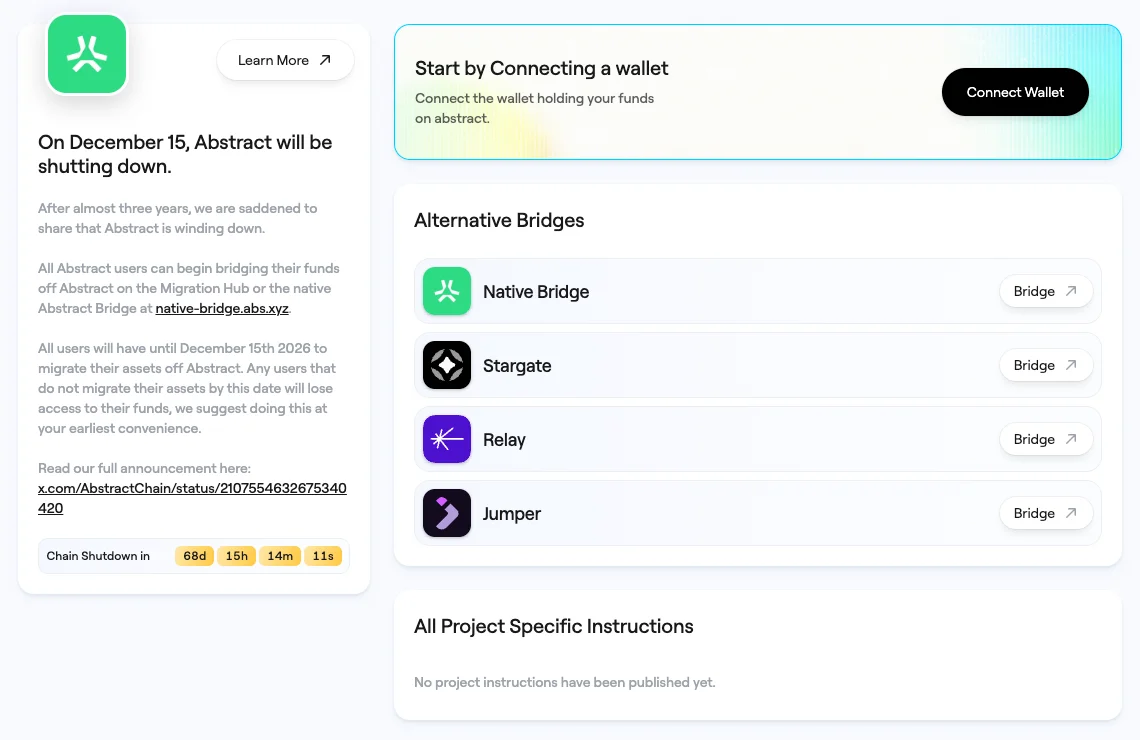
Using the official interface before the deadline is the simplest option. Blast gives users until October 26, 2026 to withdraw to Ethereum through its usual interface, including balances held in its app, and has cut its withdrawal delay to 24 hours. Abstract opened a migration hub built for the shutdown, alongside its native bridge, available until December 15, 2026.
Schedules can hide an extra step. Blast warned that withdrawals would pause for about a week while it pulls the network’s assets out of Lido, even after the delay drops to 24 hours. That kind of reliance on liquid staking, whose mechanics and risks we break down in a dedicated guide, stretches the real exit window.
Third-party bridges offer another route. Abstract’s hub lists three alongside its native bridge, Stargate, Relay and Jumper. On an optimistic rollup, ethereum.org describes how liquidity providers work: they take over your pending withdrawal and pay you directly on Ethereum in exchange for a fee, which spares you the week-long wait.
Once the deadline has passed and the interface is gone, one fallback remains. Blast says assets will stay recoverable after October 26 for users who interact directly with its bridge contracts on Ethereum. That means handling the contracts yourself, with no graphical interface to guide you.
Optimistic rollups also provide a recourse if the operator stops processing transactions. A user can submit a transaction directly on Ethereum, and the sequencer must include it within a set time to keep producing valid blocks, as the same documentation explains.
Abstract takes a harder line. Its migration hub warns that users who have not moved their assets off the network by December 15, 2026 will lose access to their funds, and urges them to act early. Two shutdowns announced in the same week offer two very different levels of protection once the deadline passes.
What to Check Before a Layer 2 Goes Dark
Writing down the deadline the network announces comes first, along with a plan to act well ahead of the final days. A technical pause like the one at Blast can shave several days off the period during which the official interface actually works.
Blast’s own timeline shows how fast that window narrows. The announcement came on October 2, withdrawals then pause for about a week while assets come out of Lido, and each withdrawal afterwards takes 24 hours until October 26. On a layer 2 that is closing, a holder who waits for the last week has almost no buffer if a technical problem delays things further, and would then have to go through the bridge contracts on Ethereum.
Before starting any withdrawal, you also need the right wallet. Abstract’s hub asks users to connect the wallet holding their funds on the network, which means still having the address used for the deposit and the keys or login that control it.
Applications you used on the network deserve a separate look of their own. On Abstract’s hub, the section reserved for project-specific instructions stated on October 7 that no instructions had been published yet. An open position inside an app may require a withdrawal step within that app before the bridge comes into play.
On cost, a third-party bridge charges for speed, and calling the bridge contracts directly means paying network fees on Ethereum, the main chain, where every operation costs more than on a layer 2. On an optimistic rollup, a liquidity provider’s fee is the price paid to skip the week-long challenge period.
Timing is the last variable, and the network type gives a first estimate. Expect a one-week challenge period on an optimistic rollup unless the team announces a shorter delay, as Blast did, and no delay on a ZK-rollup once the proof is verified.
All of these checks apply to a healthy layer 2 as well. The safeguard that matters on shutdown day, the ability to leave without the team, is best verified before depositing funds, at a moment when nothing is urgent yet.
Follow the story on Cryptonomic.