

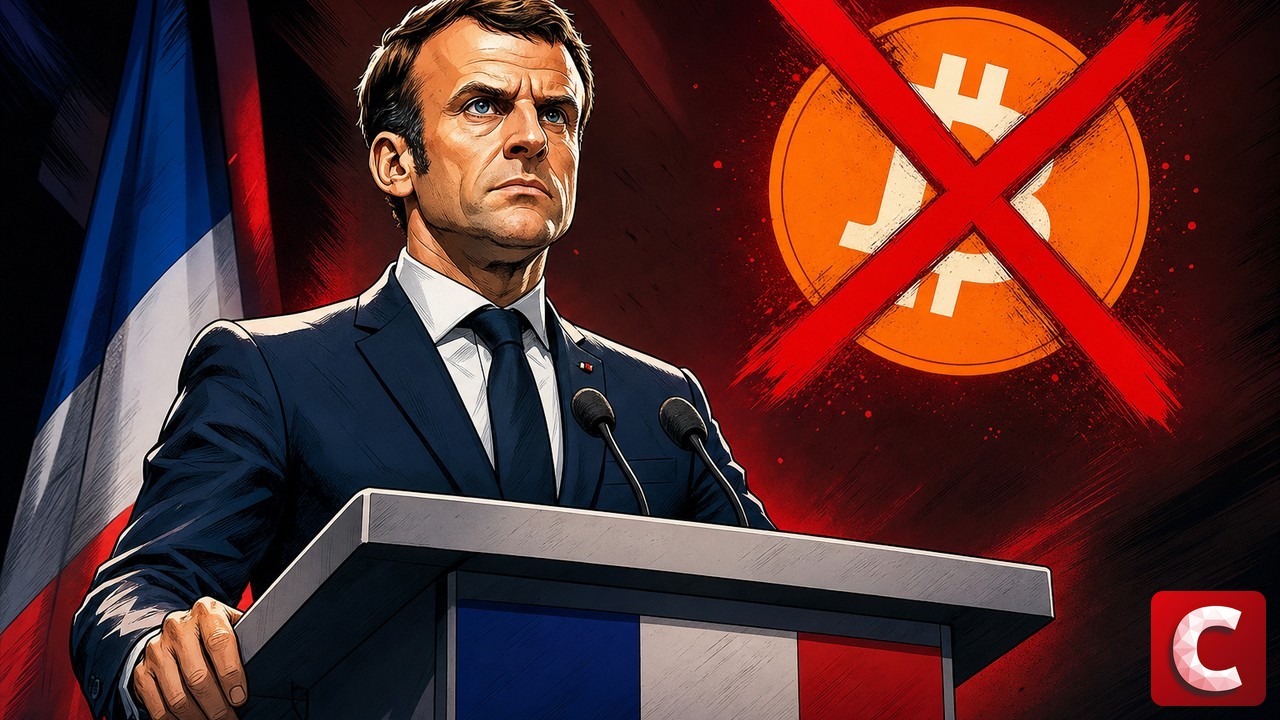
On May 19, 2026, French President Emmanuel Macron addressed the 5th international “No Money for Terror” conference in Paris and called on states to enforce strict crypto regulation to cut off terrorist financing. He framed the absence of regulation as a form of state complicity in criminal activity. Three concrete priorities were outlined, with pseudonymity-enabled transactions squarely in the crosshairs. The declaration marks the strongest political signal any major European head of state has sent directly to the crypto industry.
Key Takeaways
- Macron called on May 19, 2026, to regulate crypto assets to shut down terrorist financing channels
- Transaction pseudonymity is framed as a structural loophole that states can no longer tolerate
- The EU counterterrorism coordinator confirmed terrorists use both crypto and traditional methods like hawala
Get an AI Summary of This Article
ChatGPTThe “No Money for Terror” Conference and the Crypto Regulation Push
The fifth edition of the international “No Money for Terror” conference took place in Paris on May 19, 2026. The event brings together government officials and international institutions with a single mandate: identify and block the financing channels used by terrorist organizations worldwide.
It was in this setting that Macron delivered a statement aimed directly at the crypto sector. He declared that states must not allow crypto assets to become “opportunities for criminals and terrorists.” The framing removes any ambiguity: this is no longer a technical debate about financial innovation. It is an explicit political responsibility.
Macron structured his address around three priorities. First, regulating crypto assets by targeting pseudonymity features that enable opaque transactions. Second, strengthening cooperation between counterterrorism units and those focused on organized crime. Third, ensuring economic development and administrative normalization in territories recently liberated from terrorist control, to prevent armed groups from returning. That pressure already hits players, Binance France missing its MiCA deadline.
By connecting crypto to the broader illicit financial ecosystem rather than treating it in isolation, Macron gave his call a systemic weight that regulators across Europe are likely to pick up.

Pseudonymity, Opacity and the European Stance
The sharpest line from Macron’s address: “If we leave an emerging continent totally unregulated, we will be complicit in terrorist activities.” The message to governments that have not acted is direct. Inaction is no longer framed as neutrality. It is framed as complicity.
Bartjan Wegter, the European Union’s counterterrorism coordinator, added important context at the same conference. He noted that terrorists rely on both crypto assets and traditional financial methods, including hawala, the informal money transfer network widely used across parts of Africa, the Middle East, and Asia. Crypto is not the only vector, but it now sits alongside traditional tools on regulators’ priority list.
This European stance is part of a broader international shift. South Africa announced at the conference that it is updating its regulations to require all crypto asset purchases to go through licensed platforms. The push toward mandatory KYC across more jurisdictions is gaining momentum.
The target goes beyond terrorism financing in the narrow sense. Pseudonymity itself is being positioned as a structural flaw that regulators can no longer accept, regardless of the specific end use of the transaction. France is toughening its stance, blocking Polymarket as illegal gambling.
Also on Cryptonomic:
- Capital B Buys 192 BTC: France Enters the Top 25
- Bitcoin ETF Outflows Top $1 Billion as BTC Falls Below $77,000
- Iran Launches Hormuz Safe: Bitcoin Maritime Insurance
What This Means for Crypto in Europe
In the short term, Macron’s declaration will feed into ongoing debates around MiCA implementation in Europe. The regulation already imposes customer identification requirements on crypto service providers. This presidential statement gives additional political weight to those pushing for stricter regulation and broader scope. For context, see our earlier piece on Cryptonomic: Binance MiCA: ECB to Decide Fate of 37M EU Clients. The EU framework is tightening, MiCA targeting 10 million EU users.
Privacy-focused platforms and DeFi protocols enabling non-traceable transactions are the most directly exposed. Regulatory pressure on these specific segments in Europe is likely to intensify over the coming months, with a potential extension of on-chain transaction monitoring obligations.
Over the medium term, the alignment between France, EU-level coordination, and regulators like South Africa points to a global consensus forming around stronger crypto oversight. If that consensus translates into additional obligations on exchanges and protocols, the operational space for non-compliant actors will shrink significantly.
For investors, the direction is clear: assets and protocols whose value proposition depends on transaction privacy will face increasing institutional pressure in Europe. The regulatory environment will tighten before it stabilizes, and projects that fail to anticipate this shift will pay the price.
Follow the story on Cryptonomic.