


MSCI will remove Strategy, the largest publicly listed holder of bitcoin, from its global equity indexes after the close on November 30, including its benchmark US index. The index provider confirmed the move on November 11 under a screen for “non-operating” companies it adopted in October. Index funds hold about 13 million shares of Michael Saylor’s company, worth roughly $1.6 billion, and the decision lands while Strategy’s premium to its bitcoin is already thin.
Key Takeaways
- MSCI drops Strategy from its indexes after the close on November 30.
- Index funds hold about 13 million shares, roughly $1.6B.
- Strategy’s mNAV sits near 1.08x, down from 3.4x in November 2024.
Get an AI Summary of This Article
ChatGPTMSCI Confirms Strategy’s Exit in Its November Review
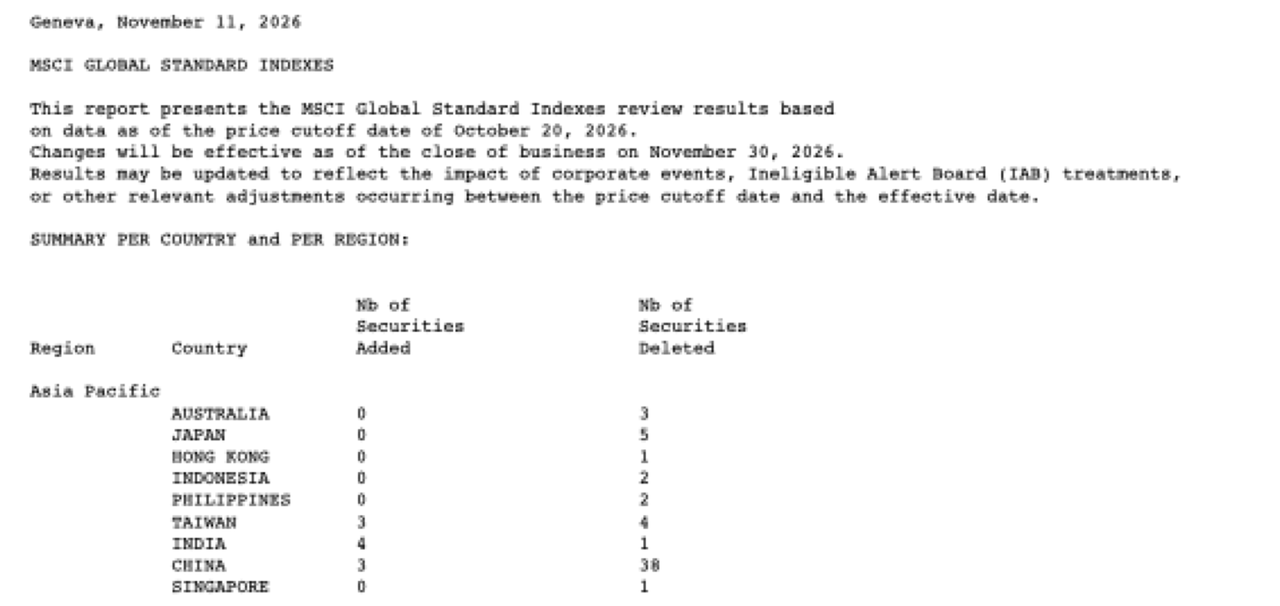
The list of index changes MSCI published from Geneva on November 11 names “Strategy A” among the deletions from its US index. The changes take effect as of the close of business on November 30, 2026, based on prices as of October 20. Strategy is one of 24 names leaving the US index, which adds a single company, Moderna, and the review gives no company-specific reasons.
The decision applies the rule adopted on October 15. A company whose balance sheet is mostly investments becomes ineligible for the provider’s indexes. The test first checks for substantial operating assets, then runs five financial ratios covering expenses, cash flows, changes in asset values and reliance on outside financing. A company flagged on four of those five ratios is out.
An existing member is removed only if it fails the screen in each of its two most recent annual filing periods. MSCI first put the screen out for consultation in August, with Strategy and its 840,447 bitcoin already in scope. A simulation on May data also flagged Metaplanet and Yellow Cake, a British uranium investment company.
The consultation ran until September 30, ahead of the final rules in mid-October. The framework also ends the temporary measures introduced in October 2025 for companies whose digital assets made up at least half of their total assets. Those companies now go through the general screen, starting with the November review.
Strategy now holds 850,364 BTC, worth about $62.6 billion. Executives Michael Saylor and Phong Le had called the proposed treatment of crypto treasuries “discriminatory,” and Saylor describes the company as an operating business with a software arm. MSTR fell 2.6% in after-hours trading to $119.06 once the list was out.
In a September letter, the company argued that an exclusion would have little effect on its business and would hurt the index provider’s reputation for neutrality.
Tokyo-listed Metaplanet leaves the MSCI Japan Small Cap Index on the same date. The company reached 43,000 BTC in July after a $170M purchase, and its shares closed 2.53% lower at 231 yen on Wednesday, before the list came out. Sharplink, the ether treasury company, is not among the small-cap deletions.

How the MSCI Exit Reaches Strategy’s Bitcoin Funding
Strategy pays for its bitcoin by issuing convertible notes, preferred stock and common shares. That works as long as the mNAV, the company’s market value relative to the bitcoin it holds, stays above 1. The mNAV has slipped to about 1.08x from a 3.4x peak in November 2024. At that level, the market values Strategy at only about 8% more than the bitcoin it holds.
Index funds are part of what props up that premium. BloFin Research and Strategy’s own consultation response both put their holdings at about 13 million shares, or 3.1% of shares outstanding, worth about $1.6 billion. JPMorgan modeled $2.8 billion of outflows in November 2025, rising to $8.8 billion if other index providers followed MSCI.
The gap between the two numbers comes down to timing. BloFin’s $1.6 billion counts the shares index funds hold today, while JPMorgan built its estimate on the first draft of the rules, a year before the final screen. For MSTR holders, the practical change is who owns the stock after November 30, once passive funds tracking these benchmarks have sold.
The latest weekly filing shows how the company is funding itself right now. In the week ended November 8, Strategy raised $283.8 million by selling 2.05 million common shares. It spent $81.9 million on 1,036 BTC and $188.3 million buying back STRC preferred stock, and added $13.6 million to a cash reserve that now stands at $4.77 billion.
Less than a third of the money raised that week went into bitcoin. The pattern looks a lot like August, when Strategy sold 1,638 BTC to raise $104.7M, almost all of it earmarked for dividends and STRC buybacks. In the short run, any further drop in the premium shrinks the share of purchases that common stock can still fund.
Convertible debt is the company’s other lever. In May, MSTR bought back $1.5B of 2029 convertible notes for $1.38B in cash, without touching its bitcoin. BloFin Research flags a further risk: losing passive demand could push the premium lower, which would slow bitcoin accumulation.
Also on Cryptonomic:
- Ethereum Could Go Post-Quantum as Early as 2027
- Stablecoin Self-Custody in France Jumps 192%
- US Inflation Runs Hot at 0.4% as Bitcoin Slips
What the MSCI Screen Means for Bitcoin Treasury Companies
Markus Thielen of 10x Research told CoinDesk the exclusion is largely priced in, since many funds already run underweight positions in the stock. He also sees little chance of the decision spilling over into bitcoin itself. The market had close to four weeks to prepare after MSCI announced its rules on October 15.
Leaving the indexes keeps MSTR listed on its exchange, and Strategy stays free to hold or sell its bitcoin. The forced seller is the index fund, while the bitcoin stays on Strategy’s balance sheet. Saylor had already dropped the “Never Sell” doctrine in May, conceding that an absolute refusal to sell could end up hurting the asset.
Independent analyst Derin Olenik expects selling pressure close to JPMorgan’s estimate and called the exclusion a blow to the institutional adoption narrative. He still welcomed it as a push toward what he calls “Treasury 2.0” models. Thielen, for his part, thinks treasury companies should start behaving more like asset managers.
Over the medium term, the risk sits with the other index providers. If they adopt a screen similar to MSCI’s, JPMorgan’s upper estimate of $8.8 billion in outflows becomes the reference point.
The framework now covers every bitcoin treasury company still in MSCI’s indexes, each judged on its two most recent annual filings. Companies outside the indexes face a stricter bar, since failing the screen in either of their two most recent periods is enough to keep them out. The November 30 rebalance is the first one carried out under that screen. The volume index funds sell that day will show how much of the exit the market had already absorbed.
Follow the story on Cryptonomic.