


Ethlabs, a research lab founded by former Ethereum Foundation researchers, wants Ethereum to be post-quantum by 2027, two years ahead of the December 2029 deadline the foundation set for itself. Its proposal, posted on November 11 to the Ethereum Magicians forum, ties the faster schedule to how quickly AI is improving. To free up engineering time, the lab is pulling its “quick slots” work out of the Hegotá upgrade.
Key Takeaways
- Ethlabs targets post-quantum consensus and protected accounts in 2027.
- The foundation still aims for December 2029 and will review that date in January 2027.
- Quick slots leave Hegotá so resources can go to the new plan.
Get an AI Summary of This Article
ChatGPTEthlabs Sets 2027 as the Post-Quantum Target for Ethereum
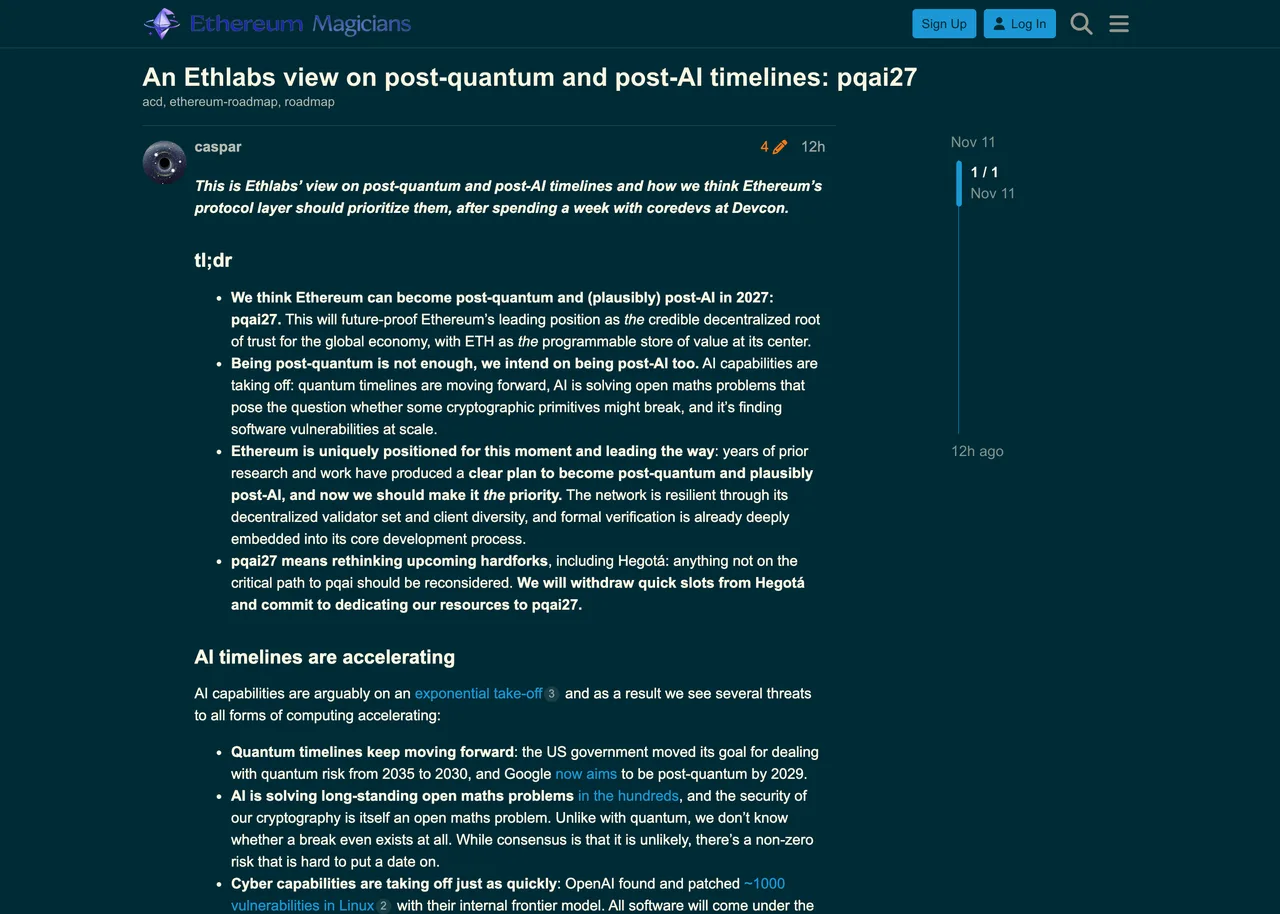
The post is titled “An Ethlabs view on post-quantum and post-AI timelines: pqai27.” Ethlabs shared it on Ethereum Magicians, the forum where protocol changes get debated in the open, after a week spent with core developers at Devcon. The lab argues that Ethereum can become post-quantum, and “plausibly” post-AI, in 2027.
Ethlabs itself is a nonprofit set up in June by former Ethereum Foundation members, with backing from Bitmine, Sharplink and Joseph Lubin. It works on Ethereum research and development, and this post speaks directly to the teams that write and ship network upgrades.
The plan goes by pqai27 and comes in two stages. Under “pqai-ready,” consensus becomes post-quantum and every user gets a protected migration path for their account, while the network keeps the capacity gains from Glamsterdam, the upgrade whose staking deposit rules were patched in late October.
Under “pqai-scaled,” Ethereum would run at full capacity with transactions and data that are protected as well. Ethlabs calls that second stage a stretch goal for 2027. If today’s cryptography breaks sooner than expected, the network could switch over and keep running at reduced capacity.
On the AI side, the post leans on two things: cryptography built on as few assumptions as possible, and client software hardened against models that can find bugs at scale. Formal verification of the code and a healthy spread of client implementations are the two tools Ethlabs names for that hardening.
The lab points out that the foundation already proves zkEVMs correct, and that the next consensus protocol was formally verified within a few weeks with help from AI. A bug in one client does not take the whole network down, which Ethlabs sees as something that sets Ethereum apart from other ecosystems.

A Post-Quantum Deadline Two Years Ahead of the Foundation’s
The Ethereum Foundation is working to a later date. In the protocol priorities it published on September 7, its protocol team aims for a quantum-resistant layer one across execution, consensus and data by December 2029. That target holds until January 2027, when the team plans to reassess quantum progress with outside experts.
The same document describes Hegotá as the upgrade that decides whether the quantum-resistant forks land on time. With Glamsterdam slated for the fourth quarter of 2026, hitting December 2029 works out to an average of 7.2 months between network upgrades.
Ethlabs builds its case for speed around artificial intelligence. It notes that the US government moved its goal for dealing with quantum risk from 2035 to 2030, and that Google now aims to be post-quantum by 2029.
The lab also flags how fast AI models now move. They are solving long-standing open maths problems in the hundreds, and the security of cryptography is one of those problems, since nobody knows whether a break exists. Ethlabs adds that OpenAI found and patched around 1,000 vulnerabilities in Linux with an internal model.
Those arguments echo what is happening on the Bitcoin side, where the number of qubits needed to break a key has dropped to 813, from 2,330 in 2017. Post-quantum work is moving from research papers into the actual upgrade calendar.
Also on Cryptonomic:
- Stablecoin Self-Custody in France Jumps 192%
- US Inflation Runs Hot at 0.4% as Bitcoin Slips
- Brazil’s Largest Exchange Mercado Bitcoin Halts Withdrawals
Hegotá Loses Quick Slots to Make Room for Post-Quantum Work
To keep 2027 within reach, Ethlabs is withdrawing quick slots from Hegotá. The proposal would have sped up block production, and the lab will put those resources into pqai27. It concedes that the community wanted the feature, based on a survey, and says it will go after faster slots in 2028. Ethlabs puts the change of plan down to how far AI has moved since January, when Opus 4.5 was the model it used as a reference.
The post also asks for a fresh look at everything in Hegotá that is off the critical path to pqai-ready. FOCIL, built to strengthen censorship resistance, would only be scheduled if the 2027 goal stays achievable. In September, the foundation had listed FOCIL and Frames among the must-ship items for Hegotá. For the scaling stage, the lab names signature aggregation (EIP-8288) and new data availability rules (EIP-8479) as necessary pieces.
Every group gets an ask. Core developers should make pqai27 their top priority, validators should get ready to move to post-quantum keys, and users should switch to protected accounts with tooling built into their wallets. Frames would give those accounts key rotation, separate recovery and execution keys, and access limited to a defined scope.
All of this assumes the engineering bench is there, at a time when the Ethereum Foundation was facing a $30M gap in funding for its core developers back in June.
For now, ether holders have nothing to do: the proposal still has to win over core developers, and the foundation will only revisit its own date in January 2027. The next thing to watch is the final scope of Hegotá, where the call on post-quantum work will become visible.
Follow the story on Cryptonomic.