


Ethereum developers merged a fix into Glamsterdam, the network’s next upgrade, on Monday, October 26. A flaw in the draft rules would have let an operator walk away with ether meant for new validators, leaving staking services with no way to recover it. The same fix had been turned down on October 19, and no losses have been reported.
Key Takeaways
- Ethereum patched a Glamsterdam flaw that exposed staking deposits.
- Rejected on October 19, the fix was merged on October 26.
- No losses reported, and mainnet now waits on a new testnet date.
Get an AI Summary of This Article
ChatGPTHow a Shared Key Could Divert Validator Deposits
Glamsterdam brings a new actor into Ethereum’s consensus layer, the block builder. EIP-8282, co-authored by Nico Flaig and Justin Traglia, treats builders as a separate staked actor and gives them their own deposit and exit contracts. The proposal, created on May 22, 2026 and also signed by Cayman and Felix Lange, sits in Last Call.
The weak spot sat in the switchover. Draft rules credited validator deposits to a builder whenever the two shared a public key. A contributor posting as avsetsin, listed as a member of Lido’s GitHub organization, laid out the scenario in pull request 5736 on the consensus specifications repository.
An operator first registers as a builder with a given key. A staking service then deposits ETH to start a validator under that same key, and both deposits land with the builder. The operator could then withdraw the funds while the staking service had no way back.
Services that deposit their clients’ ether were first in line, including the liquid staking protocols that hand out tokens such as stETH against deposited ether.

Ethereum Rejected the Fix on October 19, Then Merged It a Week Later
The pull request opened on October 12. On October 19, Justin Traglia, who maintains Ethereum’s consensus specifications, closed it, writing that “there was not enough support from clients to make this change at this time.”
It reopened on October 23 after talks with client teams, and its author added tests for three new scenarios. Nico Flaig and Justin Traglia approved it, and the change was merged on October 26 with four commits and 19 passing checks.
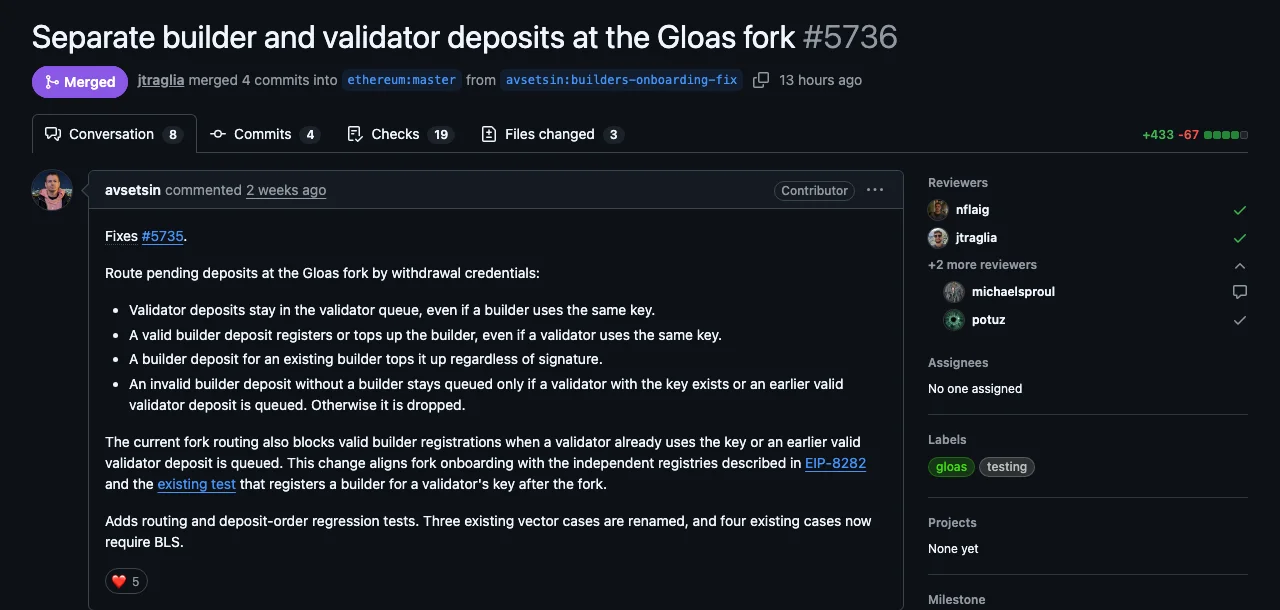
Pending deposits are now routed by withdrawal credentials, the setting that decides where a deposit’s money can eventually go. Validator deposits stay in the validator queue even when a builder uses the same key. A valid builder deposit registers or tops up the builder even when a validator shares that key.
Two edge cases get settled as well. A deposit for an existing builder tops it up whatever its signature. An invalid builder deposit with no matching builder stays queued only if a validator already holds that key or an earlier valid validator deposit is waiting, and it is dropped otherwise.
The pull request says the change aligns builder onboarding with the independent registries set out in EIP-8282. The old routing also blocked valid builder registrations when a validator already used the key, a second defect the fix clears along the way.
Also on Cryptonomic:
- Crypto Accounts Abroad: French Tax Office Will Get the Data
- French Stablecoin Tax Waits on a Delayed Budget Vote
- South Korea Blocks 27 Crypto Platforms Including KuCoin
Glamsterdam Still Needs a Date on the Ethereum Mainnet
No losses have been reported, since the flaw lived in rules that were still being drafted. Client teams now have to build the revised deposit rules into their software before the upgrade can move toward the Ethereum mainnet.
Glamsterdam has already gone through the Sepolia test network. Its Hoodi launch, set for October 26, was postponed, and the mainnet date now hangs on the new Hoodi schedule.
That timeline rests on core protocol developers whose funding has been under strain. In June, a former contributor flagged a $30M annual gap in core dev funding at the Ethereum Foundation.
In the near term, an ether holder who stakes through a service has nothing to do, because the fix lands before any activation on Ethereum’s mainnet. The next milestone to watch is the new Hoodi launch date.
Follow the story on Cryptonomic.