


France’s Senate takes up a bill on Tuesday, October 27, that lets the country approve CARF, the OECD framework for the automatic exchange of crypto data between tax authorities. Platforms in participating jurisdictions will report who their French clients are and how much they traded, and those reports will travel back to the French tax office. For crypto accounts held in Switzerland, Singapore or the United States, the first transfers are scheduled for 2028 and 2029.
Key Takeaways
- The French Senate debates the OECD crypto data exchange agreement on October 27.
- Swiss and Singapore platforms report in 2028, US platforms in 2029.
- Self-custody wallets stay outside the automatic reporting.
Get an AI Summary of This Article
ChatGPTFrench Senate Takes Up a Deal 56 Jurisdictions Signed in Asunción
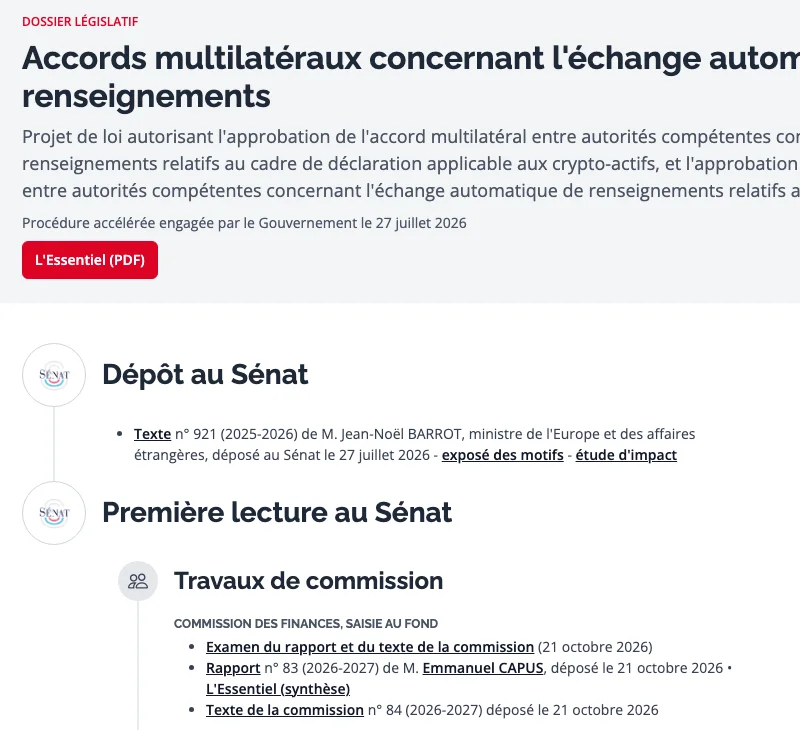
Bill No. 921 carries one of those titles only a legislature could love. It authorizes France to approve the multilateral competent authority agreement on the automatic exchange of information under the crypto-asset reporting framework, along with an addendum to the existing agreement that already covers financial accounts.
The government filed it with the Senate on July 27, 2026, under the fast-track procedure. The finance committee adopted it without changes on October 21, and Senator Emmanuel Capus walked through the timetable in his committee report No. 83. The floor debate opens at 2:30 pm Paris time.
The agreement itself goes back to November 26, 2024, when France and the other signatories put their names to it in Asunción. The report counts 56 signing states and territories, and 77 jurisdictions committed to apply the framework as of September 14, 2026.
CARF borrows its logic from the Common Reporting Standard that banks have followed since 2017. Each platform that runs crypto accounts collects its clients’ identity and tax residence, then reports the number and total value of their transactions every year, asset by asset. Purchases against euros or dollars, swaps between cryptos and outgoing transfers all land in the report.
Tax offices already have a sense of the sums at stake. Across the Channel, HMRC figures showed 240 British taxpayers each declaring more than £1 million in crypto gains.

Crypto Accounts in Switzerland, Singapore or the US: When the Data Lands
The 77 jurisdictions join in waves. Forty-six of them, France included, swap their first data in 2027. Twenty-seven more follow in 2028, Switzerland and Singapore among them, and the last four start in 2029, the United States among them.
France started collecting on January 1, 2026. Reports reach the tax office nine months after the end of the year they cover, so the first French exchange in 2027 covers 2026 activity.
For a French resident, the timing depends on where the crypto accounts sit. Platforms based in the European Union already report under the DAC8 directive, in force since January 1, 2026. Providers serving French clients also had until June 30 to secure a MiCA licence under the AMF deadline.
Crypto accounts in Switzerland or Singapore will send 2027 activity to Paris in 2028. A US platform starts in 2029 with data for 2028. Someone holding crypto accounts in all three places will see the reports arrive in three separate rounds.
Bank accounts show how big this gets. In 2025, France received information from 109 jurisdictions on 11.6 million financial accounts, with a combined balance of €456 billion. The first collection, in 2016, covered 1.16 million accounts and €80 billion.
Neighbors are reworking the tax itself at the same time. Germany is scrapping its one-year holding exemption from January 2027, and HMRC moves crypto loans and liquidity pools to a deferral regime from April 2027.
Also on Cryptonomic:
- French Stablecoin Tax Waits on a Delayed Budget Vote
- South Korea Blocks 27 Crypto Platforms Including KuCoin
- Tampered Ledger Devices Cost Buyers Over $86M
Self-Custody Wallets Sit Outside the Net While Filing Duties Remain
CARF targets service providers. A self-custody wallet, where the user alone holds the keys, has no platform to report on its owner’s behalf, so it sits outside the automatic exchange.
The 2027 budget could reach into that gap. An amendment from lawmaker Charles de Courson would require holders to declare those wallets above €100,000. It sits next to the stablecoin swap tax French lawmakers adopted, still waiting on a delayed budget vote.
Existing duties stay as they are. Foreign crypto accounts still go on form 3916-bis, and gains on form 2086. Leaving out an account worth more than €50,000 can cost a fine of up to €1,500.
What the bill adds is enforcement reach. From 2027, then with each wave in 2028 and 2029, the tax office can match what taxpayers declare against what foreign platforms send.
The Senate report also sizes the population involved. Around 10% of French adults held crypto in early 2025, with a total value estimated between €21 billion and €26 billion.
In the near term, a holder who already declares their crypto accounts has nothing to change. Anyone who never has will see cross-checks arrive on the OECD schedule, starting with platforms in the 46 first-wave jurisdictions. By 2029, all 77 committed jurisdictions will have started exchanging, the United States included.
Follow the story on Cryptonomic.