
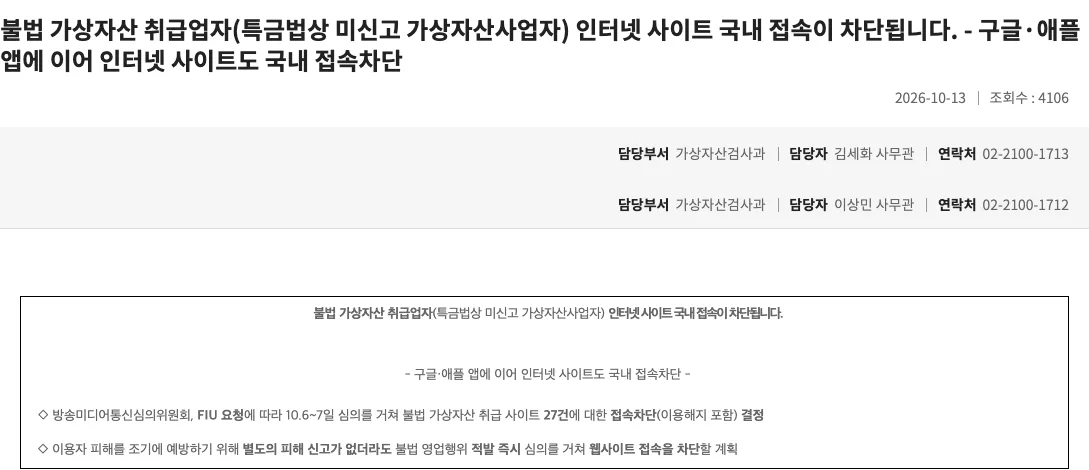
South Korea is cutting off access to the websites of 27 unregistered crypto platforms, KuCoin, MEXC, Phemex and Bitrue among them. The Financial Services Commission announced the decision on October 13, extending a crackdown that had already pushed their apps out of the Google and Apple stores. Customers who still hold funds there will have to go through a supervised withdrawal process.
Key Takeaways
- South Korea is blocking the websites of 27 unregistered crypto platforms, including KuCoin and MEXC.
- Operating without registration carries up to 5 years in prison or a 50 million won fine.
- The DAXA exchange alliance will guide existing customers through their withdrawals.
Get an AI Summary of This Article
ChatGPTSouth Korea Shuts the Door on 27 Unregistered Sites
The Financial Services Commission (FSC) released its October 13 notice announcing the block on the 27 sites in South Korea. The country’s media and communications standards commission approved the measure over two sessions on October 6 and 7, acting on a request from the Financial Intelligence Unit, or FIU.
Every site on the list is currently operating. Names include KuCoin, MEXC, Phemex, Bitrue, CoinW, BTCC, BitMart, BingX and DigiFinex. Services hosted inside the country will be terminated, while sites hosted abroad will be made unreachable from South Korea.
After the mobile apps, the websites of these platforms are now disappearing for Korean users as well. Back in April 2025, regulators had already had 14 exchange apps pulled from Apple’s App Store and 17 from Google Play.
Google now also requires any exchange app aimed at Korean users to prove it is registered with the FIU. At least 29 of the top 50 derivatives exchanges tracked by CoinMarketCap have left Google Play in the country since January 28, 2026, with Bybit gone on July 10 and OKX on July 24.
The standards commission has handled crypto cases before. In August it ordered the nationwide block on Polymarket in South Korea, using the same access-blocking tool.

Why South Korea Is Going After Offshore Platforms
The legal basis is the Act on Reporting and Using Specified Financial Transaction Information, the country’s anti-money laundering law. Any platform serving Korean customers has to hold an ISMS security certification and register with the FIU. A foreign operator falls under the same rule as soon as it targets the local market.
Regulators look at three signals: a Korean-language website, marketing aimed at Korean customers such as promotional events, and support for payments in won. Running an unregistered business carries up to 5 years in prison or a fine of up to 50 million won.
Europe tightened its own rules through MiCA, whose full application in July forced ten million EU users to move to a licensed platform. South Korea’s tool of choice is an outright block on anyone missing from its register.
The FSC is also changing its approach. The regulator now plans to block an illegal site as soon as it is detected and reviewed, without waiting for a victim to come forward. The notice stresses that operating without registration is an offense in itself.
The notice also puts a number on what users pay. A June 2026 survey led by DAXA, the alliance of registered Korean exchanges, found average trading fees of 1.5% to 10% at illegal operators. The five domestic won exchanges average 0.16%, a gap that can reach 62 times.
Several names come from an older list. In August 2022, the FIU flagged 16 unregistered platforms, KuCoin, MEXC and CoinEx among them. CoinEx said in September it was shutting its exchange after nine years.
Also on Cryptonomic:
- Tampered Ledger Devices Cost Buyers Over $86M
- Seized Bitcoin: US Government Moves 833.6 BTC
- When a Layer 2 Shuts Down, How to Get Your Funds Out
Withdrawals, Fines and Probes for Users in South Korea
Blocking the websites could make it harder for existing customers to withdraw what they still hold on these platforms. The FIU acknowledges the risk and says DAXA will guide withdrawal and asset recovery procedures, with cooperation from the operators involved.
Registered exchanges are part of the enforcement. The FIU makes sure they do no business with unregistered operators, and each violation can cost them up to 100 million won. Since a decree was revised in May 2024, credit cards can no longer be used to buy crypto from these operators.
The FIU also refers every operator caught in the act to investigators, based on public reports and joint inspections with DAXA. So far, 44 illegal operators have been reported to law enforcement.
For investors in South Korea, the next milestone arrives in January 2027 with a 22% crypto tax on gains coming into force. The FSC expects the block to prevent customer losses before they even happen.
Follow the story on Cryptonomic.