


Binance says it will absorb the full cost of the Binance hack, the largest crypto theft on record, after $6.3B was drained from the exchange on Thursday, October 29. The company has reserved more than $6.34B of its own funds, $5B of which already sits in the exact tokens that were taken. Withdrawals, frozen since the attack, are due to restart on Sunday, November 1, with a proof of reserves update promised for Monday.
Key Takeaways
- Binance has reserved over $6.34B of company funds to cover the Binance hack.
- $5B is already held in the stolen tokens, and the rest is being bought on the market.
- Withdrawals are set to resume Sunday, with proof of reserves numbers on Monday.
Get an AI Summary of This Article
ChatGPTHow Binance Plans to Pay for the Binance Hack
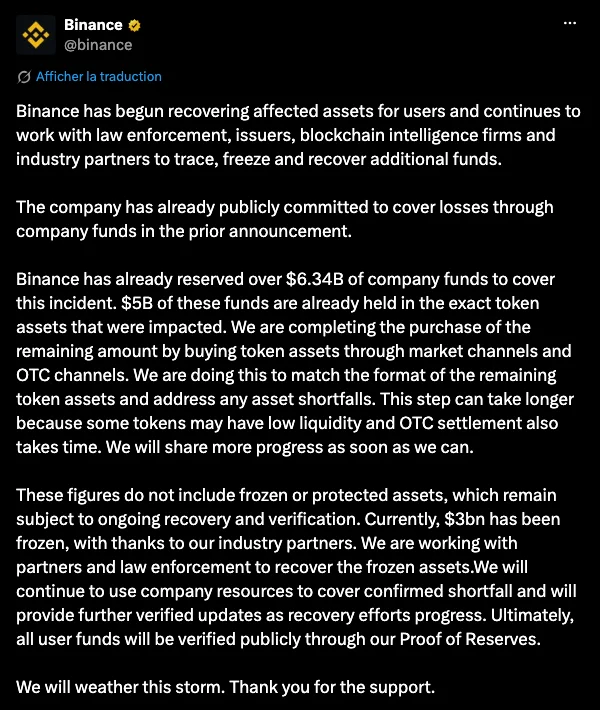
The exchange laid out its plan in a statement posted on October 30 from its official X account, committing more than $6.34B of company money to the incident. Of that amount, $5B is already held in the exact token assets that left its wallets.
The balance is being bought through market channels and over-the-counter desks so that every token can be replaced in its original form. Binance warned that this second step will take longer, because some of the affected tokens trade thinly and OTC settlement carries its own delays.
Co-CEO Yi He added detail in her own post on X the same day, saying the exchange is buying back every stolen altcoin in matching amounts, both on its order books and through OTC trades.
The SAFU emergency fund, which holds about 15,000 BTC worth roughly $1.18B, is being tapped for the first time since May 2019, when a $40M theft hit the platform. Measured against the Binance hack, that reserve covers only about 19% of the total loss.
Management insists customer balances were never part of the damage. Binance says it does not use client funds for its own operations and keeps most user holdings in cold wallets, which the attackers did not reach.

A Compromised Laptop and an Ethereum Delegation Feature
The internal investigation first traced the intrusion to the compromised laptop of a DevOps engineer, which let the attackers submit unauthorized withdrawal requests. Binance said it found no evidence that any private key had leaked.
Further digging uncovered additional points of entry. The attackers relied on the account delegation mechanism set out in the official EIP-7702 specification, which went live on Ethereum with the Pectra upgrade in May 2025. That feature handed them control of a hot wallet without going through the exchange’s normal approval controls.
About $2.5B left that single hot wallet within minutes. Across the whole Binance hack, wallets on several blockchains were emptied in roughly 20 minutes on Thursday evening, with bitcoin, ether, USDT and USDC all hit.
The company also described a self-destruct mechanism the Binance hackers used to wipe traces of their activity. Its teams are now reviewing cloud systems, employee devices, private key management and transaction signing procedures, working alongside law enforcement.
The entry point fits a pattern seen in other recent incidents, such as the three DeFi protocols drained of $35M in six hours this summer, where compromised internal access also opened the door.
Also on Cryptonomic:
- Zcash Co-Founder Moves to Redirect 8% of New ZEC
- Ethereum Fixes a Flaw That Put Staking Deposits at Risk
- Crypto Accounts Abroad: French Tax Office Will Get the Data
Withdrawals on Sunday, Reserves on Monday
Deposits remain open, while withdrawals have been paused since Thursday night for security checks. Binance is targeting Sunday, November 1, for a restart, a pause that echoes the debate in Japan, where the FSA wants exchanges to hold back withdrawals after each deposit.
A first proof of reserves update is scheduled for Monday, November 2, with a full report to follow. In its statement, Binance said every user balance will ultimately be verified publicly through that process.
Frozen assets sit outside the $6.34B figure. Industry partners have locked about $3B of the loot, including more than $1.56B in USDT blocked by Tether and roughly $823M in USDC blocked by Circle. Those tokens stay frozen onchain until ownership is settled, and getting them back to Binance may require court orders in several jurisdictions.
Markets absorbed the blow. Bitcoin slipped below $77,000 on October 30 and $1.57B of leveraged positions were liquidated across the market, as the Binance hack landed on top of a heavy session for tech stocks.
Other platforms have picked a harder line in the past. In September, Crypto.com halted its entire Cronos blockchain after a $75M theft, leaving about $60M stuck with no restart date.
For Binance users, the near term comes down to two checkpoints: withdrawals that actually reopen on Sunday, then reserve figures published on Monday. The next chapter of the Binance hack now hangs on that two-day calendar.
Follow the story on Cryptonomic.